
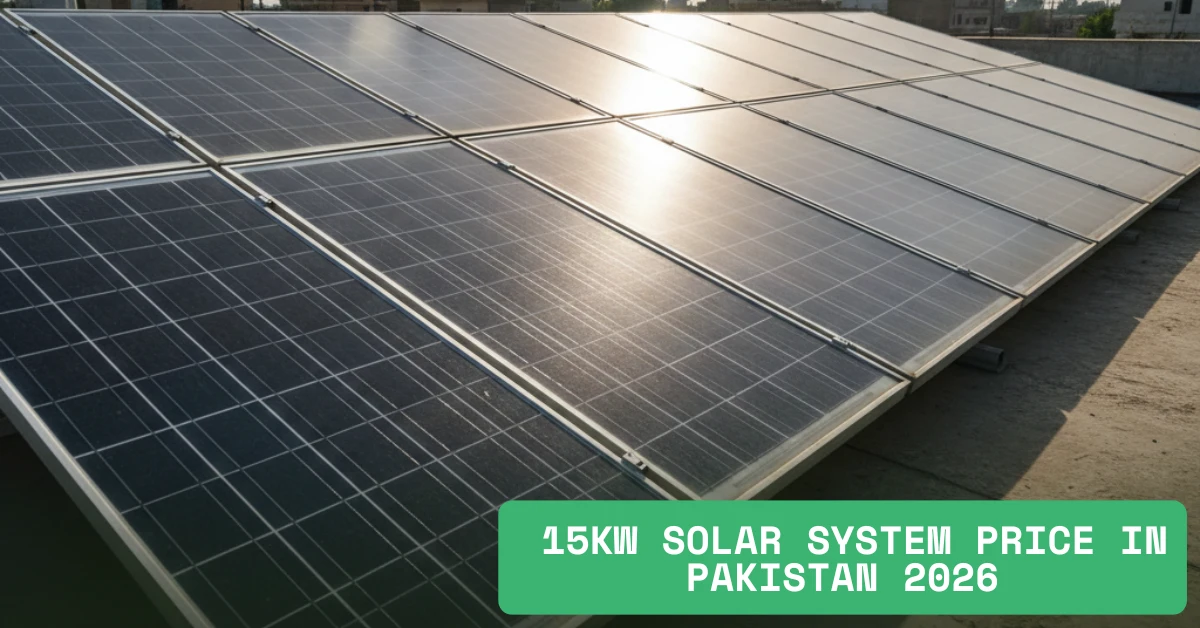
Are you considering installing a 15kW solar system in Pakistan in 2026? With electricity prices skyrocketing and load shedding disrupting daily life, thousands of Pakistani homeowners and businesses are turning to solar energy as a permanent solution. A 15kW solar system is one of the most popular choices for large homes, small commercial setups, and industrial units looking to slash their electricity bills by up to 90%.
In this comprehensive guide, you’ll discover everything about the 15kW solar system price in Pakistan 2026, including detailed cost breakdowns, component specifications, government subsidies, installation requirements, and expert tips to help you make an informed decision. Whether you’re in Lahore, Karachi, Islamabad, or any other city, this guide will answer all your questions.
What is a 15kW Solar System?
A 15kW (15-kilowatt) solar system is a mid-to-large scale photovoltaic (PV) installation designed to generate approximately 60-75 units (kWh) of electricity per day under optimal Pakistani weather conditions. This system is ideal for:
- Large residential properties with 5+ bedrooms
- Small commercial establishments (shops, clinics, offices)
- Agricultural operations and tube wells
- Light industrial units
- Properties with monthly electricity consumption of 1,800-2,200 units
The system typically consists of 30-40 solar panels (depending on panel wattage), inverters, mounting structures, batteries (for hybrid systems), and associated electrical components.
15kW Solar System Price in Pakistan 2026: Detailed Breakdown
The 15kW solar system price in Pakistan 2026 varies significantly based on the type of system, component quality, and brand selection. Here’s a comprehensive price breakdown:
Current Market Prices (March 2026)
| System Type | Price Range (PKR) | Price Range (USD) | Monthly Savings |
|---|---|---|---|
| On-Grid 15kW System | PKR 1,800,000 – 2,400,000 | $6,400 – $8,600 | 50,000 – 70,000 |
| Hybrid 15kW System | PKR 2,800,000 – 3,800,000 | $10,000 – $13,600 | 60,000 – 85,000 |
| Off-Grid 15kW System | PKR 3,500,000 – 4,800,000 | $12,500 – $17,200 | 65,000 – 90,000 |
Note: Prices include GST and installation charges. Dollar rates calculated at PKR 280 per USD (March 2026 approximate rate).
Component-Wise Cost Distribution
Understanding where your money goes helps you make informed decisions:
For an On-Grid 15kW System:
- Solar Panels (Tier-1): PKR 900,000 – 1,200,000 (50-55% of total cost)
- Inverter: PKR 450,000 – 650,000 (25-30%)
- Mounting Structure: PKR 180,000 – 250,000 (10-12%)
- Wiring & Accessories: PKR 120,000 – 180,000 (6-8%)
- Installation & Labor: PKR 150,000 – 220,000 (8-10%)
For a Hybrid 15kW System (add battery costs):
- Battery Bank (20-30kWh): PKR 800,000 – 1,400,000 (additional)
- Hybrid Inverter: PKR 600,000 – 850,000 (instead of regular inverter)
Factors Affecting 15kW Solar System Price in Pakistan
Several critical factors influence the final price you’ll pay for your solar installation:
1. Panel Quality and Brand
Tier-1 Brands (Longi, JinkoSolar, Canadian Solar, Trina):
- Higher efficiency (21-22%)
- 25-year performance warranty
- Better low-light performance
- Price: PKR 30,000-40,000 per panel (400W)
Tier-2 Brands (Local Chinese brands):
- Moderate efficiency (18-20%)
- 10-15 year warranty
- Decent performance
- Price: PKR 20,000-28,000 per panel (400W)
Tier-3 Brands (Uncertified local assembly):
- Lower efficiency (15-18%)
- Limited or no warranty
- Price: PKR 15,000-22,000 per panel (400W)
- Not recommended for long-term investment
2. Inverter Type and Technology
Your inverter choice dramatically impacts both upfront cost and long-term performance:
String Inverters: PKR 350,000-500,000
- Most economical option
- Suitable for unshaded roofs
- Single point of failure
Hybrid Inverters: PKR 600,000-850,000
- Battery backup capability
- Future-proof investment
- Load shedding protection
- Brands: Growatt, Goodwe, SMA, Huawei
Microinverters: PKR 700,000-950,000
- Panel-level optimization
- Better shading tolerance
- Higher initial cost but maximum efficiency
3. System Type Selection
On-Grid Systems are cheapest as they:
- Require no batteries
- Export excess power to grid (net metering)
- Depend on grid availability
- Best ROI for areas with minimal load shedding
Hybrid Systems offer:
- Battery backup (4-8 hours typical)
- Grid independence during outages
- Net metering capability
- Higher upfront cost but maximum reliability
Off-Grid Systems provide:
- Complete independence
- Suitable for remote locations
- Highest initial investment
- Require larger battery banks
4. Installation Complexity
Installation costs vary based on:
- Roof type (concrete, tin, ground-mounted)
- Roof accessibility and height
- Distance between panels and inverter location
- Electrical infrastructure upgrades needed
- City/location (urban vs. remote areas)
Standard installation: PKR 150,000-200,000 Complex installation: PKR 250,000-350,000
Government Subsidies and Financing Options 2026
The Pakistani government continues to incentivize solar adoption through various programs:
State Bank of Pakistan Green Banking Scheme
- Subsidized loans at 6-9% markup (significantly below commercial rates)
- Loan amounts up to PKR 5,000,000
- Repayment period: 5-8 years
- Available through Allied Bank, HBL, MCB, and other partner banks
- Processing time: 2-4 weeks
Net Metering Benefits
- Sell excess electricity back to WAPDA/K-Electric
- Units rollover for 12 months
- Reduces payback period by 20-30%
- Free net metering approval for systems under 1MW
- Processing time: 4-8 weeks (varies by DISCO)
Provincial Subsidies (Limited Availability)
Some provinces offer additional incentives:
- Punjab: Up to PKR 200,000 subsidy (subject to availability)
- Khyber Pakhtunkhwa: Expedited net metering approvals
- Sindh: Tax exemptions on solar equipment imports
(link to your article on “How to Apply for Net Metering in Pakistan 2026“)
15kW Solar System Specifications and Components
Recommended Panel Configuration
| Panel Wattage | Number of Panels | Total Capacity | Roof Space Required |
|---|---|---|---|
| 400W | 38 panels | 15.2kW | 750-800 sq ft |
| 450W | 34 panels | 15.3kW | 680-720 sq ft |
| 500W | 30 panels | 15.0kW | 600-650 sq ft |
Pro Tip: Higher wattage panels reduce installation time and space requirements, though they cost slightly more per panel.
Battery Requirements (For Hybrid/Off-Grid)
For meaningful backup during load shedding:
Minimum Backup (4-6 hours):
- 20kWh lithium battery bank: PKR 800,000-1,000,000
- 24 units of 200Ah tubular batteries: PKR 600,000-800,000
Standard Backup (8-10 hours):
- 30kWh lithium battery bank: PKR 1,200,000-1,500,000
- 36 units of 200Ah tubular batteries: PKR 900,000-1,200,000
Lithium vs. Lead-Acid Comparison:
| Feature | Lithium (LiFePO4) | Lead-Acid Tubular |
|---|---|---|
| Lifespan | 10-15 years | 3-5 years |
| Depth of Discharge | 80-90% | 50-60% |
| Maintenance | Zero | Regular water topping |
| Efficiency | 95-98% | 80-85% |
| Initial Cost | Higher (2-3x) | Lower |
| Long-term Value | Better | Needs replacement |
(link to your article on “Lithium vs Lead-Acid Batteries for Solar Systems in Pakistan“)
Daily and Monthly Energy Generation
Understanding your system’s output helps set realistic expectations:
Daily Generation (15kW System)
Summer Months (April-September):
- Peak sun hours: 6-7 hours
- Daily generation: 70-85 units (kWh)
- Monthly generation: 2,100-2,550 units
Winter Months (October-March):
- Peak sun hours: 4-5 hours
- Daily generation: 55-70 units (kWh)
- Monthly generation: 1,650-2,100 units
Annual Average: 22,000-26,000 units per year
City-Wise Performance Variations
| City | Avg. Daily Generation | Best Months |
|---|---|---|
| Quetta | 75-80 units | May-August |
| Multan | 72-78 units | April-September |
| Lahore | 68-75 units | May-August |
| Islamabad | 65-72 units | May-July |
| Karachi | 70-76 units | March-October |
| Peshawar | 66-73 units | May-August |
Note: Actual generation depends on panel orientation, shading, dust accumulation, and system maintenance.
Return on Investment (ROI) Analysis
Let’s calculate realistic payback periods for different scenarios:
Scenario 1: Commercial Unit (On-Grid)
Assumptions:
- System cost: PKR 2,200,000
- Monthly electricity bill (before solar): PKR 80,000
- Average monthly savings: PKR 68,000 (85% reduction)
- Net metering credits: PKR 8,000/month (average)
Calculation:
- Total monthly benefit: PKR 76,000
- Annual savings: PKR 912,000
- Payback period: 2.4 years
- 20-year profit: PKR 16,000,000+
Scenario 2: Large Home (Hybrid System)
Assumptions:
- System cost: PKR 3,200,000
- Monthly electricity bill (before solar): PKR 55,000
- Average monthly savings: PKR 47,000 (85% reduction)
- Battery replacement cost after 5 years: PKR 800,000
Calculation:
- Annual savings: PKR 564,000
- Payback period: 5.7 years
- 20-year profit (accounting for battery replacement): PKR 8,500,000+
Scenario 3: Agricultural Tube Well (Off-Grid)
Assumptions:
- System cost: PKR 4,000,000
- Diesel generator running costs: PKR 90,000/month
- Solar maintenance: PKR 15,000/month
- Net savings: PKR 75,000/month
Calculation:
- Annual net savings: PKR 900,000
- Payback period: 4.4 years
- 20-year profit: PKR 14,000,000+
(link to your article on “Solar System ROI Calculator for Pakistan“)
Installation Process: Step-by-Step Guide
Phase 1: Pre-Installation (1-2 weeks)
1. Site Survey: Professional assessment of your roof/property
- Shadow analysis throughout the day
- Roof strength verification
- Electrical infrastructure check
- Optimal panel placement planning
2. System Design: Customized solution based on:
- Your electricity consumption patterns
- Available roof space
- Budget constraints
- Future expansion possibilities
3. Documentation:
- DISCO/utility company approvals
- Net metering application (if applicable)
- Building permission (for commercial properties)
Phase 2: Installation (3-5 days)
Day 1-2: Mounting structure installation
- Roof preparation and waterproofing
- Mounting rail installation
- Cable pathway creation
Day 3-4: Panel and electrical work
- Solar panel installation and wiring
- Inverter and battery placement
- AC/DC wiring and connections
- Earthing and lightning protection
Day 5: Testing and commissioning
- System performance testing
- Grid synchronization (on-grid systems)
- Monitoring system setup
- Final inspection
Phase 3: Post-Installation (2-8 weeks)
- Net metering approval and installation (if applicable)
- System monitoring and optimization
- Maintenance training for property owner
- Warranty documentation
Top Solar Companies in Pakistan 2026
Choosing a reliable installer is as important as component selection:
Tier-1 Companies (Premium Service)
1. Bright Energy
- Experience: 12+ years
- Warranty: 10 years comprehensive
- After-sales rating: 4.7/5
- Price range: Premium (15-20% above market)
2. Reon Energy
- Experience: 10+ years
- Warranty: 8 years comprehensive
- After-sales rating: 4.5/5
- Price range: Mid-to-premium
3. Skyline Solar
- Experience: 8+ years
- Warranty: 7 years comprehensive
- After-sales rating: 4.4/5
- Price range: Mid-range
Tier-2 Companies (Value for Money)
- Emerging companies with 3-6 years experience
- Competitive pricing (10-15% below tier-1)
- Adequate after-sales support
- 5-7 year warranties
Due Diligence Checklist: ✓ Verify company registration with SECP ✓ Check past customer reviews on Google and social media ✓ Demand detailed written warranty terms ✓ Verify installer certifications ✓ Compare at least 3-4 quotes
(link to your article on “How to Choose the Best Solar Company in Pakistan“)
Maintenance and Operational Costs
Annual Maintenance Requirements
Panel Cleaning: PKR 15,000-25,000/year
- Frequency: Every 2-3 months (more in dusty areas)
- DIY option available with proper safety equipment
- Professional cleaning recommended for commercial systems
Inverter Maintenance: PKR 8,000-12,000/year
- Annual inspection and filter cleaning
- Firmware updates
- Connection tightening
Battery Maintenance (Lead-Acid only): PKR 10,000-15,000/year
- Monthly water level checks
- Terminal cleaning
- Equalization charging
- (Lithium batteries require zero maintenance)
Long-term Replacement Costs
| Component | Lifespan | Replacement Cost (2026) |
|---|---|---|
| Solar Panels | 25-30 years | Usually not needed |
| Inverter | 10-15 years | PKR 400,000-600,000 |
| Lithium Batteries | 10-15 years | PKR 900,000-1,300,000 |
| Lead-Acid Batteries | 3-5 years | PKR 600,000-900,000 |
| Mounting Structure | 25+ years | Usually not needed |
Annual Insurance (Optional but Recommended): PKR 25,000-40,000
- Covers theft, fire, storm damage
- Available through EFU, Adamjee, and other insurers
Common Mistakes to Avoid
1. Choosing Based on Price Alone
The cheapest system often costs more in the long run due to:
- Frequent component failures
- Poor after-sales support
- Substandard materials degrading quickly
- Voided warranties due to non-certified components
Solution: Compare total cost of ownership over 10 years, not just upfront cost.
2. Oversizing or Undersizing the System
Oversizing issues:
- Wasted investment on excess capacity
- Longer payback periods
- Grid export limitations in some areas
Undersizing issues:
- Insufficient electricity generation
- Continued reliance on grid power
- Poor ROI
Solution: Get professional load analysis based on actual consumption patterns, not just monthly units.
3. Ignoring Roof Suitability
Many installers don’t properly assess:
- Roof structural capacity (panels weigh 600-800 kg total)
- Shading from nearby buildings or trees
- Roof orientation (south-facing optimal in Pakistan)
- Future construction plans
Solution: Insist on detailed structural assessment before signing contract.
4. Neglecting Net Metering Process
- Net metering approval can take 4-12 weeks
- Some areas have connection queue times
- Missing documentation delays everything
Solution: Start net metering application simultaneously with system ordering.
5. No Written Warranty Documentation
Verbal promises mean nothing when you need support:
- Demand written warranties for all components
- Clarify what’s covered (parts, labor, transportation)
- Understand exclusions and claim process
Future Trends and Price Predictions
Expected Price Trajectory (2026-2028)
Based on global solar market trends and local manufacturing:
2026 (Current): PKR 1,800,000-2,400,000 (on-grid) 2027 (Projected): PKR 1,650,000-2,150,000 (8-10% decrease) 2028 (Projected): PKR 1,500,000-1,950,000 (Additional 7-9% decrease)
Factors driving price reduction:
- Increased local manufacturing (announced solar panel factories)
- Technology improvements in panel efficiency
- Rupee stabilization (if continues)
- Economies of scale as market matures
Factors that may increase prices:
- Import duty changes
- GST adjustments
- Rupee devaluation
- Global silicon shortage
Emerging Technologies
Bifacial Solar Panels:
- Capture sunlight from both sides
- 10-15% higher efficiency
- Premium pricing: 20-25% above standard panels
- Ideal for ground-mounted systems
Smart Monitoring Systems:
- Real-time generation tracking via mobile apps
- Predictive maintenance alerts
- Individual panel performance monitoring
- Becoming standard in premium installations
Energy Management Systems:
- Automatic load switching during peak generation
- Battery optimization algorithms
- Grid export maximization
- Adding PKR 80,000-150,000 to system cost
Conclusion
The 15kW solar system price in Pakistan in 2026 represents a significant but highly worthwhile investment for large homes, commercial properties, and industrial users. With prices ranging from PKR 1,800,000 for on-grid systems to PKR 4,800,000 for off-grid installations, the initial cost is offset by substantial electricity savings, with payback periods as short as 2.4 years for high-consumption users.
Pakistan’s abundant sunshine, rising electricity tariffs, and government incentives make 2026 an ideal time to transition to solar energy. A well-designed 15kW system will generate 22,000-26,000 units annually, potentially saving PKR 600,000-900,000 per year at current electricity rates.

Pingback: Best Solar Power System for Home in Pakistan 2026