
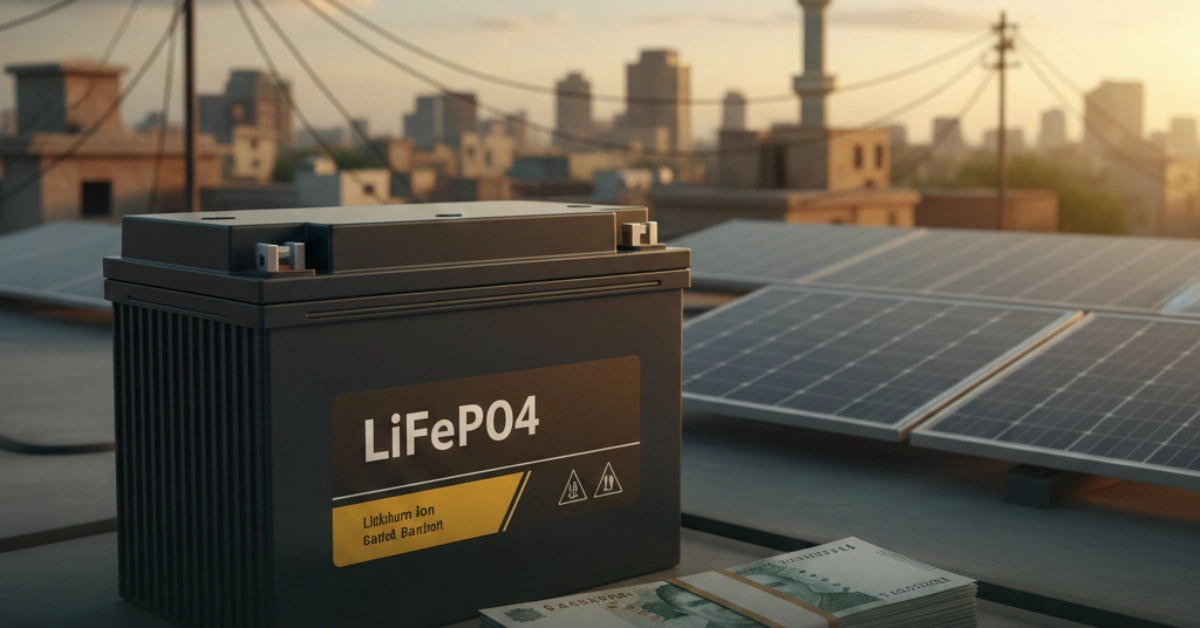
Searching for the 200Ah Lithium Ion Solar Battery Price Pakistan 2026 You’re making the right choice—200Ah lithium batteries represent the sweet spot for residential and small commercial solar systems in Pakistan. With a capacity of 10.24 kWh at 51.2V, a 200Ah lithium ion solar battery provides enough storage to power an entire household through load shedding periods, yet remains more affordable than larger capacity options.
But here’s the challenge: prices vary dramatically depending on brand, chemistry, voltage configuration, and where you purchase. A 200Ah lithium ion solar battery in Pakistan can cost anywhere from PKR 400,000 to PKR 550,000+—a difference of over PKR 150,000. This comprehensive guide reveals exactly what you should pay, which brands deliver genuine value, and how to avoid overpaying for inferior products. By the end, you’ll understand every factor influencing 200Ah lithium ion solar battery prices in Pakistan and make a purchase you won’t regret.
Current Market Pricing: 200Ah Lithium Ion Solar Battery in Pakistan 2026
Let’s start with real, current pricing data for 200Ah Lithium Ion Solar Battery Price Pakistan 2026 market:
Official Retail Prices for 200Ah Lithium Batteries
| Brand | Model | Voltage | Capacity | Price Range | Type |
|---|---|---|---|---|---|
| Narada | NESR48200 | 51.2V | 200Ah (10.24kWh) | PKR 480,000-495,000 | LiFePO4 |
| GenixGreen | ES-BOX26 Plus | 51.2V | 200Ah (10.24kWh) | PKR 450,000-460,000 | LiFePO4 |
| Crown | CMLB-230AH | 51.2V | 230Ah (11.78kWh) | PKR 550,000+ | LiFePO4 |
| Energy Powerwall | HJ-ES-512200 | 51.2V | 200Ah (10.24kWh) | PKR 420,000-450,000 | LiFePO4 |
| ITEL | 25V 200AH | 25.6V | 200Ah (5.12kWh) | PKR 160,000-162,000 | LiFePO4 |
| Gripsun | Magic Box | 51.2V | 100Ah (5.12kWh) | PKR 200,000-201,000 | LiFePO4 |
Important note: Prices quoted above represent February 2026 market rates from authorized distributors. Prices fluctuate based on:
- Import duty variations
- Pakistani Rupee exchange rate fluctuations
- Regional availability differences
- Seasonal demand variations
- Distributor markup variations
Price Trend Analysis: How 200Ah Lithium Prices Have Changed
Understanding price trends helps you decide whether to purchase now or wait:
2022: 100Ah lithium batteries averaged PKR 60,000-80,000 (200Ah equivalent: approximately PKR 600,000+)
2023: Global lithium carbonate price declines of 20%+ led to Pakistani reductions. 200Ah batteries dropped to PKR 520,000-550,000 range.
2024: Continued global decline (lithium carbonate fell from $70,000 to below $15,000 per metric ton) further reduced Pakistani prices to PKR 480,000-500,000 range.
Early 2025: Customs valuation changes (Directorate General of Customs in Karachi implemented new import valuations) temporarily increased prices. However, by mid-2025, prices stabilized around current levels.
2026 Projection: Lithium prices are expected to remain stable globally. Pakistani 200Ah battery prices should hold steady at PKR 450,000-510,000 through year-end, barring major Rupee devaluation.
Understanding 200Ah Capacity: What It Really Means
Before comparing prices, you must understand what “200Ah” actually means—and why capacity alone doesn’t tell the complete story.
Ampere-Hours (Ah) vs. Kilowatt-Hours (kWh)
200Ah at 51.2V = 10.24 kWh usable capacity
This calculation: 200Ah × 51.2V ÷ 1,000 = 10.24 kWh
This is fundamentally different from lead-acid battery ratings. A 200Ah lead-acid battery only provides ~100Ah of usable power (50% depth of discharge), whereas a 200Ah lithium battery provides 180-190Ah of usable power (90-95% depth of discharge).
Practical translation: A 200Ah lithium battery stores approximately the same usable energy as 300-400Ah of lead-acid battery—a massive efficiency advantage that partially justifies higher lithium prices. (Internal link suggestion: link to your article on “lead-acid vs. lithium battery comparison for Pakistan”)
Real-World Usage Duration: How Long 200Ah Powers Your Home
The actual backup duration depends on your load:
Example scenario – typical Pakistani household during load shedding:
- Refrigerator: 300W (8 hours continuous)
- LED lights (5 bulbs): 50W
- Ceiling fans (2 units): 200W
- Phone/device charging: 100W
- Misc (water pressure switch, etc.): 150W
- Total daytime load: 800W average
A 200Ah lithium battery provides 10.24 kWh ÷ 0.8 kW = 12.8 hours of full backup
However, if you reduce load to essentials only (refrigerator + essential lights + one fan):
- Reduced load: ~400W
- 10.24 kWh ÷ 0.4 kW = 25.6 hours of backup
Most Pakistani families operating essential loads only find a 200Ah lithium battery provides 18-24 hours of continuous backup during load shedding—more than sufficient for typical 6-8 hour daily outage patterns.
Why 200Ah Lithium Batteries Cost So Much: Breaking Down the Price
The PKR 450,000-510,000 price tag for a 200Ah lithium battery might seem expensive until you understand the cost components. Transparency here helps justify the investment:
Manufacturing Cost Breakdown (Typical 200Ah Lithium Battery)
LiFePO4 Battery Cells (45% of manufacturing cost): A 200Ah battery requires approximately 64-80 individual cells, each costing $3-5 wholesale. Total cell cost: ~$200-250 per battery. In PKR at current exchange rates: approximately PKR 110,000-150,000 per battery.
Battery Management System (BMS) – (15% of manufacturing cost): The intelligent brain managing charge/discharge cycles, temperature monitoring, and cell balancing costs $40-80 to manufacture. Pakistani import price: PKR 30,000-50,000 per unit.
Connectors, Wiring, and Housing (12% of manufacturing cost): Quality connectors rated for high current (200A continuous), copper wiring, aluminum or steel housing, and internal connections cost $20-35 to manufacture. Pakistani cost: PKR 15,000-25,000.
Safety Components (10% of manufacturing cost): Fuses, relays, thermal sensors, and protection circuits ensure safe operation. Cost: PKR 15,000-25,000.
Labor and Assembly (8% of manufacturing cost): Manufacturing in Chinese facilities is low-cost but still requires proper assembly, quality testing, and calibration. Labor cost: PKR 20,000-30,000 per battery.
Packaging, Shipping, and Logistics (10% of manufacturing cost): Specialized packaging protecting a 96kg battery, international shipping from China, customs clearance, and last-mile delivery in Pakistan costs PKR 40,000-60,000 per battery.
Total Manufacturing + Shipping Cost: approximately PKR 230,000-340,000
Distributor Markup (15-25%): Pakistani authorized distributors add 15-25% markup to cover:
- Local warehousing costs
- Technical support and training
- Warranty claims and replacements
- Marketing and showroom expenses
- Their profit margin
Result: A 200Ah battery manufacturing cost of ~PKR 280,000 becomes a retail price of PKR 450,000-510,000 after distributor markup.
Top Brands: 200Ah Lithium Ion Solar Battery Prices in Pakistan
1. Narada NESR48200 – Market Leader
Retail Price: PKR 480,000-495,000
Specifications:
- Voltage: 51.2V
- Capacity: 200Ah (10.24 kWh)
- Cycle life: 6,000+ cycles
- Warranty: 5-year product warranty
- Depth of discharge: 90%
- Operating temperature: -10°C to +60°C
Why Narada dominates Pakistan’s market:
Narada batteries have been available in Pakistan for 8+ years, giving them the deepest local support network. The NESR48200 is specifically designed for solar applications with optimized charging algorithms for Pakistan’s climate extremes.
Pakistani installers consistently report that Narada batteries integrate flawlessly with popular hybrid inverters (Solis, Growatt, SAJ, Voltronic). The BMS communicates seamlessly with these inverters, eliminating compatibility headaches.
Typical backup duration: 12-18 hours (depending on load)
Reliability rating in Pakistan: 9/10 (based on distributed units performing 6+ years without major issues)
Best for: Reliability-focused buyers, those prioritizing installer network support, homes with existing hybrid inverters already specified for Narada compatibility
2. GenixGreen ES-BOX26 Plus – Best Value Option
Retail Price: PKR 450,000-460,000
Specifications:
- Voltage: 51.2V
- Capacity: 200Ah (10.24 kWh)
- Cycle life: 6,000+ cycles
- Warranty: 5-year product warranty
- Depth of discharge: 95%
- Modular design: Stackable for capacity expansion
Why GenixGreen offers exceptional value:
GenixGreen delivers virtually identical specifications to Narada at PKR 30,000-35,000 lower cost. The ES-BOX26 Plus features modular design allowing you to stack two units (20.48 kWh total) if needed later—a flexibility advantage over single-unit Narada designs.
The 95% depth of discharge (vs. Narada’s 90%) means slightly more usable energy from the same capacity.
Typical backup duration: 13-20 hours
Reliability rating in Pakistan: 8/10 (newer brand but rapidly gaining distributor support; fewer long-term reliability records than Narada)
Best for: Budget-conscious buyers, those wanting expandable capacity, willing to accept slightly less established brand for cost savings
3. Energy Powerwall HJ-ES-512200 – Aggressive Pricing
Retail Price: PKR 420,000-450,000
Specifications:
- Voltage: 51.2V
- Capacity: 200Ah (10.24 kWh)
- Cycle life: 6,000 cycles
- Warranty: 5-year product warranty
- Weight: 96kg (standard for 200Ah batteries)
- Maximum discharge current: 200A continuous
Why Energy Powerwall offers competitive pricing:
Energy Powerwall batteries are manufactured in China with aggressive pricing strategy to capture market share in emerging markets like Pakistan. While the specifications match competitors, warranty support is less established locally—Energy Powerwall has limited service centers in Karachi and Lahore compared to Narada.
Typical backup duration: 12-18 hours
Reliability rating in Pakistan: 7/10 (limited local deployment history; warranty claims may require international coordination)
Best for: Price-sensitive buyers comfortable with less established local support, those with technical installers who can troubleshoot independently
4. Crown CMLB-230Ah – Premium Local Manufacturing
Retail Price: PKR 550,000+
Specifications:
- Voltage: 51.2V
- Capacity: 230Ah (11.78 kWh) – higher than standard 200Ah
- Cycle life: 6,000+ cycles
- Warranty: 5-year local warranty + 10-year service warranty
- Locally assembled in Pakistan
Why Crown commands premium pricing:
Crown is Pakistan’s own battery manufacturer, offering superior local support. The 230Ah capacity (vs. standard 200Ah) provides 13% more usable energy—equivalent to paying for 200Ah but receiving 230Ah capacity.
Crown’s local assembly eliminates import delays and customs issues affecting other brands. Warranty claims receive immediate attention from the factory in Pakistan.
Typical backup duration: 14-22 hours (higher capacity than competitors)
Reliability rating in Pakistan: 8.5/10 (excellent local support; solid performance but fewer long-term case studies than Narada)
Best for: Buyers prioritizing local manufacturing support, those wanting higher capacity (230Ah vs. standard 200Ah), Pakistani nationalists supporting indigenous industry
5. ITEL 25V 200Ah – Ultra-Budget Option
Retail Price: PKR 160,000-162,000
Specifications:
- Voltage: 25.6V (half-voltage compared to 51.2V standard)
- Capacity: 200Ah (5.12 kWh)
- Cycle life: 3,000-4,000 cycles
- Warranty: 3-year product warranty
Critical caveat: This is NOT equivalent to 51.2V 200Ah batteries
ITEL’s ultra-low pricing comes because the voltage is halved (25.6V vs. 51.2V). This means:
- 25.6V systems require different inverters (less common in Pakistan)
- Energy storage is only 5.12 kWh (half of 51.2V 200Ah)
- NOT directly comparable to other 200Ah batteries listed above
Only consider ITEL if: You already have a 24V hybrid inverter system, or you’re installing a completely new 24V system (rare in Pakistan in 2026)
Factors Influencing 200Ah Lithium Ion Solar Battery Prices in Pakistan
Understanding what drives prices helps you negotiate effectively and understand value:
1. Battery Chemistry: LiFePO4 vs. NMC
All 200Ah batteries sold in Pakistan use LiFePO4 (Lithium Iron Phosphate) chemistry—the safest and most durable option for solar applications. NMC (Nickel Manganese Cobalt) batteries are absent from Pakistan’s market because Pakistan’s extreme heat (50°C+) makes NMC thermally unstable.
Result: No chemistry-based price variation—all major brands use identical LiFePO4 chemistry.
2. Voltage Configuration: 48V vs. 51.2V vs. 25.6V
The vast majority of 200Ah batteries sold in Pakistan are 51.2V configuration—the industry standard for modern hybrid solar inverters in Pakistan.
Price variation by voltage:
- 51.2V 200Ah: PKR 450,000-510,000 (standard)
- 48V 200Ah: PKR 440,000-490,000 (slightly cheaper, older standard)
- 25.6V 200Ah: PKR 160,000-162,000 (half-voltage, different application entirely)
Most installers recommend 51.2V for new installations because compatibility with latest Solis, Growatt, and SAJ inverters is guaranteed.
3. Brand Reputation and Warranty Length
Brand reputation directly impacts pricing:
- Narada (established 2009, global distribution): Commands 10-15% price premium due to proven track record
- Crown (local manufacturing, newer): Slight premium (5-10%) for local support advantage
- GenixGreen (emerging brand): 5-10% discount vs. Narada for identical specifications
- Energy Powerwall (aggressive entrant): Deepest discounts (10-15% below Narada) to build market share
Warranty length also affects price:
- 10-year service warranty (Narada, Crown): justifies higher prices
- 5-year product warranty only: justifies lower prices (more realistic for solar batteries—actual degradation after 8 years is minimal)
4. Battery Management System (BMS) Features
Advanced BMS features increase manufacturing cost and retail price:
Standard features (all major brands):
- Over-charge protection
- Over-discharge protection
- Cell balancing
- Temperature monitoring
- Short-circuit protection
Premium features (Narada, Crown, some others):
- WiFi monitoring via smartphone app
- Predictive maintenance alerts
- Advanced thermal management for Pakistan’s heat
- Integration protocols for specific inverter models
Premium BMS features add PKR 10,000-20,000 to final price but provide genuinely valuable functionality for Pakistan’s climate.
5. Regional Availability and Distributor Pricing
Prices vary significantly by region due to distributor competition:
Karachi (most competitive):
- Deepest discounts due to highest competition
- Multiple authorized distributors per brand
- Average 200Ah price: PKR 445,000-480,000
Lahore (moderate competition):
- Moderate pricing
- Average 200Ah price: PKR 460,000-495,000
Islamabad/Rawalpindi (limited competition):
- Higher prices due to fewer distributors
- Average 200Ah price: PKR 480,000-510,000
Peshawar/KPK (minimal competition):
- Premium pricing
- Limited brand availability
- Average 200Ah price: PKR 500,000-550,000
Rural areas: Typically require shipping from major cities, adding PKR 5,000-15,000 delivery charge
Where to Buy 200Ah Lithium Ion Solar Battery in Pakistan
Price and availability vary dramatically by retailer:
Authorized Distributors (Recommended)
Advantages:
- Genuine product guarantee
- Proper warranty registration
- Technical support
- Reasonable pricing
Disadvantages:
- Limited negotiation room
- May charge delivery fees
Major authorized distributors:
- Karachi: W11Stop, Kamal Solar House, Nizam Energy
- Lahore: Alpha Solar, SolarShop.pk, Progressive Ventures
- Islamabad: Local inverter shops (ask for distributor partnerships)
- Peshawar: Limited availability (order from Karachi/Lahore)
Online Marketplaces
Platforms: Daraz.pk, OLX.pk, Facebook Marketplace
Advantages:
- Price competition often yields 5-10% discounts
- Home delivery
- Easy comparison shopping
Disadvantages:
- Product authenticity risk (counterfeit batteries exist)
- Warranty registration complications
- Seller reliability varies
Recommendation: Only purchase from sellers with 4.5+ star ratings, minimum 100+ reviews, and established business presence.
Direct from Solar Installation Companies
When you hire a solar installer: Often they can source batteries at distributor costs, sometimes passing 10-15% savings to you
Advantages:
- Integrated installation and warranty
- Professional technical support
- Installation cost savings (no separate labor charges)
Disadvantages:
- Less price transparency
- Cannot switch suppliers easily if unhappy
Total Cost of Ownership: The Real Price Beyond Purchase Price
The PKR 450,000-510,000 initial price is not your total 200Ah battery cost. Account for:
Installation Cost: PKR 15,000-30,000
Professional installation by certified technician ensuring proper BMS communication with inverter.
Annual Maintenance: PKR 5,000-10,000
Annual inspection and firmware updates (not mandatory but recommended).
10-Year Total Cost:
- Battery cost: PKR 480,000
- Installation: PKR 20,000
- Maintenance (10 years × PKR 7,500 avg): PKR 75,000
- Total 10-year cost: PKR 575,000
- Cost per month: PKR 4,792
Comparative cost vs. lead-acid: A 200Ah lead-acid battery equivalent (requiring 400-500Ah capacity) costs PKR 300,000 but requires replacement every 3-5 years, plus monthly maintenance:
- Initial cost: PKR 350,000
- Replacement at year 5: PKR 350,000
- Maintenance (annual): PKR 5,000 × 5 years = PKR 25,000
- 10-year total cost: PKR 725,000
- Cost per month: PKR 6,042
Verdict: Lithium battery’s higher upfront cost yields PKR 150,000 savings over 10 years compared to lead-acid—justifying the premium price.
Installation Requirements: Don’t Overpay for Unnecessary Upgrades
When purchasing a 200Ah lithium battery, understand what installation components are essential vs. optional:
Essential Components (Must Have):
- Battery-to-inverter connectors: PKR 3,000-5,000 (include in quote)
- DC isolator switch: PKR 2,000-3,500 (safety critical)
- DC monitoring meter: PKR 1,500-3,000 (helpful for troubleshooting)
- Professional installation labor: PKR 15,000-30,000 (safety-critical)
Total essential additions: PKR 22,000-41,500
Optional Components (Nice-to-Have):
- WiFi monitoring system: PKR 5,000-10,000 (smartphone app tracking)
- Battery enclosure/cabinet: PKR 8,000-15,000 (aesthetic, not essential)
- Advanced BMS display: PKR 4,000-8,000 (redundant if inverter displays exist)
- Surge protection devices: PKR 3,000-6,000 (rarely necessary with modern BMS)
Total optional additions: PKR 20,000-39,000
Buying tip: Get detailed installation quotes specifying what’s included. Avoid installers bundling unnecessary accessories inflating final cost.
200Ah Battery Selection Guide: Which Model Should You Buy?
Choosing among comparable 200Ah options requires understanding your priorities:
If Reliability is Your #1 Priority: Choose Narada
- Proven 8+ year track record in Pakistan
- Most established installer networks
- Best long-term warranty terms
- Worth the PKR 30,000-50,000 premium over competitors
If Budget is Your #1 Priority: Choose GenixGreen
- Nearly identical specifications to Narada
- PKR 30,000-35,000 cheaper
- Modular expandable design for future upgrades
- Solid 5-year warranty
If Local Support is Priority: Choose Crown
- Pakistan-manufactured alternative
- Fastest warranty claims (no international shipping)
- Support local industry
- Higher capacity (230Ah) for similar price as others’ 200Ah
If Maximum Budget Flexibility: Choose Energy Powerwall
- Lowest cost (PKR 420,000-450,000)
- Acceptable specifications
- Best for technically-competent installers
- Risk: Limited local support infrastructure
Common Buying Mistakes and How to Avoid Them
Learning from others’ mistakes saves money and frustration:
Mistake #1: Prioritizing Price Over Compatibility
Buying the cheapest 200Ah battery without verifying inverter compatibility creates integration problems.
Solution: Confirm your inverter model is listed in the battery’s compatibility documentation before purchasing.
Mistake #2: Confusing Voltage Configurations
Purchasing a 25.6V 200Ah battery thinking it equals a 51.2V 200Ah creates wired installation problems.
Solution: Explicitly confirm 51.2V specification when purchasing—most solar installations in Pakistan use 51.2V standard.
Mistake #3: Skipping Professional Installation
DIY lithium battery installation voids warranties and risks electrocution/fire hazards.
Solution: Always hire certified professional installers. The PKR 20,000-30,000 labor cost is insurance against catastrophic risks.
Mistake #4: Not Reading Battery Specifications
Assuming all 200Ah batteries are identical ignores important differences in cycle life, warranty, and depth of discharge.
Solution: Compare specifications across brands. Narada’s 6,000 cycles differs from Energy Powerwall’s lower specification—affecting long-term viability.
Mistake #5: Negotiating Below Distributor Cost
Pushing sellers below wholesale cost attracts counterfeit products.
Solution: Accept that authorized distributors operate on 15-20% margins. Unrealistically low prices signal counterfeit risk.
FAQ: 200Ah Lithium Ion Solar Battery Price in Pakistan
Q1: Why is a 200Ah lithium battery so expensive compared to lead-acid?
A: Manufacturing costs are genuinely higher. LiFePO4 cells cost $3-5 each, requiring 64-80 cells per 200Ah battery (total $200-250 in cell costs alone). Add BMS ($40-80), connectors, labor, and shipping, and manufacturing cost reaches PKR 280,000-340,000. Lithium’s 10-year lifespan vs. lead-acid’s 3-5 years makes it cheaper long-term (PKR 4,800/month vs. PKR 6,000/month), justifying higher upfront cost.
Q2: Will 200Ah lithium battery prices drop in 2026?
A: Unlikely. Global lithium commodity prices have stabilized, and manufacturing costs have plateaued. Pakistani prices may remain steady at current levels (PKR 450,000-510,000) or slightly increase if Pakistani Rupee weakens vs. USD. Don’t wait hoping for price cuts—purchase when you need the battery rather than speculating on future discounts.
Q3: Is a 200Ah battery enough for my household?
A: Depends on your load. For essential loads only (refrigerator, lights, fans, water pump): 12-24 hours backup. For comfort loads (AC, multiple TVs, electric heating): 4-8 hours backup. Calculate your critical load (appliances during load shedding) and multiply by typical load-shedding duration (4-8 hours) to determine if 200Ah is sufficient or if 300Ah+ is necessary.
Q4: Can I install a 200Ah battery with my 10-year-old inverter?
A: Possibly, but risky. Old inverters (pre-2015) may not communicate with modern BMS systems, causing charging inefficiency or safety risks. Upgrading to a modern hybrid inverter (PKR 150,000-250,000) is recommended alongside battery purchase. This combined investment remains economically superior to continued lead-acid battery replacement cycles.
Q5: What’s the actual usable capacity of a 200Ah lithium battery?
A: Approximately 180-190Ah (90-95% depth of discharge). A 200Ah battery stores 10.24 kWh but you should never discharge below 10-20% remaining charge to maximize lifespan. In practice, you get 9.2-9.7 kWh usable energy, not the full 10.24 kWh. This is still dramatically better than lead-acid (50% usable capacity) or NMC lithium (70-80% usable).
Q6: Should I buy 200Ah now or wait for price drops?
A: If you’re experiencing frequent load shedding now, purchase immediately. The daily convenience of backup power is worth PKR 480,000 today. If load shedding is infrequent and predictable, waiting 6-12 months for potential 5-10% price reduction might be worthwhile. But don’t wait hoping for unrealistic 30-50% drops—it won’t happen given current global lithium market stabilization.
Q7: Is Narada worth PKR 50,000 more than GenixGreen?
A: Depends on your values. Narada’s 10-year service warranty (vs. GenixGreen’s 5-year product warranty) justifies the premium if you want maximum peace of mind. GenixGreen’s modular design appeals to those wanting future expandability. Both are reliable—Narada is like buying a Toyota (proven reliability), GenixGreen is like buying a Hyundai (good value, fewer long-term records).
Q8: What warranty terms should I verify before purchasing?
A: Confirm three items: (1) Product warranty length (5-10 years), (2) Capacity retention guarantee (80% after warranty period), (3) Labor/replacement included or not. Some warranties cover parts only—you pay labor for replacement. Get warranty terms in writing before purchase.
Q9: Can I return a 200Ah battery if I’m unsatisfied?
A: Authorized distributors typically offer 7-14 day return period if battery is unopened and undamaged. Once installed, returns become complicated (reversal logistics, restocking fees). Inspect battery thoroughly before installation—once connected, return options vanish.
Q10: How do I know if I’m buying a counterfeit 200Ah battery?
A: Check for: (1) Authorized distributor verification, (2) Original packaging with holograms, (3) QR code verifying authenticity with manufacturer, (4) Serial number registration options, (5) Seller reputation (4.5+ stars, 100+ reviews minimum). Never purchase from unknown sellers claiming “wholesale prices”—counterfeit batteries at discounted pricing are common in OLX/Facebook marketplaces.
Conclusion: 200Ah Lithium Ion Solar Battery Price in Pakistan 2026
The 200Ah lithium ion solar battery price in Pakistan 2026 ranges from PKR 450,000 to PKR 510,000 for quality, brand-name units from authorized distributors. While this represents significant investment, the 10-year lifespan, minimal maintenance, and superior performance compared to lead-acid alternatives make lithium the clear winner for Pakistani homes.


Pingback: Today 48V Lithium Ion Solar Battery Price in Pakistan 2026