
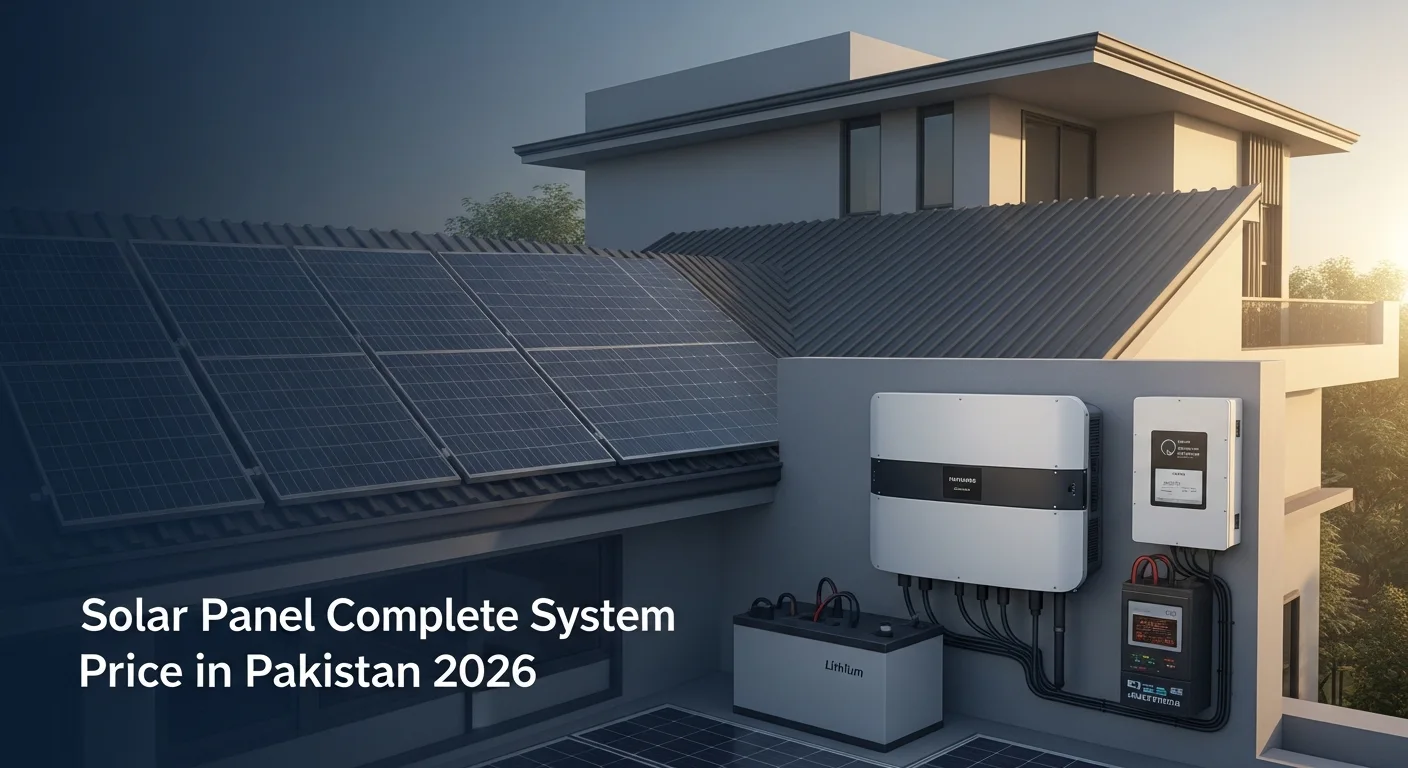
Pakistan’s electricity crisis has reached a breaking point. Grid power is unreliable, bills are skyrocketing, and load shedding is becoming unbearable. But there’s a sustainable solution: solar panel complete systems. Today, investing in solar energy is more affordable and practical than ever before.
The Solar Panel Complete System Price in Pakistan 2026 varies significantly based on system size, components, and installation quality. A 3kW system starts from PKR 330,000–400,000, while a comprehensive 10kW system ranges from PKR 1,000,000–1,400,000. Most importantly, these systems generate returns on investment within 3–4 years through electricity bill savings.
This guide provides exact 2026 pricing for every system size, breaks down what’s included in complete packages, compares on-grid versus hybrid systems, and reveals hidden costs that most vendors won’t mention. Whether you’re a homeowner seeking energy independence or a business owner looking to cut operational costs, you’ll find everything needed to make an informed investment decision. Best Solar Hybrid Inverter in Pakistan 2026 – Top hybrid inverters reviewed & compared.
What Exactly Is Included in a “Complete Solar System”?
Before discussing pricing, understanding Solar Panel Complete System Price in Pakistan what constitutes a complete system prevents overpaying or purchasing incomplete setups.
Core Components of Every Complete Solar System
A truly complete solar system includes:
1. Solar Panels (60-70% of total cost) The photovoltaic modules that convert sunlight into electricity. Measured in watts (150W, 300W, 550W, etc.). Quality impacts efficiency, lifespan, and warranty duration.
2. Inverter (15-25% of total cost) Converts DC electricity from panels into AC electricity for home use. Types include on-grid, off-grid, and hybrid. Better inverters achieve 95-98% efficiency versus 92% for budget models.
3. Mounting Structure (5-10% of total cost) Aluminum or steel frames securing panels to your roof. Includes:
- Roof mounting brackets
- MC4 connectors and cables
- Hardware and fastening systems
- Concrete bases (if ground-mounted)
4. Electrical Wiring & Safety Equipment (5-7% of total cost) DC cables connecting panels to inverter, AC cables from inverter to home, breakers, safety switches, earthing systems, and junction boxes.
5. Installation & Labor (8-12% of total cost) Professional installation ensures optimal panel angle, proper electrical connections, safety compliance, and system testing.
6. Documentation & Permits (2-3% of total cost) Net metering licenses (if applicable), technical drawings, warranty registration, and DISCO (Distribution Company) documentation.
What Complete Systems Don’t Automatically Include
Many vendors claim “complete systems” but exclude batteries. In Pakistan’s context, this matters:
- Batteries (Optional but Recommended) – Provide backup during load shedding. Add PKR 150,000–400,000 depending on capacity and type (lead-acid vs. lithium-ion).
- Smart Monitoring Equipment – WiFi monitoring systems cost an additional PKR 15,000–25,000 but provide real-time energy tracking.
Complete Solar System Pricing Breakdown by Capacity (January 2026)
Here’s the most current pricing for complete systems installed across Pakistan: How to Clean Solar Panels – Easy step‑by‑step cleaning tips for better performance.
| System Size | Typical Use | Without Batteries | With Lead-Acid Batteries | Monthly Generation | Annual ROI |
|---|---|---|---|---|---|
| 1kW | Small office, shop, guest house | PKR 110,000–150,000 | PKR 240,000–300,000 | ~80-100 units | 3-4 years |
| 3kW | Small-medium home, clinic | PKR 330,000–420,000 | PKR 520,000–650,000 | ~240-300 units | 3-4 years |
| 5kW | Average home, medium shop | PKR 550,000–750,000 | PKR 810,000–950,000 | ~400-500 units | 3-4 years |
| 6kW | Homes with AC, larger shops | PKR 650,000–850,000 | PKR 900,000–1,100,000 | ~480-600 units | 3-4 years |
| 8kW | Large homes, small businesses | PKR 850,000–1,100,000 | PKR 1,200,000–1,400,000 | ~640-800 units | 3-4 years |
| 10kW | 1 Kanal houses, businesses | PKR 1,000,000–1,350,000 | PKR 1,500,000–1,800,000 | ~800-1,000 units | 3-4 years |
| 15kW | Commercial, large offices | PKR 1,500,000–2,000,000 | PKR 2,200,000–2,700,000 | ~1,200-1,500 units | 3-4 years |
| 20kW | Industrial, farms | PKR 2,000,000–2,600,000 | PKR 3,000,000–3,600,000 | ~1,600-2,000 units | 3-4 years |
Important Notes:
- Prices current as of January, 2026
- “Without batteries” = on-grid systems (connected to national grid)
- Prices include installation, documentation, and warranties
- Fluctuations occur due to exchange rates (USD/PKR conversion around 280–300 PKR per USD)
- Lead-acid batteries last 3-5 years; lithium-ion batteries last 10-15 years but cost 2-3X more
Complete System Price Breakdown: What Costs What?
Understanding where your money goes prevents overpaying. Here’s a realistic breakdown for a 5kW complete solar system (the most popular choice for Pakistani homes):
Component-Wise Cost Allocation
Solar Panels (5,000W capacity)
- 9-10 panels × 550W = PKR 190,000–240,000
- Quality: A-Grade Tier-1 brands (Longi, Jinko, Canadian, Trina)
- Price per watt: PKR 27–33
Inverter (5-6kW capacity)
- On-grid: PKR 80,000–120,000 (brands: Solis, Goodwe, Growatt)
- Hybrid: PKR 150,000–220,000 (brands: Inverex, Knox, Fronius)
- On-grid vs. hybrid: Hybrid adds battery management capability
Mounting Structure
- Aluminum roof-mounted L2 brackets: PKR 60,000–90,000
- Includes installation hardware and fasteners
- Custom mounting (if needed): +PKR 20,000–40,000
Electrical Wiring & Safety
- DC cables (4mm² cross-section): PKR 8,000–12,000
- AC cables, breakers, switches: PKR 15,000–25,000
- Earthing and grounding equipment: PKR 10,000–15,000
- Junction boxes and connectors: PKR 8,000–12,000
Installation & Labor
- Professional installation: PKR 40,000–60,000
- Wiring and connections: PKR 15,000–25,000
- System testing and commissioning: PKR 10,000–15,000
- Rooftop assessment and reinforcement (if needed): +PKR 20,000–40,000
Documentation & Permits
- Net metering license (if on-grid): PKR 5,000–8,000
- Technical drawings and plans: PKR 3,000–5,000
- Warranty registration and documentation: No additional cost
- Inspection fees (DISCO/municipal): PKR 2,000–5,000
Total for 5kW On-Grid System: PKR 549,000–750,000
Sample Installation Quotes (Real Market Prices, January 2026)
Quote 1 – Budget Option (5kW On-Grid)
- Panels: Trina 550W × 9 = PKR 198,000
- Inverter: Goodwe 5kW = PKR 95,000
- Mounting: Standard aluminum = PKR 75,000
- Wiring & safety: PKR 45,000
- Installation: PKR 50,000
- Documentation: PKR 8,000
- Total: PKR 471,000
Quote 2 – Mid-Range Option (5kW On-Grid)
- Panels: Longi 550W × 9 = PKR 225,000
- Inverter: Growatt 5kW = PKR 110,000
- Mounting: Premium aluminum = PKR 85,000
- Wiring & safety: PKR 52,000
- Installation: PKR 60,000
- Documentation: PKR 8,000
- Total: PKR 540,000
Quote 3 – Premium Option (5kW Hybrid)
- Panels: Canadian 550W × 9 = PKR 240,000
- Inverter: Inverex 5kW Hybrid = PKR 180,000
- Mounting: Heavy-duty aluminum = PKR 90,000
- Wiring & safety: PKR 55,000
- Installation: PKR 70,000
- Documentation: PKR 8,000
- Batteries (2 × 200Ah lead-acid): PKR 120,000
- Total: PKR 763,000
On-Grid vs. Hybrid vs. Off-Grid: Complete System Prices Compared
The type of system dramatically affects pricing. Understanding these differences ensures you select the right system for your needs. Solar Panel Price in Pakistan 2026 – Latest updated solar panel rates and cost guide.
On-Grid Solar Systems (Most Affordable)
Definition: Directly connected to the national electricity grid. No batteries. Excess power is fed back to the grid.
Price Range for Complete Systems:
- 3kW: PKR 330,000–390,000
- 5kW: PKR 549,000–680,000
- 10kW: PKR 1,000,000–1,250,000
Advantages: ✓ Lowest upfront cost (no expensive batteries) ✓ Net metering allows selling excess power back to grid ✓ Simplest installation and maintenance ✓ Inverters are cheaper (PKR 80,000–120,000 for 5kW)
Disadvantages: ✗ No power during grid outages (major issue in Pakistan) ✗ Dependent on grid stability ✗ No 24/7 energy independence
Best For: Urban areas with reliable grid supply (parts of Karachi, Lahore if load shedding isn’t severe), businesses that operate during daylight only.
Hybrid Solar Systems (Most Popular in Pakistan)
Definition: Combines solar panels, grid connection, and batteries. Intelligently switches between power sources.
Price Range for Complete Systems:
- 3kW + 1-2 batteries: PKR 520,000–650,000
- 5kW + 2-4 batteries: PKR 810,000–950,000
- 10kW + 4-8 batteries: PKR 1,500,000–1,800,000
Battery Costs Included:
- Lead-acid (200Ah): PKR 55,000–65,000 per unit
- Lithium-ion (5kWh): PKR 200,000–280,000 per unit
- Typical hybrid: 2-4 lead-acid batteries (PKR 110,000–260,000)
Advantages: ✓ Full backup during load shedding (critical for Pakistan) ✓ Uses net metering + battery backup ✓ Energy independence during grid failures ✓ Batteries charge during low-cost off-peak hours (if applicable)
Disadvantages: ✗ Higher upfront cost (batteries add PKR 110,000–260,000+) ✗ Batteries require replacement every 3-5 years (lead-acid) ✗ More complex system maintenance
Best For: Most Pakistani homes and businesses. Provides peace of mind during unpredictable load shedding while maintaining grid connection benefits.
Off-Grid Solar Systems (Most Expensive)
Definition: Completely independent from the grid. Relies entirely on solar panels and battery storage.
Price Range for Complete Systems:
- 3kW + 4-6 batteries: PKR 750,000–950,000
- 5kW + 8-12 batteries: PKR 1,200,000–1,600,000
- 10kW + 16-20 batteries: PKR 2,500,000–3,500,000
Advantages: ✓ 100% energy independence ✓ No grid dependency whatsoever ✓ Ideal for remote areas without grid access
Disadvantages: ✗ Extremely high upfront cost (massive battery investment) ✗ Battery replacement costs are substantial ✗ Requires expert system design and management ✗ Limited power generation on cloudy days ✗ Not economically viable for most Pakistani households
Best For: Remote rural areas without grid connection, farms far from cities, specialty applications requiring complete independence.
Cost Factors That Affect Your Final Price
Why do two seemingly identical 5kW systems cost PKR 500,000 in one quote and PKR 800,000 in another? These factors explain the variations:
1. Solar Panel Brand & Quality
Budget (PKR 24–27 per watt):
- Trina, Astronergy (lesser-known brands)
- May have durability concerns in Pakistan’s heat
- 25-year warranty but lower efficiency
Mid-Range (PKR 28–33 per watt):
- Longi, Jinko, Canadian, JA Solar
- Proven reliability in Pakistan’s climate
- Better efficiency (20-22%) and service networks
- Recommended for most buyers
Premium (PKR 34–40 per watt):
- Fronius, SMA (European brands)
- Highest efficiency (22%+) and durability
- Exceptional warranty and support
- Overkill for average homes; justified for commercial systems
Real-World Example: For a 5kW system:
- Budget panels: 9 × 550W @ PKR 27/W = PKR 133,650
- Mid-range panels: 9 × 550W @ PKR 31/W = PKR 153,900
- Premium panels: 9 × 550W @ PKR 37/W = PKR 184,050
- Difference: PKR 50,400 (27% cost variance)
2. Inverter Brand & Specifications
Budget Inverters (PKR 80,000–100,000 for 5kW):
- Local brands or lesser-known imports
- 92-94% efficiency
- Basic features, limited warranty (1-3 years)
- Minimal customer support
Quality Inverters (PKR 110,000–150,000 for 5kW):
- Growatt, Solis, Goodwe (trusted imported brands)
- 96-97% efficiency
- 5-year warranty, good customer support
- Best value option
Premium Inverters (PKR 160,000–220,000 for 5kW):
- Huawei, Inverex, Fronius (top-tier)
- 97-98% efficiency
- 10-year warranty, excellent support networks
- Advanced features (WiFi monitoring, AI optimization)
Impact on System Cost: Inverter choice creates PKR 30,000–70,000 variance for a 5kW system.
3. Mounting Structure Type
Budget (PKR 60,000–75,000 for 5kW):
- Basic aluminum L-brackets
- No weatherproofing coating
- May require replacement within 10 years
Standard (PKR 75,000–90,000):
- Quality aluminum with corrosion protection
- Proper wind-load engineering
- Lasts 20+ years
- Recommended choice
Premium (PKR 90,000–120,000):
- Galvanized steel with heavy-duty design
- Customizable to complex roof shapes
- Designed for extreme weather resistance
Regional Cost Variations:
- Karachi (coastal): Add PKR 15,000 for corrosion-resistant materials
- Northern areas (high wind): Add PKR 10,000–20,000 for stronger structures
- Flat roofs: Standard pricing
- Sloped roofs: Add PKR 8,000–15,000 for custom fitting
4. Installation Complexity
Simple Installation (PKR 40,000–50,000):
- Flat concrete roof, ground level access
- Straightforward electrical connections
- No structural modifications needed
- Urban homes in Karachi, Lahore, Islamabad
Standard Installation (PKR 50,000–70,000):
- Pitched roofs, height considerations
- Minor electrical upgrades (wiring extensions, breakers)
- Typical for most homes
Complex Installation (PKR 70,000–100,000+):
- Multiple-level buildings
- Underground wiring required
- Structural reinforcement needed (if roof load capacity is low)
- Difficult roof access, safety complications
- Rural setups requiring trenching
Regional Labor Cost Differences:
- Karachi/Lahore/Islamabad: PKR 40,000–60,000
- Secondary cities (Multan, Faisalabad): PKR 35,000–50,000
- Remote areas: PKR 25,000–40,000 (fewer skilled installers)
5. Battery Type (For Hybrid Systems)
Lead-Acid Batteries (Most Common):
- Cost: PKR 55,000–65,000 per 200Ah unit
- Lifespan: 3-5 years
- A 5kW system typically needs 2-4 batteries
- Total: PKR 110,000–260,000
- Best for: Budget-conscious buyers, moderate backup needs
Lithium-Ion (LiFePO4) Batteries (Premium):
- Cost: PKR 200,000–280,000 per 5kWh unit
- Lifespan: 10-15 years
- More efficient, compact, and safer
- A 5kW system needs 1-2 lithium units
- Total: PKR 200,000–560,000
- Best for: Long-term installations, businesses wanting low maintenance
Cost Comparison for 5kW Hybrid System:
- With 2 lead-acid batteries: PKR 810,000–880,000
- With 1 lithium-ion battery: PKR 950,000–1,100,000
- Lithium costs PKR 140,000–220,000 more upfront
- But lasts 2-3X longer (better 10-year ROI)
6. Government Policies & Import Duties
Pakistan’s renewable energy incentives significantly affect pricing:
Current Government Benefits (2025-2026): ✓ Tax Exemption on Solar Equipment – 0% tariff on imported panels, inverters, batteries (vs. 25-35% before exemption) ✓ Net Metering Program – Sell excess power back to grid ✓ Subsidized Financing – State Bank-backed low-interest loans (as low as 3-6% APR) ✓ Sales Tax Exemption – No 17% GST on solar systems
Real-World Complete System Costs by City (January 2026)
Prices vary by location due to transportation, labor rates, and local competition:
Karachi
- 5kW On-Grid: PKR 520,000–650,000
- 5kW Hybrid: PKR 800,000–900,000
- Labor: Most competitive due to high installer density
- Note: Add PKR 15,000 for salt-water corrosion protection
Lahore
- 5kW On-Grid: PKR 540,000–680,000
- 5kW Hybrid: PKR 820,000–920,000
- Labor: Reasonable competition, standard rates
- Note: Best installation quality due to organized installer networks
Islamabad/Rawalpindi
- 5kW On-Grid: PKR 560,000–700,000
- 5kW Hybrid: PKR 850,000–950,000
- Labor: Slightly higher due to fewer installers
- Note: Cold winters reduce panel efficiency 5-10%
Multan/Bahawalpur/Southern Punjab
- 5kW On-Grid: PKR 510,000–630,000
- 5kW Hybrid: PKR 790,000–870,000
- Labor: Most affordable labor costs
- Note: Excellent sunlight conditions (6-7 peak hours daily)
Peshawar/Northern Areas
- 5kW On-Grid: PKR 550,000–700,000
- 5kW Hybrid: PKR 840,000–950,000
- Labor: Higher installation costs (less competition)
- Note: Winter rainfall reduces efficiency significantly
Quetta/Remote Areas
- 5kW On-Grid: PKR 580,000–750,000
- 5kW Hybrid: PKR 900,000–1,050,000
- Labor: Premium labor rates for skilled technicians
- Note: Limited spare parts availability adds costs
Hidden Costs Most Vendors Don’t Mention
Awareness of these “hidden” expenses prevents budget shock:
1. Net Metering License & DISCO Processing (PKR 5,000–10,000)
For on-grid systems, you must obtain a net metering license from your electricity distribution company (DISCO). This involves:
- Technical drawings and documentation: PKR 2,000–3,000
- DISCO inspection and approval: PKR 2,000–5,000
- License processing: No charge but administrative time
- Total: PKR 4,000–8,000
Some installers include this; others bill separately.
2. Structural Roof Modifications (PKR 15,000–50,000 if needed)
Occasionally, roofs require:
- Waterproofing or concrete leveling
- Structural reinforcement if load-bearing capacity is questionable
- Reparation of cracks or leaks before panel installation
- These range from PKR 0 (if your roof is ideal) to PKR 50,000+
3. Electrical Upgrades to Home Wiring (PKR 10,000–40,000)
If your home wiring is outdated:
- Main switchboard upgrades (old switches can’t handle solar input)
- Additional circuit breakers for solar connection
- Upgrading AC cables from 2.5mm² to 4mm² or 6mm²
- Typical cost: PKR 15,000–30,000
4. Uninterruptible Power Supply (UPS) for Critical Loads (PKR 20,000–40,000)
A backup UPS protects sensitive equipment (computers, medical devices) during solar-to-battery switching. Optional but recommended for:
- Home office setups
- Security systems
- Medical equipment
- Cost: PKR 25,000–35,000 for 2kVA UPS
5. Annual Maintenance Contracts (PKR 5,000–10,000 per year)
While solar systems require minimal maintenance, many vendors offer:
- Annual inspections (PKR 3,000–5,000)
- Panel cleaning service (PKR 2,000–5,000 per session)
- Inverter health checks
- Battery monitoring
6. System Expansion in Future (PKR 100,000–300,000 if needed later)
If your electricity needs increase:
- Adding more panels: PKR 40,000–60,000 per 1kW
- Upgrading inverter: PKR 50,000–100,000
- Additional batteries: PKR 50,000–280,000
- Plan for this possibility when installing initially
Common Mistakes When Purchasing Complete Systems
Avoid these costly errors:
❌ Mistake #1: Buying from Unauthorized Vendors
Problem: Gray market solar equipment often lacks:
- Authentic warranties (may be forged)
- Technical support
- Proper documentation
- Genuine spare parts availability
Solution: Purchase from authorized distributors of major brands. Ask for:
- Original warranty certificates
- Import documents and bills
- Authorized dealer verification from manufacturer’s website
❌ Mistake #2: Choosing the Cheapest Quote
Problem: Saving PKR 50,000 upfront but getting inferior components costs:
- Lower efficiency (2-3% lower = PKR 5,000–10,000 annual loss)
- Shorter lifespan (5 years vs. 20 years)
- Repeated failures and repairs
Solution: Compare value, not just price. A PKR 50,000 difference is recovered within 5-6 years through better efficiency.
❌ Mistake #3: Skipping Professional Installation
Problem: DIY or unqualified installers cause:
- Incorrect wiring (fire hazard)
- Suboptimal panel angle (10-15% efficiency loss)
- Voided warranties
- Electrical safety violations
Solution: Always hire NEPRA-certified installers with 3+ years experience. Verify credentials and ask for references.
❌ Mistake #4: Not Accounting for Seasonal Variation
Problem: Sizing your system for summer peak means insufficient winter generation when you need it most (more load shedding).
Solution: Size for winter generation (60-70% of summer). Add 15-20% safety buffer for this.
❌ Mistake #5: Ignoring Long-Term Maintenance
Problem: Neglecting panel cleaning (dust + pollution reduce efficiency 15-20%) and not checking battery health.
Solution: Budget for:
- Quarterly panel cleaning: PKR 3,000–5,000 per cleaning
- Annual battery health checks: PKR 2,000–3,000
- Inverter inspection: Free (usually covered by warranty)
FAQ
Conclusion
The Solar Panel Complete System Price in Pakistan has become increasingly affordable, making solar energy accessible to more Pakistani homes and businesses than ever before. A quality 5kW system costs between PKR 550,000–750,000 (on-grid) or PKR 810,000–950,000 (hybrid with batteries), generating returns within 3-4 years through electricity bill savings.
Pingback: what are the best and most efficient solar panels: (2026)