Pakistan’s electricity crisis demands solutions. Load shedding destroys your daily routine, electricity bills climb 15–25% annually, and grid instability threatens your appliances. Yet millions are turning to solar energy with one critical realization: best batteries for solar in Pakistan aren’t optional—they’re essential for true energy independence.
Without battery storage, your solar system generates power only during daylight. The moment the sun sets, you’re back to grid dependence and load shedding suffering. The right battery transforms solar from “daytime luxury” into “24/7 energy security.” But choosing from dozens of battery types, brands, and capacities across Pakistan’s fragmented market is overwhelming.
This guide cuts through the confusion. You’ll discover which Best Batteries for Solar in Pakistan actually deliver value, understand the real differences between lead-acid, tubular, gel, and lithium technologies, review exact pricing by brand and capacity, and learn the Pakistan-specific factors that determine which battery truly is “best” for your home or business.
While choosing the right storage technology, most homeowners now prioritize longevity and efficiency. To see the latest rates and performance specs, check our guide on the 5kW Lithium Battery Price in Pakistan 2026.)
Why Battery Selection Matters More Than Solar Panels
Most Pakistani buyers focus entirely on solar panel cost and inverter quality, overlooking the critical role batteries play in system performance. Here’s why this matters:
The Battery’s True Role in Your Solar System
Your solar battery isn’t just backup power—it’s the intelligence center managing when you use solar, when you draw from grid, and when you activate backup:
- Peak shaving – Store solar energy during 10 AM–4 PM when generation peaks, use it during peak-rate hours (6–10 PM when DISCO charges 30–50% more)
- Load shedding protection – Automatically activate during grid outages, keeping essential appliances running
- Grid synchronization – Enable net metering by storing excess generation, selling it back to DISCO during peak hours
- System longevity – Proper battery charging extends panel and inverter life by 5–7 years
Real impact: A 5kW system with cheap batteries saves you PKR 8,000–10,000 monthly. A 5kW system with quality batteries saves PKR 14,000–16,000 monthly because it optimizes energy timing and reduces peak-rate charges. That PKR 4,000–6,000 monthly difference = PKR 48,000–72,000 annually—often exceeding the battery upfront cost difference.
If you are opting for a hybrid setup, the battery is your biggest investment after the panels. You can find the most recent market rates in our guide on Lithium Ion Solar Battery Price in Pakistan 2025.)
Pakistan’s Climate Challenges for Batteries
Unlike temperate climates, Pakistan presents extreme conditions that directly impact battery performance:
Summer Heat (May–September)
- Temperatures exceed 45–50°C in Karachi, Lahore, Multan
- High heat accelerates chemical reactions inside batteries, reducing lifespan 30–40%
- Standard batteries rated for 25°C operation degrade rapidly
- Solution: Choose batteries with active thermal management or high-temperature ratings
Humidity & Coastal Corrosion (Karachi, Gwadar)
- Salt-laden air corrodes terminals and connections
- Humidity penetrates poorly sealed batteries causing internal corrosion
- Traditional lead-acid batteries corrode from inside, failing unexpectedly
- Solution: Select sealed, maintenance-free batteries with corrosion-resistant terminals
Dust & Air Pollution (Northern Punjab, Lahore)
- Dust settles on terminal connections, increasing resistance
- Pollution accelerates acid degradation in lead-acid batteries
- Air quality index 300+ days/year in some cities
- Solution: Choose sealed batteries requiring zero maintenance
These environmental factors mean the “best” battery for US or European markets may fail in Pakistan. That’s why choosing Pakistan-tested, climate-appropriate batteries is non-negotiable.
Complete Overview of Battery Types Available in Pakistan
Pakistan’s battery market offers four primary types. Understanding their advantages, disadvantages, and ideal use cases prevents costly mistakes.
1. Lead-Acid Batteries (Flat-Plate)
What They Are: Traditional car-style batteries with flat plates submerged in liquid sulfuric acid electrolyte. Ancient technology (invented 1859) but still widely used because of ultra-low cost.
Specifications:
- Voltage: 12V per unit (typically connect 2 units in series for 24V systems)
- Capacity: 100–200Ah typical
- Cycle life: 400–600 cycles (roughly 1–2 years real-world use)
- Efficiency: 80–85%
- Depth of discharge (DoD): 50% safe maximum
- Maintenance: Requires monthly water top-ups, terminal cleaning, acid handling
- Temperature range: -20°C to +60°C (struggles in Pakistan’s 45–50°C summers)
Pricing:
- 12V 150Ah: PKR 15,000–22,000
- 12V 200Ah: PKR 20,000–28,000
Real-World Lifespan in Pakistan:
- 1–2 years with heavy use (frequent deep discharges)
- Degradation accelerates after year 1; capacity drops 10% annually
- Not recommended for hybrid systems requiring daily charging/discharging
Pros: ✅ Cheapest upfront cost (PKR 15,000–22,000) ✅ Widely available everywhere in Pakistan ✅ Simple replacement (every shop carries them)
Cons: ❌ Shortest lifespan (1–2 years) ❌ Dangerous (acid, hydrogen gas, explosive) ❌ High maintenance burden (monthly water checks, terminal cleaning) ❌ Poor efficiency (20% power lost during charge/discharge) ❌ Heavy (requires dedicated space, difficult to move) ❌ False economy—replacement costs exceed initial savings ❌ Unreliable in Pakistan’s heat (capacity drops 30% at 50°C)
Verdict: Only acceptable for temporary backup, not solar systems. The “savings” disappear within 18 months when you replace failed batteries twice.
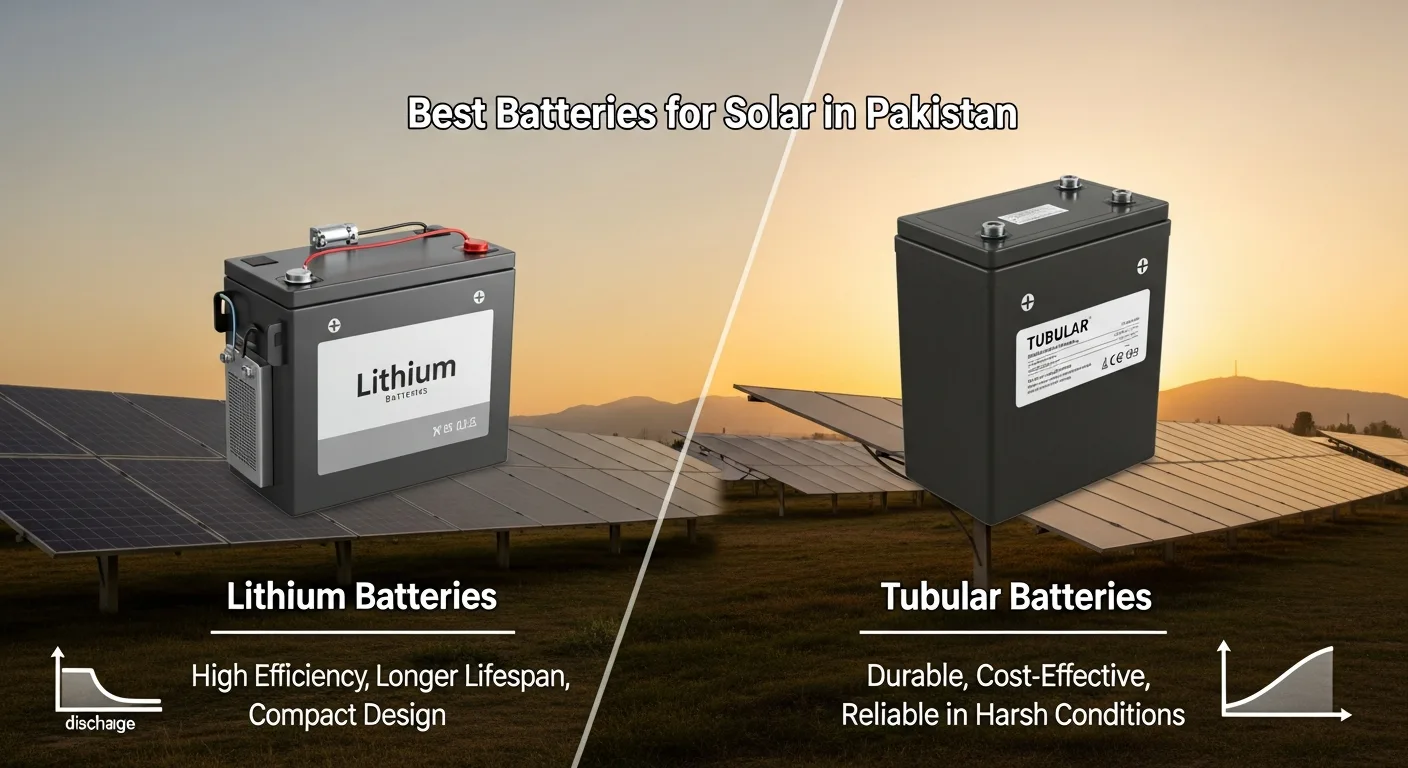
2. Tubular Lead-Acid Batteries (Most Popular in Pakistan)
What They Are: An evolved version of lead-acid technology using hollow “tubular” positive plates instead of flat plates. Much more durable than flat-plate while still using lead-acid chemistry.
Specifications:
- Voltage: 12V per unit (connect 2 for 24V, 4 for 48V systems)
- Capacity: 150–300Ah common (some up to 500Ah industrial)
- Cycle life: 1,200–1,500 cycles (roughly 4–7 years real-world)
- Efficiency: 85–90%
- Depth of discharge (DoD): 60–70% safe operating range
- Maintenance: Monthly water top-ups (many brands have water indicators), minimal terminal cleaning
- Temperature performance: Better than flat-plate; still degrades in extreme Pakistan heat but acceptable
- Charging time: 6–10 hours typical
Popular Capacities & Pricing (January 2026):
- 12V 150Ah: PKR 28,000–35,000 (AGS, Osaka, Phoenix, Exide)
- 12V 185Ah: PKR 35,000–45,000
- 12V 200Ah: PKR 40,000–52,000
- 12V 230Ah: PKR 50,000–68,000
- 12V 250Ah: PKR 55,000–75,000
- 12V 300Ah: PKR 70,000–95,000
Top Brands: ✅ AGS (Atlas Group) – Premium tubular, PKR 40,000–65,000 range, 1-year warranty ✅ Osaka – Most popular in Pakistan, PKR 38,000–62,000, trusted quality ✅ Phoenix – Budget-friendly tubular, PKR 36,000–58,000 ✅ Exide – Quality tubular, PKR 39,000–61,000 ✅ Ritar – Specialty solar tubular, PKR 42,000–68,000 ✅ Volta – Growing brand, PKR 37,000–60,000
Real-World Lifespan in Pakistan:
- 4–7 years with proper maintenance (water top-ups every 1–2 months)
- Capacity remains 85%+ until year 4–5, then degrades quickly
- Most users replace after 5–6 years when capacity drops below 75%
Pros: ✅ Proven reliability across Pakistan (most popular choice nationally) ✅ Affordable upfront (PKR 35,000–45,000 for quality brands) ✅ Widely available with local service networks ✅ Good cycle life (1,200–1,500 cycles = 4–7 years) ✅ Handles moderate deep cycling well ✅ Can be repaired/reconditioned if properly maintained ✅ Decent efficiency (85–90%, meaning less wasted energy) ✅ Tolerates Pakistan’s climate reasonably well
Cons: ❌ Requires monthly water top-ups (tedious maintenance) ❌ Acid handling hazard (spills, battery acid damage to concrete) ❌ Creates hydrogen gas (requires ventilation) ❌ Heavy (requires dedicated space) ❌ Efficiency still lower than lithium (losing 10–15% to heat) ❌ Short lifespan compared to lithium (need replacement every 5–7 years) ❌ Cannot be left fully discharged (degrades rapidly if DoD exceeds 80%)
Best For: → Budget-conscious Pakistani homeowners → 5–10 year investment horizon → Hybrid systems with predictable daily usage → Anyone willing to perform monthly maintenance
Verdict: BEST OVERALL VALUE for 90% of Pakistani homes. Tubular batteries strike the optimal balance between affordability, reliability, and lifespan. They’re proven to work in Pakistan’s climate and market infrastructure supports them everywhere.
3. Gel & AGM Batteries (Premium Lead-Acid)
What They Are: Advanced lead-acid batteries using gel or absorbed glass mat (AGM) technology instead of liquid electrolyte. The electrolyte is immobilized in gel or glass, making them spill-proof and maintenance-free.
Specifications:
- Voltage: 12V per unit
- Capacity: 100–250Ah typical
- Cycle life: 800–1,000 cycles (similar to basic tubular)
- Efficiency: 85–90%
- Depth of discharge (DoD): 50–60% (lower than tubular)
- Maintenance: ZERO—completely sealed, no water needed
- Temperature tolerance: Poor—must stay between 15–25°C
- Charging time: 8–12 hours
- Self-discharge: Low (good for seasonal storage)
Pricing:
- 12V 150Ah Gel: PKR 35,000–50,000
- 12V 200Ah Gel: PKR 45,000–65,000
- 12V 200Ah AGM: PKR 48,000–68,000
Pros: ✅ Completely maintenance-free (sealed design) ✅ Spill-proof and safe (no acid handling) ✅ Good for harsh vibration environments ✅ Low self-discharge (reliable after months of storage)
Cons: ❌ Higher upfront cost than tubular (PKR 10,000–20,000 premium) ❌ Poor temperature tolerance (Pakistan’s heat destroys them) ❌ Lower cycle life than tubular (worse value long-term) ❌ Cannot handle deep discharge as well as tubular ❌ Difficult to maintain optimal temperature in Pakistan ❌ NOT RECOMMENDED for Pakistan’s climate
Verdict: ❌ NOT RECOMMENDED FOR PAKISTAN. Gel batteries require 15–25°C operating temperature, which Pakistan’s climate (45–50°C summers) cannot provide. They’ll fail within 2–3 years in most Pakistani cities. The “maintenance-free” advantage doesn’t offset the temperature-related failures.
4. Lithium-Ion & LiFePO4 Batteries (Future Standard)
What They Are: Modern rechargeable batteries using lithium chemistry. Two main types: standard Li-ion (NMC, NCA) and LiFePO4 (LFP), which is safer and more durable. Revolutionary technology that’s making rapid price drops in Pakistan.
Key Specifications:
Standard Lithium-Ion (Li-ion NMC/NCA):
- Voltage: 48V systems typical (multiple cells in series/parallel)
- Capacity: 5–15 kWh typical for home systems
- Cycle life: 3,000–5,000 cycles (8–12 years real-world)
- Efficiency: 95–97% (nearly no energy wasted)
- Depth of discharge (DoD): 90–95% usable capacity
- Maintenance: ZERO
- Temperature tolerance: Better than lead-acid but sensitive to extremes
- Charging time: 2–4 hours (FAST)
- Built-in Battery Management System (BMS): Prevents overcharging, overheating, over-discharge
LiFePO4 (Lithium Iron Phosphate) – SAFEST VARIANT:
- Voltage: 48V systems standard
- Capacity: 5–20 kWh residential
- Cycle life: 4,000–6,000 cycles (10–15 years real-world)
- Efficiency: 95–97%
- Depth of discharge (DoD): 90% safe (can do 100% without damage)
- Maintenance: ZERO
- Temperature tolerance: Better than standard Li-ion; works up to 50°C with thermal protection
- Charging time: 2–3 hours
- Safety: Superior thermal stability; no thermal runaway risk
Popular Brands & Pricing in Pakistan:
Local/Asian Brands (More Affordable):
- Inverex Lithium (5kWh 48V): PKR 220,000–280,000
- Knox LiFePO4 (5kWh 48V): PKR 200,000–260,000
- Badar Energy (5kWh 48V): PKR 210,000–270,000
- CoreTECH (5kWh 48V): PKR 190,000–250,000
- Lantrun (5kWh 48V): PKR 200,000–265,000
Premium International Brands:
- Pylontech (5kWh 48V LiFePO4): PKR 280,000–350,000
- Huawei Battery System (5kWh 48V): PKR 300,000–400,000
- CATL (5kWh 48V): PKR 270,000–330,000
Real-World Lifespan in Pakistan:
- 8–12 years guaranteed by manufacturers
- Actual lifespan often exceeds 12 years with proper management
- Capacity remains 95%+ for first 8 years, then gradual decline
- Most users keep for 10+ years (no replacement needed during system life)
Pros: ✅ LONGEST LIFESPAN (10–15 years, covering entire solar system lifetime) ✅ ZERO maintenance (no water, no cleaning, no acid handling) ✅ HIGHEST efficiency (95–97% vs. 85% tubular = 10% better energy capture) ✅ FASTEST charging (2–4 hours vs. 8–10 hours tubular) ✅ MOST USABLE CAPACITY (90–95% DoD vs. 60% tubular) ✅ Built-in safety (thermal management, overcharge protection) ✅ No dangerous acid or hydrogen gas ✅ Compact and lightweight (easier installation) ✅ Enable peak shaving for maximum DISCO bill savings ✅ Prices dropping 15–20% annually (future-proof investment)
Cons: ❌ Higher upfront cost (PKR 200,000–400,000 vs. PKR 35,000–50,000 tubular) ❌ Requires compatible hybrid inverter (adds PKR 50,000–100,000) ❌ Sensitive to extreme temperatures (below 0°C or above 50°C reduces efficiency) ❌ Less local service network than lead-acid ❌ Overkill if only needed 5–7 years
Cost Analysis Over 20 Years (Realistic Comparison):
Option 1: Tubular Batteries
- Initial 2 × 200Ah batteries: PKR 90,000
- Replacement every 5 years: Batteries at years 5, 10, 15 = 3 replacements × PKR 90,000 = PKR 270,000
- Maintenance (water, terminal cleaning): PKR 200/month × 12 × 20 = PKR 48,000
- Total 20-year cost: PKR 408,000
- Total energy wasted (15% inefficiency × 20 years): Equivalent to PKR 120,000 in extra generation needed
Option 2: Lithium-Ion (Single PKR 250,000 investment)
- Initial investment: PKR 250,000
- Replacement: None needed (lasts 15+ years)
- Maintenance: Zero cost
- Total 20-year cost: PKR 250,000
- Total energy wasted (3% inefficiency × 20 years): Equivalent to PKR 20,000 in extra generation needed
- Net advantage: PKR 158,000 savings + superior efficiency = PKR 178,000 real value advantage
VERDICT: LITHIUM COSTS LESS OVER 20 YEARS despite higher upfront cost.
The Best Batteries for Solar in Pakistan: Final Rankings
After analyzing price, lifespan, performance, maintenance, and Pakistan-climate suitability, here’s the definitive ranking:
Tier 1: BEST OVERALL VALUE (For 90% of Pakistani Homes)
Winner: Tubular Lead-Acid Batteries (Quality Brands)
Recommended Setup: 2–4 × 200Ah 12V Tubular batteries (depending on system size)
Why:
- Perfect middle ground between cost and reliability
- 4–7 year lifespan matches typical financing timelines
- Proven performance across Pakistan’s climate
- Monthly water top-ups manageable for most users
- Service and replacement readily available nationwide
- ROI: Break-even in 3–4 years through electricity savings
Best Brands (In Order of Recommendation):
- AGS (Atlas Group) – Premium tubular, exceptional heat resistance, PKR 40,000–65,000, best warranty
- Osaka – Most popular, reliable, PKR 38,000–62,000, excellent local support
- Exide – Quality lead-acid heritage, PKR 39,000–61,000, trusted brand
- Ritar – Specialty solar batteries, PKR 42,000–68,000, optimized for cycles
- Phoenix – Budget option, PKR 36,000–58,000, acceptable quality
Tier 2: BEST LONG-TERM INVESTMENT (If Budget Permits)
Winner: LiFePO4 Lithium-Ion Batteries
Recommended Setup: Single 5–10kWh Lithium battery system with built-in BMS
Why:
- 10–15 year lifespan = no replacement during solar system lifetime
- 95–97% efficiency vs. 85% tubular = 10% more effective generation
- Zero maintenance for entire lifespan
- Fast charging (2–4 hours vs. 8–10 hours)
- Peak shaving optimization enables 20–30% extra bill savings
- Prices dropping 15–20% annually (invest early before prices rise after subsidies end)
- Pakistan-appropriate thermal management (LiFePO4 rated for 50°C+ operation)
Best Brands (In Order of Recommendation):
- Pylontech (South Korea) – Industry leader, LiFePO4 specialist, PKR 280,000–350,000
- Inverex (Pakistan) – Local availability, PKR 220,000–280,000, good warranty
- Huawei (China) – Enterprise-grade, scalable, PKR 300,000–400,000
- CATL (China) – Fast-growing, good quality, PKR 270,000–330,000
- CoreTECH (China) – Budget LiFePO4, PKR 190,000–250,000, emerging brand
Comparing Top Brands Head-to-Head
This comprehensive table shows why the brands listed above dominate Pakistan’s market:
| Brand | Type | Capacity | Price | Lifespan | Warranty | Pakistan Availability | Service Network | Verdict |
|---|---|---|---|---|---|---|---|---|
| AGS | Tubular | 150–300Ah | PKR 40–65K | 5–7 yrs | 1 year | Excellent | National | Top choice tubular |
| Osaka | Tubular | 150–250Ah | PKR 38–62K | 4–6 yrs | 1 year | Excellent | Excellent | Most popular |
| Exide | Tubular | 150–250Ah | PKR 39–61K | 5–7 yrs | 1 year | Excellent | Very good | Trusted brand |
| Ritar | Tubular | 200–300Ah | PKR 42–68K | 5–7 yrs | 2 years | Good | Good | Solar specialist |
| Phoenix | Tubular | 150–250Ah | PKR 36–58K | 4–6 yrs | 6 months | Excellent | Good | Budget option |
| Inverex | LiFePO4 | 5kWh 48V | PKR 220–280K | 10–12 yrs | 5 years | Excellent | National | Best local lithium |
| Pylontech | LiFePO4 | 5–15kWh | PKR 280–350K | 10–15 yrs | 10 years | Good | Growing | Premium choice |
| Knox | LiFePO4 | 5–10kWh | PKR 200–260K | 10–12 yrs | 5 years | Good | Good | Affordable lithium |
| CoreTECH | LiFePO4 | 5–10kWh | PKR 190–250K | 8–10 yrs | 3 years | Emerging | Limited | Budget lithium |
Complete Battery Sizing Guide for Pakistani Homes
Choosing the right capacity is critical. Too small = insufficient backup during load shedding. Too large = wasted money.
Step 1: Calculate Your Daily Energy Needs
Check your latest DISCO bill for monthly kWh consumption.
Example: Bill shows 300 units = 300 kWh per month
Daily average: 300 ÷ 30 = 10 kWh daily
Step 2: Determine Battery Backup Duration Needed
How many hours during load shedding do you need battery backup?
- 4 hours load shedding: Need 4 ÷ 24 = 16% daily capacity in batteries
- 6 hours load shedding: Need 6 ÷ 24 = 25% daily capacity
- 8 hours load shedding: Need 8 ÷ 24 = 33% daily capacity
- 12 hours load shedding: Need 12 ÷ 24 = 50% daily capacity
Step 3: Calculate Required Battery Capacity
Formula: Daily needs × Backup percentage ÷ Depth of Discharge = Battery capacity needed
Using 10 kWh daily, 8 hours load shedding, 60% DoD (safe for tubular):
- Needed = 10 × 0.33 ÷ 0.60 = 5.5 kWh
Step 4: Convert to Battery Specifications
Option A: Tubular Batteries
- 1 kWh ≈ 1 × 12V 200Ah battery (approximately)
- 5.5 kWh ≈ 6 × 12V 200Ah batteries needed
- Typical installation: 4 × 12V 200Ah in series for 48V system (19.2 kWh capacity)
- Cost: 4 × PKR 45,000 = PKR 180,000
Option B: Lithium-Ion
- Single 5kWh LiFePO4 battery provides desired capacity
- Cost: PKR 220,000–280,000
- Advantage: Takes 1/20th the space, zero maintenance
Real-World Sizing Examples
Small Home (250 kWh/month)
- Daily needs: 8.3 kWh
- For 6 hours backup (25% capacity): Need ~3.5 kWh
- Tubular recommendation: 3–4 × 12V 200Ah (PKR 135,000–180,000)
- Lithium recommendation: 1 × 5kWh LiFePO4 (PKR 220,000–280,000)
Average Home (400 kWh/month)
- Daily needs: 13.3 kWh
- For 8 hours backup (33% capacity): Need ~7.3 kWh
- Tubular recommendation: 4–5 × 12V 200Ah (PKR 180,000–225,000)
- Lithium recommendation: 1–2 × 5kWh LiFePO4 (PKR 450,000–560,000 for 10kWh)
Large Home (700+ kWh/month)
- Daily needs: 23.3 kWh
- For 12 hours backup (50% capacity): Need ~19.4 kWh
- Tubular recommendation: 8–10 × 12V 200Ah (PKR 360,000–450,000)
- Lithium recommendation: 2–3 × 5kWh LiFePO4 (PKR 675,000–900,000)