
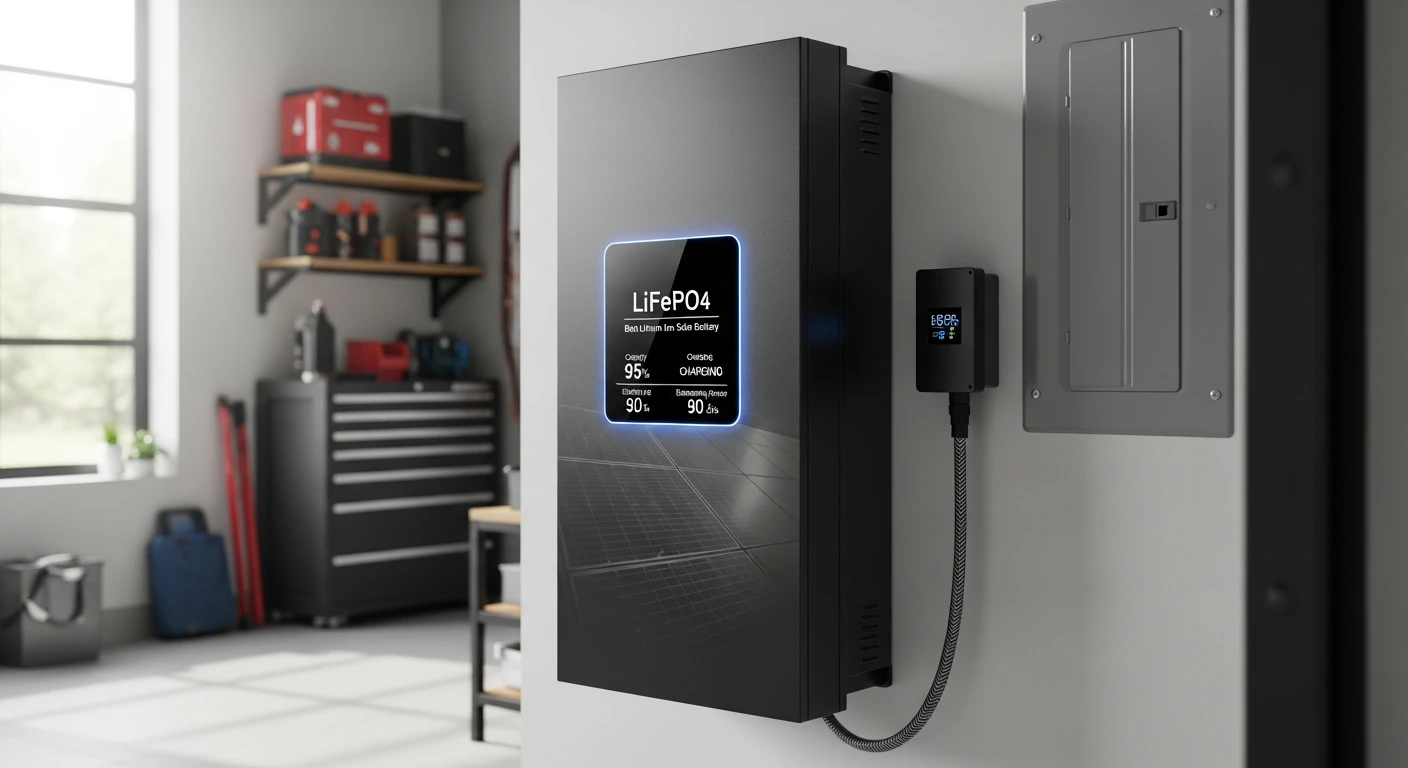
Finding the Best Lithium Ion Solar Battery is one of the most important decisions you’ll make when installing a solar power system. Whether you’re facing Pakistan’s frequent power outages or seeking complete energy independence, the right battery storage can transform your solar investment from a daytime-only solution into a 24/7 energy powerhouse.
This comprehensive guide reviews the Best Lithium Ion Solar Battery currently available in Pakistan, explains the technology behind them, compares leading brands, and provides pricing data updated for January 2026. By the end, you’ll understand exactly which lithium ion solar battery matches your needs and budget—without wasting money on features you don’t need or settling for inferior technology.
What Makes a Lithium Ion Solar Battery the “Best”?
Before diving into specific brands and models, let’s clarify what separates exceptional lithium ion solar batteries from mediocre ones. If you have a small roof or limited space, a 1kW setup is the perfect entry point. You can find the latest 1000W Solar Panel Price in Pakistan 2026 in our updated pricing guide to see how affordable starting with solar can be.
Core Performance Metrics
1. Cycle Life (Charge-Discharge Cycles)
The number of complete charge-discharge cycles a battery can endure before capacity degrades to 80% is critical for long-term value.
- Exceptional: 4,000–6,000+ cycles (10–15 years of daily use)
- Good: 2,000–4,000 cycles (5–10 years of daily use)
- Poor: Under 2,000 cycles (less than 5 years)
A battery with 5,000 cycles at 100% depth of discharge will outlast one with 2,000 cycles at 80% depth of discharge, making total usable energy the real measure of longevity.
2. Depth of Discharge (DoD)
DoD indicates what percentage of stored energy you can safely use without harming the battery.
- 100% DoD: Use all stored energy; ideal for off-grid systems
- 80–90% DoD: Use 80–90% of stored energy; balanced approach
- 50% DoD: Use only half the energy; conservative, extends lifespan
The Best Lithium Ion Solar Battery allow 100% DoD without significantly reducing cycle life, unlike lead-acid batteries that require 50% DoD conservative use.
3. Round-Trip Efficiency
This measures how much energy you recover after storing it. Superior batteries achieve 95%+ efficiency, meaning you lose less than 5% of energy in storage and retrieval processes. This matters significantly for monthly cost calculations.
4. Temperature Performance
The Best Lithium Ion Solar Battery operate reliably across Pakistan’s extreme temperature ranges, from Lahore’s freezing winters (0°C) to Karachi’s scorching summers (50°C). Look for batteries rated for -20°C to +60°C operation.
5. Battery Management System (BMS)
An intelligent BMS protects against overcharge, over-discharge, temperature extremes, and short circuits. Advanced BMS technology includes cell balancing, remote monitoring via mobile app, and predictive maintenance alerts.
LiFePO4 vs Other Lithium Ion Battery Types
Lithium Iron Phosphate (LiFePO4) – The Clear Winner for Solar
Why LiFePO4 dominates solar energy storage:
LiFePO4 batteries have become the industry standard for solar applications, capturing 90%+ of the residential solar battery market in Pakistan and globally. Here’s why:
Safety Advantages:
- No thermal runaway risk (critical safety issue with NMC/NCA batteries)
- Non-toxic, cobalt-free composition
- Safe for homes with children, pets, and in confined spaces
- Excellent fire resistance due to stable chemistry
Performance Advantages:
- 10–15 year lifespan with daily use (vs. 5–7 years for NMC)
- 4,000–6,000 charge-discharge cycles at 100% depth of discharge
- Maintains 80%+ capacity after a decade
- Excellent low-temperature performance (critical for winter in northern Pakistan)
- Consistently stable voltage output throughout discharge cycle
Economic Advantages:
- Lowest total cost of ownership despite higher upfront price
- Minimal maintenance (completely maintenance-free)
- No need for environmental monitoring systems
- Recyclable and increasingly supported by emerging programs
Environmental Advantages:
- No toxic cobalt mining required
- Fully recyclable chemistry
- Longer lifespan reduces e-waste
NMC/NCA Lithium Ion Batteries
Characteristics:
- Higher energy density than LiFePO4 (more energy in same weight/space)
- Used in electric vehicles and consumer electronics
- Lower upfront cost (10–20% cheaper)
- Risk of thermal runaway under certain conditions
Why not for solar: Shorter lifespan (5–7 years), safety concerns, higher maintenance needs, and total cost of ownership often exceeds LiFePO4 despite lower initial price. Not recommended for residential solar in Pakistan.
Lithium Titanate (LTO) Batteries
Characteristics:
- Extremely fast charging and discharging
- Ultra-long cycle life (20,000+ cycles)
- Exceptional cold-weather performance (-50°C capable)
- Very expensive and bulky
Why not for solar: Cost is prohibitive for residential use; ultra-fast charging capability unnecessary for solar applications. Better suited to specialized industrial applications.
Lithium Polymer Batteries
Characteristics:
- Flexible, thin design
- Used in consumer electronics (phones, tablets)
- Shorter cycle life (500–1,000 cycles)
- Lower energy density
Why not for solar: Insufficient cycle life for residential solar; designed for portable electronics, not stationary energy storage.
Best Lithium Ion Solar Battery Brands in Pakistan (2026)
Tier-1 International Brands
1. LiFePO4 by BYD – Premium Choice for Large Systems
Why it’s best:
- World’s largest battery manufacturer by volume
- Advanced cell technology with consistent quality
- Extensive local distributor network in Pakistan
- 10+ year presence in Pakistani market with proven reliability
Available Models in Pakistan:
- BYD LVH-48100: 48V, 100Ah (5.12kWh)
- BYD LVL-48050: 48V, 50Ah (2.56kWh)
Pakistani Pricing (January 2026):
- BYD 48V 100Ah: PKR 240,000–280,000
- Warranty: 10 years, 6,000 cycles minimum
- Round-trip Efficiency: 95%+
- Temperature Range: -20°C to +50°C
Best For: Commercial installations, large homes, industrial backup, microgrid systems Local Support: Excellent distributor network; available in Karachi, Lahore, Islamabad Pros: Proven technology, exceptional reliability, scalable solutions, excellent BMS Cons: Highest price point; requires professional installation
2. Pylontech UF5000 & US5000 – Premium Modular Solution
Why it’s best:
- Modular design allows easy expansion from 5.12kWh to 20kWh+
- Advanced BMS with APP monitoring
- Excellent customer support network in Pakistan
- Specifically optimized for hybrid solar systems with popular inverters
Available Models in Pakistan:
- Pylontech US5000: 48V, 100Ah (5.12kWh) wall-mounted
- Pylontech UF5000: 48V, 100Ah (5.12kWh) floor-standing
- Pylontech UP2500: 24V (2.56kWh) low voltage option
Pakistani Pricing (January 2026):
- Pylontech US5000/UF5000: PKR 248,000–295,000
- Pylontech UP2500: PKR 140,000–160,000
- Warranty: 10 years, 6,000 cycles
- Temperature Range: -20°C to +50°C
Best For: Expandable home systems, hybrid solar setups, smart home integration Local Support: Authorized distributors in major cities; excellent technical support Pros: Modular, intelligent BMS, smartphone app control, flexible installation Cons: Requires compatible hybrid inverter; integration complexity for some installers.
While a single plate is affordable, most homeowners start with at least two panels to build a 1kW array. Check out the current 1000W Solar Panel Price in Pakistan 2026 to see the full cost of a starter system.
3. Narada LV48200 – Affordable Premium Option
Why it’s best:
- Excellent price-to-performance ratio
- Proven reliability in tropical/subtropical climates (perfect for Pakistan)
- Competitive cycle life with lower price than BYD
- Local technical support through authorized dealers
Available Models in Pakistan:
- Narada LV48200: 48V, 200Ah (9.6kWh) rack-mounted
- Narada LV48100: 48V, 100Ah (4.8kWh) rack-mounted
Pakistani Pricing (January 2026):
- Narada 48V 100Ah: PKR 220,000–260,000
- Narada 48V 200Ah: PKR 400,000–480,000
- Warranty: 10 years, 5,000 cycles
- DoD: 80–100% usable capacity
Best For: Budget-conscious large installations, commercial solar, industrial backup Local Support: Available through authorized dealers nationwide Pros: Competitive pricing, proven tropical climate performance, good warranty Cons: Rack-mounted only (requires space); less modular than competitors
Tier-2 Reliable Mid-Range Brands
4. Knox Lithium Batteries – Pakistani Assembly Advantage
Why it’s worth considering:
- Locally assembled with international-grade cells
- Excellent after-sales service and warranty support
- Compatible with popular Pakistani inverter brands (Inverex, Voltronic, Must)
- Significantly lower cost due to local assembly
Available Models:
- Knox 48V 100Ah: (4.8–5.12kWh depending on variant)
- Knox 24V 100Ah: (2.4–2.56kWh)
Pakistani Pricing (January 2026):
- Knox 48V 100Ah: PKR 180,000–220,000
- Knox 24V 100Ah: PKR 100,000–140,000
- Warranty: 7–10 years depending on package
- Cycle Life: 3,000–4,000 cycles
Best For: Residential solar systems, tight budgets, locally-supported installations Local Support: Excellent; authorized service centers nationwide Pros: Affordable, local assembly, compatible with popular inverters, good support Cons: Fewer features than premium imports; smaller company (less track record)
5. Dyness BX51100 – Chinese Quality at Competitive Price
Why it’s worth considering:
- Excellent value with proven reliability
- Compact design suitable for space-limited installations
- Advanced BMS with temperature management
- Growing distributor network in Pakistan
Available Models:
- Dyness BX51100: 51.2V, 100Ah (5.12kWh)
- Dyness LV48100: 48V, 100Ah (4.8kWh)
Pakistani Pricing (January 2026):
- Dyness BX51100: PKR 200,000–250,000
- Warranty: 10 years, 5,000 cycles
- Usable Capacity: 90–100% DoD
Best For: Residential systems, space-limited installations, mid-budget buyers Local Support: Growing distributor network in major cities Pros: Affordable, compact design, excellent BMS, good warranty Cons: Smaller local support network compared to BYD/Pylontech
6. MaxPower MP10000 Pro – Emerging Pakistani Brand
Why it’s worth considering:
- Purpose-designed for Pakistani climate conditions
- Excellent local technical support
- Competitive pricing for Tier-1 quality
- Hybrid inverter compatibility verified with local systems
Available Models:
- MaxPower MP10000 Pro: Large capacity system
- MaxPower MP5000 Pro: Mid-range option
- MaxPower MP2500: Compact option
Pakistani Pricing (January 2026):
- MaxPower MP5000 Pro: PKR 200,000
- MaxPower MP10000 Pro: PKR 440,000
- Warranty: 10 years
- Cycles: 4,000–5,000
Best For: Budget-conscious installations, local support preference Local Support: Excellent; designed specifically for Pakistan market Pros: Competitive pricing, Pakistan-optimized, good warranty Cons: Limited international recognition; fewer customer reviews compared to established brands
Budget-Friendly Options (Not Recommended)
LiTime 12V/24V Modular Batteries
While popular for off-grid RVs and boats, small LiTime 12V 100Ah batteries (PKR 40,000–60,000 per unit) require stacking multiple units for home solar systems, creating installation complexity and higher total costs. Better to buy a single integrated 48V system from tier-2 brands than to stack multiple low-voltage units.
Price Comparison: Complete 2026 Matrix for Pakistan
| Battery Brand & Model | Capacity | Voltage | Cycle Life | DoD | Pakistani Price Range | Warranty |
|---|---|---|---|---|---|---|
| BYD LVH-48100 | 5.12kWh | 48V | 6,000 | 100% | PKR 240,000–280,000 | 10 years |
| Pylontech US5000 | 5.12kWh | 48V | 6,000 | 100% | PKR 248,000–295,000 | 10 years |
| Narada LV48100 | 4.8kWh | 48V | 5,000 | 100% | PKR 220,000–260,000 | 10 years |
| Dyness BX51100 | 5.12kWh | 51.2V | 5,000 | 90% | PKR 200,000–250,000 | 10 years |
| Knox 48V 100Ah | 4.8–5.12kWh | 48V | 4,000 | 80–100% | PKR 180,000–220,000 | 7–10 years |
| MaxPower MP5000 Pro | ~5kWh | 48V | 4,500 | 80% | PKR 200,000 | 10 years |
| Pylontech UP2500 (low voltage) | 2.56kWh | 24V | 6,000 | 100% | PKR 140,000–160,000 | 10 years |
| Crown CMLB-51.2 | Variable | 48V–51.2V | 3,000–4,000 | 80% | PKR 400,000–557,000 (large) | 8 years |
Capacity Calculator: Choosing the Right Size
Determine Your Daily Energy Needs
Step 1: Calculate your average daily consumption
Review your electricity bills for 3–6 months and calculate average monthly units (kWh), then divide by 30 days.
Example Calculations:
Small Home (3–4 rooms):
- Monthly consumption: 150–200 kWh
- Daily average: 5–6.7 kWh
- Recommended battery: 5.12kWh (one Pylontech/BYD unit)
- Daily solar generation covers 2.5–3 kWh → battery fills 2–3 kWh for night use
Medium Home (4–6 rooms):
- Monthly consumption: 300–400 kWh
- Daily average: 10–13.3 kWh
- Recommended battery: 10.24kWh (two 5.12kWh units stacked)
- Daily solar generation covers 5–6 kWh → battery fills 4–6 kWh for night use
Large Home/Commercial:
- Monthly consumption: 500+ kWh
- Daily average: 16+ kWh
- Recommended battery: 15–20kWh (three or more units)
- May require additional solar panel capacity
Realistic Backup Duration
A 5.12kWh battery with 100% DoD and 95% efficiency provides approximately:
- 1.5–2 hours: Full home power (3–4 kW loads like AC)
- 4–6 hours: Essential appliances only (lights, fans, fridge, TV)
- 8–12 hours: Minimal load (just lights and fans)
- Overnight coverage: Complete (7–8 PM to 6–7 AM)
Pro Tip: Most Pakistani homes should not expect 24/7 battery backup without significantly oversizing the system. Instead, design systems for overnight coverage (8–10 hours) plus daytime solar generation for complete daily energy needs.
Best Lithium Ion Solar Battery by Application
Residential Grid-Tied with Backup
Best Choice: Pylontech US5000 (if expandable future) or Narada LV48100 (if budget-conscious)
Why:
- Sufficient overnight backup (8–10 hours)
- Modular for future expansion
- Compatible with net metering in Pakistan
- Local support and warranty
System Cost: Battery + hybrid inverter + installation: PKR 350,000–500,000 Payback Period: 5–7 years through electricity savings + backup value
Off-Grid/Remote Cabin
Best Choice: BYD LVH-48100 or Pylontech US5000
Why:
- Maximum cycle life ensures 10+ years reliable daily use
- 100% DoD critical for off-grid applications
- Superior low-temperature performance (for northern Pakistan)
- Robust BMS handles variable solar generation
System Cost: Battery + hybrid inverter + solar panels + installation: PKR 500,000–800,000 Expected Output: 5–8 years minimum to full payback
Load-Shedding Protection (Pakistan Standard Use Case)
Best Choice: Knox 48V 100Ah or MaxPower MP5000 Pro
Why:
- Costs 20–30% less than premium imports
- Sufficient for 6–8 hours evening backup
- Excellent local support for warranty/repairs
- Compatible with locally popular inverters
System Cost: Battery + hybrid inverter + installation: PKR 280,000–400,000 Value Proposition: Most cost-effective for Pakistan’s typical 4–6 hour evening load-shedding
Commercial/Industrial Backup
Best Choice: BYD LVH-48100 or Narada LV48100/200Ah
Why:
- Proven reliability for continuous operation
- Excellent scalability for multiple units
- Lower total cost of ownership through extended lifespan
- Supported by major commercial inverter brands
System Cost: Battery + commercial inverter + installation: PKR 600,000–1,200,000+ Return on Investment: 4–6 years through reduced downtime and productivity losses
Complete System Cost Breakdown (January 2026)
Minimum Battery-Only Installation
5.12kWh Pylontech US5000 Package:
- Battery unit: PKR 248,000–295,000
- Installation labor: PKR 10,000–15,000
- Wiring and safety equipment: PKR 5,000–8,000
- Basic warranty registration: Included
- Total: PKR 263,000–318,000
Maintenance: Keeping Your Battery Healthy
Monthly Tasks (Homeowner)
- Monitor battery voltage and state of charge via inverter display
- Check for any physical damage or corrosion
- Ensure battery ventilation is not blocked
- Note any error codes or unusual sounds
Estimated Time: 5–10 minutes
Annual Professional Inspection
- Complete system health diagnostic (PKR 5,000–8,000)
- BMS firmware update if available
- Safety system verification
- Documentation of capacity degradation
Estimated Time: 2–3 hours Cost: PKR 5,000–8,000 annually
Avoid These Common Mistakes
- Never attempt to repair the battery yourself – BMS systems are complex; improper repair voids warranty and creates safety hazards
- Don’t expose to extreme temperatures – Ensure proper ventilation; avoid direct sunlight on battery enclosures
- Avoid overcharging from mismatched inverters – Always use compatible, well-programmed inverters
- Don’t ignore firmware updates – BMS improvements and safety patches should be installed when available
Financial Benefits & ROI Calculation
Monthly Savings Example (Pakistan)
Assumptions:
- 5.12kWh battery system stores daily solar generation
- Electricity rate: PKR 28 per unit (average across Pakistan)
- Average home uses 150 units monthly (5 kWh daily)
- System covers 60% of daily needs (80% efficiency)
Calculation:
- Daily solar generation stored: 3 kWh × 0.95 efficiency = 2.85 kWh usable
- Monthly savings: 2.85 kWh × 30 days × PKR 28 = PKR 2,394
- Annual savings from battery: PKR 28,728
Plus Load-Shedding Avoidance:
- Pakistan’s average family spends PKR 50,000–80,000 annually on generators
- Battery system eliminates generator use = PKR 50,000–80,000 saved
- Total Annual Savings: PKR 78,728–108,728
Break-Even Analysis
System Investment: PKR 450,000 (5.12kWh + inverter + installation)
Break-Even Period:
- Conservative (PKR 30,000 annual savings): 15 years
- Realistic (PKR 80,000 annual savings): 5.6 years
- Optimistic (PKR 100,000 annual savings): 4.5 years
10-Year Total Savings: PKR 300,000–1,000,000 (depending on load-shedding duration and electricity rates)
Comparison: Lithium Ion vs Lead-Acid Batteries
| Feature | Lithium Ion (LiFePO4) | Lead-Acid (Tubular/AGM) |
|---|---|---|
| Lifespan | 10–15 years | 3–5 years |
| Cycle Life | 4,000–6,000 | 400–800 |
| Depth of Discharge | 100% | 50% (recommended) |
| Maintenance | None | Monthly water refill, cleaning |
| Initial Cost | PKR 200,000–300,000 (5kWh) | PKR 60,000–100,000 (5kWh) |
| Total 10-Year Cost | PKR 300,000–400,000 | PKR 400,000–600,000+ |
| Round-Trip Efficiency | 95%+ | 80–85% |
| Temperature Range | -20°C to +60°C | -10°C to +40°C |
| Weight | 60–80 kg | 200–300 kg |
| Installation Complexity | Simple (BMS managed) | Requires ventilation, monitoring |
Verdict: For residential solar in Pakistan, lithium ion batteries deliver superior long-term value despite higher initial cost. They eliminate maintenance hassles, provide better performance in Pakistan’s climate, and achieve payback in 4–7 years.
Future Trends in Battery Technology (2026 and Beyond)
Solid-State Batteries
Emerging technology promising 50% higher energy density and improved safety through solid electrolytes instead of liquid. Timeline to market: 2027–2030 for commercial use.
Impact on current purchases: Current lithium batteries will remain optimal choice through 2026; solid-state prices will likely exceed today’s premium batteries initially.
Sodium-Ion Batteries
Lower cost alternative using abundant sodium instead of lithium. Potential savings: 20–30% cost reduction once mass production begins.
Timeline to market: 2027–2030 for commercial residential use.
Impact on current purchases: Worth monitoring, but lithium ion remains superior for now; sodium-ion less suitable for high-temperature Pakistan climate.
AI-Powered Battery Management
Next-generation BMS using artificial intelligence to optimize charging patterns, predict maintenance needs, and extend battery life by 10–20%.
Impact: 2026–2027 adoption; existing batteries can sometimes receive software updates for modest improvements.
Virtual Power Plants (VPP)
Pakistan’s utilities exploring programs where residential batteries collectively provide grid stability during peak demand, with homeowners receiving additional compensation.
Potential Impact: Could add PKR 10,000–20,000 annual income in participating areas by 2027–2028.


Pingback: Solar Battery Price Guide 2026 in Pakistan – Top Brands