
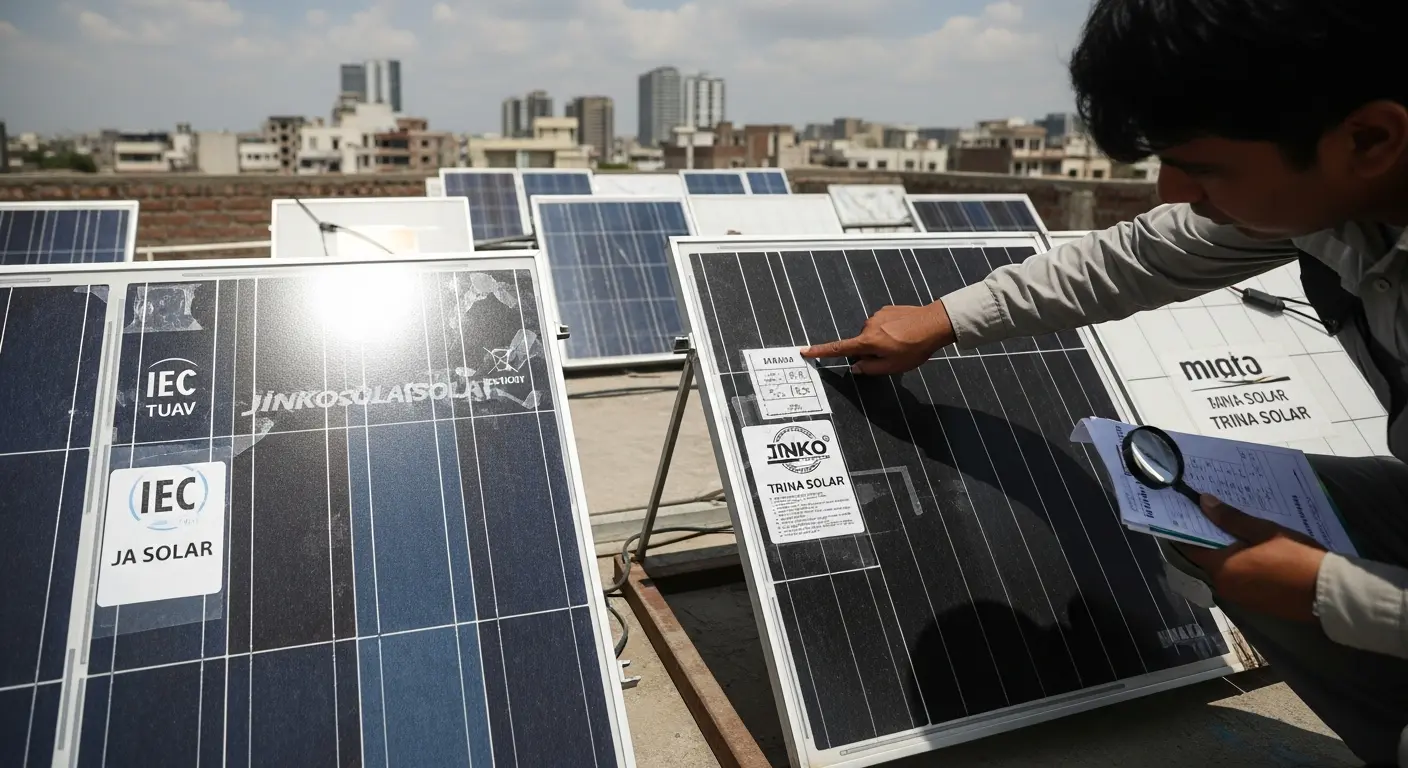
Buying solar panels is a major investment—often PKR 500,000 to 1,500,000 for a complete home system. But here’s the scary truth: Pakistan’s booming solar market is flooded with counterfeit panels that look identical to genuine ones. These fake panels can fail within months, produce 30-50% less power, void your warranty, and even pose fire hazards.
So How to Identify Original Solar Panels in Pakistan before you hand over your hard-earned money? This comprehensive guide reveals the exact verification methods, visual inspection techniques, and authentication tools that protect you from fake solar panels. Whether you’re buying Longi, Jinko, Canadian Solar, or any other brand, you’ll learn the insider secrets that separate genuine Tier-1 panels from dangerous counterfeits.
Why Identifying Original Solar Panels Matters
How to Identify Original Solar Panels in Pakistan, Before diving into verification methods, let’s understand what’s at stake when you unknowingly purchase counterfeit solar panels.
The Real Cost of Fake Solar Panels
Financial Losses:
- Initial investment wasted: PKR 150,000-500,000+ for fake panels that fail early
- Reduced electricity generation: 30-50% lower output means higher grid bills
- Replacement costs: PKR 100,000-300,000 to replace fake panels after 2-5 years
- Voided warranties: Zero manufacturer support when panels fail
- Total 25-year loss: PKR 500,000-1,500,000 compared to genuine panels
Safety Hazards:
- Fire risk from substandard electrical components
- Roof damage from poor-quality mounting points
- Electrical shock hazards during maintenance
- Insurance claims denied due to non-certified equipment
Performance Problems:
- Actual output 40-60% below rated capacity
- Rapid degradation (5-10% annually vs 0.5% for genuine panels)
- Mismatched electrical characteristics causing system failures
- Incompatibility with inverters and other components
According to market reports, over 15% of solar panels in Pakistan fail manufacturer verification—meaning 1 in 6 buyers unknowingly purchased counterfeit or unauthorized products. Don’t become a statistic.
Understanding Solar Panel Grading and Authenticity
Not all non-genuine panels are “fake”—understanding the difference helps you make informed decisions.
A-Grade vs B-Grade vs Counterfeit Panels
A-Grade Original Panels (What You Want):
- Factory-fresh with zero defects
- Full manufacturer warranty (12-25 years product, 25-30 years performance)
- Complete documentation with verifiable serial numbers
- Passed all quality control tests
- Price: PKR 27-40 per watt
B-Grade Panels (Legitimate but Reduced Quality):
- Cosmetic defects (scratches, chips, color variations)
- Electrically functional but no full warranty
- Documented by manufacturer as B-Grade
- Honest dealers disclose grade status
- Price: PKR 20-28 per watt
Counterfeit Panels (Completely Fake):
- Unauthorized copies of branded panels
- Zero quality control or safety testing
- Fake serial numbers or missing documentation
- No manufacturer connection whatsoever
- Price: PKR 12-22 per watt (suspiciously cheap)
C-Grade/D-Grade Panels (Avoid at All Costs):
- Cracked cells or severe defects
- Water damage or delamination
- Refurbished or salvaged components
- Potential electrical hazards
The key difference: B-Grade panels are legitimate manufacturer products with cosmetic flaws, while counterfeit panels are illegal copies with no manufacturer connection. Both should be avoided for permanent residential installations, but B-Grade at least has some quality baseline.
How to Identify Original Solar Panels: 10 Proven Methods
Let’s dive into the exact verification techniques that expose counterfeit solar panels.
Method #1: Serial Number Verification (Most Reliable)
Every genuine solar panel has a unique serial number that can be verified through the manufacturer’s official database. This is your single most powerful authenticity check.
Where to Find the Serial Number:
- Primary location: Back of panel near junction box
- Secondary location: On the panel frame edge
- Also printed on: Original packaging and warranty card
Step-by-Step Serial Number Verification:
For Longi Solar Panels:
- Locate serial number on panel back (barcode label)
- Visit: https://www.longi.com/en/modules-authenticity/
- Enter the product barcode number from front AND back of panel
- Submit for instant verification
- Result shows: Production date, model, authenticity status
- Pakistan support email: LONGicare.pakistan@longi.com
For Jinko Solar Panels:
- Find 24-digit serial number (starts with “JINKO”)
- Visit: https://cs.jinkosolar.com/app/index.html#/customer-complaint/authenticity
- Select “Pakistan” from country dropdown
- Enter serial number from panel back
- Enter verification code shown
- Click verify for instant authentication
- Result confirms: Warranty eligibility, production date, sales region
For Canadian Solar Panels:
- Locate serial number on panel frame or back sheet
- Visit: Canadian Solar official website authentication portal
- Enter serial number exactly as printed
- Submit verification request
- System confirms: Authenticity, production batch, model details
- Register warranty after confirmation
For JA Solar Panels:
- Find product code or serial number on back label
- Visit: https://product.jasolar.com/en.html
- Enter serial number in verification field
- System validates: Originality, model specifications
- Confirms warranty coverage
For Trina Solar Panels:
- Locate serial number on back of module
- Visit Trina Solar official website verification page
- Enter module serial number
- Verify authenticity status instantly
For Astronergy Solar Panels:
- Find serial number on panel back
- Visit Astronergy official verification tool
- Input serial number for authentication
- Receive confirmation of genuine product
Red Flags During Serial Number Check: 🚩 Serial number not found in manufacturer database 🚩 Serial number format doesn’t match brand standards 🚩 Seller refuses to provide serial number before purchase 🚩 Serial number handwritten instead of printed 🚩 Multiple panels with identical serial numbers 🚩 Verification shows different model than panel label
Pro Tip: Always verify serial numbers BEFORE finalizing payment. Reputable dealers welcome verification and will wait while you check. Dishonest sellers make excuses or pressure immediate purchase.
Method #2: Visual Inspection Checklist
Authentic solar panels have distinctive quality markers that counterfeits can’t replicate cost-effectively.
Glass and Surface Quality:
✓ Genuine Panels:
- Flawless tempered glass with uniform coating
- Anti-reflective coating appears consistent
- No scratches, chips, or surface imperfections
- Glass feels smooth and substantial (4-5mm thickness)
✗ Counterfeit Warning Signs:
- Surface scratches visible at angles
- Glass appears thin or fragile
- Uneven or patchy anti-reflective coating
- Edge chips or rough glass edges
Solar Cell Alignment and Quality:
✓ Genuine Panels:
- Perfect cell alignment in rows and columns
- Uniform cell color (deep blue or black)
- Clean, precise gaps between cells (2-3mm)
- No visible cracks, chips, or discoloration
- Soldering ribbons perfectly straight and centered
✗ Counterfeit Warning Signs:
- Misaligned cells (crooked rows)
- Color variations between cells
- Visible cell cracks or chips
- Wavy or poorly soldered ribbons
- Foreign particles visible inside (debris, dust)
Frame and Construction:
✓ Genuine Panels:
- Solid aluminum frame with smooth edges
- Corner joints precisely machined and sealed
- Drainage holes present at specific locations
- No dents, scratches, or manufacturing defects
- Frame thickness consistent (35-45mm)
✗ Counterfeit Warning Signs:
- Thin or lightweight frame
- Rough edges or poor welding
- Frame dents or visible damage
- Missing drainage holes
- Cheap-feeling metal construction
Junction Box Quality:
✓ Genuine Panels:
- Heavy-duty junction box with proper sealing
- IP67 or IP68 rating clearly marked
- Brand name embossed on junction box
- High-quality MC4 connectors pre-attached
- Proper cable management and strain relief
✗ Counterfeit Warning Signs:
- Flimsy plastic junction box
- No IP rating markings
- Generic junction box without branding
- Loose or poorly attached connectors
- Exposed wiring or poor cable routing
Back Sheet Inspection:
✓ Genuine Panels:
- Clean white or black back sheet
- No discoloration, yellowing, or bubbles
- Labels perfectly printed with sharp text
- Weatherproof material that feels durable
✗ Counterfeit Warning Signs:
- Yellow spots or staining
- Peeling or bubbling lamination
- Blurry or poorly printed labels
- Thin, cheap-feeling back sheet material
Method #3: Documentation and Certification Verification
Required Documentation for Original Panels:
1. Product Datasheet:
- Official manufacturer document
- Technical specifications: voltage, current, power output
- Temperature coefficients and efficiency ratings
- Physical dimensions and weight
- Download from manufacturer website and compare
2. Warranty Certificate:
- Product warranty: 10-25 years
- Performance warranty: 25-30 years at 80%+ output
- Signed and stamped by authorized dealer
- Warranty registration instructions included
- Serial number matches panel
3. Test Certificate (IEC Certifications):
- IEC 61215: Design qualification and type approval
- IEC 61730: Safety qualification
- CE Certification: European safety standards
- TUV Certification: German technical inspection
- UL Certification: Underwriters Laboratories (US standard)
- RoHS Compliance: Restriction of hazardous substances
4. Tier-1 Bloomberg Certification:
- Bloomberg New Energy Finance Tier-1 list
- Indicates bankable, financially stable manufacturer
- Check current Tier-1 list: Longi, Jinko, Canadian, Trina, JA Solar all included
How to Verify Certifications:
Check Certificate Authenticity:
- Request high-resolution photos of all certificates
- Look for official logos, signatures, dates
- Cross-reference certificate numbers with issuing bodies
- Visit issuer websites (TUV, UL, etc.) to verify certificates
- Check validity dates—expired certificates are red flags
Red Flag Certificates: 🚩 Photocopied or blurry certificates 🚩 Missing certificate numbers or dates 🚩 Certificates from unknown organizations 🚩 “In-house” certifications (not recognized internationally) 🚩 Certificates that can’t be verified online
Method #4: Packaging and Presentation
Original Panel Packaging:
✓ What to Expect:
- Heavy-duty cardboard boxes with brand logos
- Corner protectors (foam or plastic guards)
- Individual panels wrapped in protective film
- Proper pallet stacking with straps
- Shipping labels with tracking information
- Handling instructions printed on boxes
- Bar codes and batch numbers visible
✗ Counterfeit Packaging Signs:
- Generic brown boxes without branding
- Loose or minimal protective wrapping
- Panels stacked without corner protection
- Rewrapped or tampered packaging
- Missing handling instructions
- No batch numbers or tracking labels
Label Quality Check:
Genuine Label Characteristics:
- Professional printing with sharp text
- Weather-resistant material
- Includes: model number, wattage, voltage, current
- Serial number clearly printed (not handwritten)
- Certifications logos (CE, TUV, IEC)
- QR code for authenticity verification
- Brand logo with correct colors and fonts
Counterfeit Label Giveaways:
- Blurry or poorly printed text
- Handwritten specifications or serial numbers
- Misspelled words or grammar errors
- Incorrect brand logo (wrong colors, fonts)
- Missing certification logos
- No QR code or barcode
- Label easily peels off or is loosely attached
Method #5: Price Reality Check
Current Market Prices in Pakistan (February 2026):
| Brand | Genuine A-Grade Price | Suspiciously Low Price (Likely Fake) |
|---|---|---|
| Longi Solar (580W N-Type) | PKR 32-40/watt | Below PKR 24/watt |
| Jinko Solar (580W N-Type) | PKR 30-34/watt | Below PKR 22/watt |
| Canadian Solar (580W TOPCon) | PKR 31-36/watt | Below PKR 23/watt |
| JA Solar (550W Mono) | PKR 27-31/watt | Below PKR 20/watt |
| Trina Solar (580W N-Type) | PKR 31-35/watt | Below PKR 23/watt |
Price Red Flags: 🚩 Prices 30-40% below market average 🚩 “Too good to be true” promotional offers 🚩 Significantly cheaper than authorized dealers 🚩 No clear explanation for low pricing 🚩 Seller claims “direct factory import” at impossible prices
Important Context: While B-Grade panels legitimately cost PKR 4-7 less per watt, any “branded” panel below PKR 20/watt is almost certainly counterfeit, not genuine B-Grade.
Method #6: Authorized Dealer Verification
How to Verify Dealer Authorization:
Step 1: Check Manufacturer’s Website
- Visit brand’s official website
- Look for “Authorized Dealers” or “Where to Buy” section
- Search for dealer name in Pakistan listings
- Verify physical address matches
Step 2: Contact Manufacturer Directly
- Email or call manufacturer’s Pakistan office
- Ask: “Is [Dealer Name] an authorized distributor?”
- Request written confirmation if possible
Step 3: Ask Dealer for Proof
- Request authorization certificate
- Check certificate date (should be current year)
- Verify certificate with manufacturer
Authorized Dealer Benefits: ✓ Access to genuine A-Grade products ✓ Manufacturer warranty honored ✓ After-sales support guaranteed ✓ Proper installation guidance ✓ Net metering documentation support
Unauthorized Dealer Risks: ✗ May sell gray market or counterfeit panels ✗ Warranty claims rejected by manufacturer ✗ No recourse if panels fail ✗ Potential for fake documentation ✗ Unknown panel sources and quality
Major Authorized Solar Dealers in Pakistan (Always Verify Current Status):
- Leading solar companies with physical offices in major cities
- Dealers listed on Longi Pakistan, Jinko Pakistan, Canadian Solar official websites
- Companies with 5+ years established business history
Method #7: Physical Weight Test
Genuine vs. Counterfeit Weight Difference:
Authentic solar panels use quality materials that result in specific weights:
| Panel Size | Genuine Weight | Counterfeit Typical Weight |
|---|---|---|
| 550W Panel | 26-30 kg | 20-24 kg (feels noticeably lighter) |
| 580W Panel | 28-32 kg | 22-26 kg |
| 605W Panel | 30-34 kg | 24-28 kg |
Weight Discrepancy Causes in Fakes:
- Thinner glass (2-3mm instead of 4mm)
- Lower-grade silicon cells
- Thinner aluminum frames
- Cheaper back sheet materials
- Reduced junction box quality
How to Test:
- Check manufacturer datasheet for official weight
- Weigh panel using accurate scale
- If weight is 15-20% less than specified, investigate further
- Compare with other panels of same model
Note: Weight alone isn’t conclusive but combined with other red flags, it’s strong evidence of counterfeit panels.
Method #8: Electrical Performance Testing
Pre-Installation Testing (Requires Multimeter):
Open Circuit Voltage (Voc) Test:
- On a sunny day, expose panel to direct sunlight
- Use digital multimeter on DC voltage setting
- Measure voltage across positive and negative terminals
- Compare with datasheet Voc (typically 45-55V for 550-600W panels)
- Red flag: Voltage 10-15% lower than datasheet
Short Circuit Current (Isc) Test:
- Set multimeter to DC current (minimum 15A range)
- Connect multimeter across terminals (creates short circuit)
- Measure current in full sunlight
- Compare with datasheet Isc (typically 13-15A)
- Red flag: Current 10-15% lower than specifications
Power Output Verification (Requires Professional Equipment):
- Hire certified testing lab or ask dealer to provide flash test report
- Flash testing measures actual power output under standard conditions
- Genuine panels: Within ±3% of rated power
- Counterfeit panels: Often 20-40% below rated power
Warning: Don’t rely solely on seller’s testing. Counterfeiters can temporarily boost panel performance during demonstrations.
Method #9: QR Code and Barcode Verification
Modern Verification Technology:
Many genuine panels now include QR codes that link directly to authentication portals:
QR Code Verification Process:
- Locate QR code on panel back label
- Scan using smartphone camera or QR reader app
- Should redirect to manufacturer’s verification page
- Automatically populates serial number
- Confirms authenticity immediately
Barcode Verification:
- Most panels have barcode containing serial number
- Can be scanned by manufacturer’s app
- Instant database check
- Provides production date and specifications
Red Flags: 🚩 QR code leads to generic website (not manufacturer) 🚩 QR code doesn’t work or shows error 🚩 Barcode format doesn’t match brand standard 🚩 QR code added with sticker (not printed on label)
Method #10: Dealer Transparency Test
Ask These Critical Questions:
- “Can I verify the serial number before purchasing?”
- ✓ Good answer: “Absolutely, here’s the number. Let’s verify together.”
- ✗ Bad answer: “You can verify after payment” or “That’s not necessary.”
- “Is this A-Grade or B-Grade? If B-Grade, what are the defects?”
- ✓ Good answer: Honest disclosure of grade and specific issues
- ✗ Bad answer: Vague terms like “Premium quality” or “Export grade”
- “Can you provide the manufacturer’s warranty certificate?”
- ✓ Good answer: Shows original warranty documentation immediately
- ✗ Bad answer: “Warranty is with us, not manufacturer” or delays
- “Are you an authorized dealer for this brand?”
- ✓ Good answer: Shows authorization certificate, provides manufacturer contact
- ✗ Bad answer: “We import directly” or “Same quality, better price”
- “Can I see the original packaging?”
- ✓ Good answer: Shows branded boxes, proper packaging materials
- ✗ Bad answer: “Already unpacked for inspection” or generic packaging
- “What happens if this panel fails in 3 years?”
- ✓ Good answer: Explains warranty claim process, manufacturer support
- ✗ Bad answer: “Our panels never fail” or “We’ll repair it ourselves”
Pressure Tactics That Signal Fake Panels: 🚩 “Limited time offer ending today” 🚩 “Only 5 panels left at this price” 🚩 “Make decision now or price increases tomorrow” 🚩 “Pay 100% advance to secure this deal” 🚩 Unwilling to provide references or previous customer contacts
Red Flags: 15 Warning Signs of Counterfeit Panels
Memorize these warning signs to instantly spot fake panels:
Critical Red Flags (Walk Away Immediately)
🚨 Serial number fails manufacturer verification 🚨 Seller refuses serial number verification before purchase 🚨 Price 35%+ below authorized dealer pricing 🚨 No manufacturer warranty certificate provided 🚨 Dealer not listed as authorized on brand website 🚨 Multiple panels have identical serial numbers 🚨 Visible cell cracks or severe cosmetic damage 🚨 Junction box has no brand name or IP rating 🚨 Labels show spelling errors or wrong brand logo 🚨 QR code doesn’t link to manufacturer site
Strong Warning Signs (Investigate Further)
⚠️ Panel weight 15-20% below datasheet specification ⚠️ Generic or rewrapped packaging without brand logos ⚠️ Seller uses high-pressure sales tactics ⚠️ Certificate copies (not originals) provided ⚠️ Electrical testing shows 10%+ performance deviation ⚠️ Back sheet discoloration or bubbling visible ⚠️ No QR code or barcode on panel ⚠️ Warranty terms vague or dealer-provided (not manufacturer) ⚠️ Dealer can’t explain source of lower pricing ⚠️ Physical inspection reveals poor construction quality
Step-by-Step Original Panel Verification Protocol
Follow this complete protocol before purchasing:
Pre-Purchase Verification (Before Payment)
Step 1: Dealer Research (1-2 hours) □ Google dealer name + “reviews” + “Pakistan” □ Check dealer authorization on brand websites □ Visit dealer’s physical office/showroom □ Ask for business registration and tax documents □ Request customer references and contact 2-3 previous buyers
Step 2: Documentation Review (30 minutes) □ Request photos of serial numbers □ Ask for warranty certificate images □ Review datasheet and specifications □ Check certification documents (IEC, TUV, CE) □ Verify Tier-1 Bloomberg status of brand
Step 3: Serial Number Verification (10 minutes) □ Access manufacturer’s verification portal □ Enter serial number for each panel □ Confirm results show genuine product □ Screenshot verification results for records □ If verification fails, walk away immediately
Step 4: Physical Inspection (If Possible) (20 minutes) □ Inspect glass surface for scratches or defects □ Check cell alignment and color uniformity □ Examine frame quality and junction box □ Read all labels for accuracy and quality □ Check panel weight against datasheet
Trusted Solar Panel Brands in Pakistan (2026)
These Tier-1 brands have official verification systems and authorized dealer networks:
International Tier-1 Brands
| Brand | Country | Market Share (Global) | Pakistan Availability | Verification System |
|---|---|---|---|---|
| Longi Solar | China | #1 Worldwide | Excellent | longi.com/modules-authenticity |
| Jinko Solar | China | #2 Worldwide | Excellent | Official SN verification portal |
| Canadian Solar | Canada/China | Top 5 | Very Good | Serial number authentication |
| JA Solar | China | Top 5 | Good | Product verification webpage |
| Trina Solar | China | Top 5 | Good | Online authentication tool |
| Astronergy | China | Top 10 | Moderate | Official verification portal |
| Risen Solar | China | Top 10 | Moderate | Serial verification available |
Verification Priority
Always Verify These Brands First (Most Counterfeited in Pakistan):
- Longi Solar (due to premium status)
- Jinko Solar (due to popularity)
- Canadian Solar (high demand)
Medium Counterfeiting Risk: 4. JA Solar 5. Trina Solar
Lower Risk (but still verify): 6. Astronergy 7. Risen
Unknown Brands: If brand doesn’t have online verification system, consider it high risk and demand extensive documentation.
Pingback: On-Grid Solar Systems in Pakistan 2026 - PRICES CRASHED!