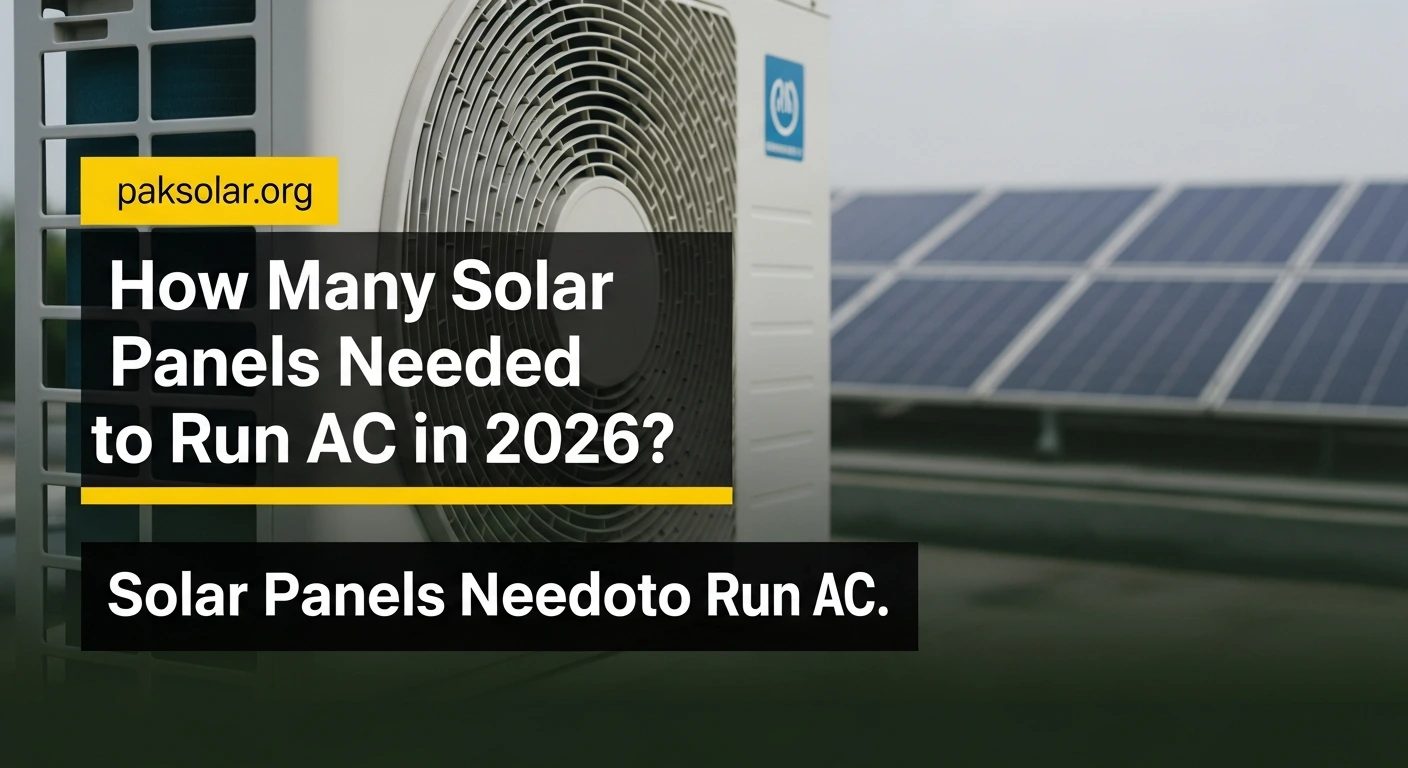
Air conditioning represents one of the most energy-demanding appliances in any home or business, consuming up to 17% of household electricity worldwide. The user searching “How Many Solar Panels Needed to Run AC in 2026?” has a specific primary intent: understanding the exact number of solar panels required to power different air conditioning units, learning how to calculate solar requirements based on AC wattage and daily usage hours, and determining if solar power can realistically handle cooling loads without excessive battery backup.
This question lacks a simple one-answer solution because the number of panels depends on multiple critical variables—AC unit size (measured in BTU or tons), daily runtime hours, geographic location (affecting peak sunlight hours), panel wattage capacity, and system type (grid-tied, hybrid, or off-grid). Understanding these variables and mastering calculation methods allows homeowners and businesses to design accurate solar systems that genuinely power air conditioning with confidence and long-term reliability.
Understanding AC Power Consumption and BTU Ratings
What Are BTU and AC Tonnage Ratings
BTU (British Thermal Units) measures cooling capacity—specifically the amount of heat an AC removes hourly. One ton of cooling capacity equals 12,000 BTU, a term originating from the cooling required to freeze one ton of ice in 24 hours. When manufacturers label ACs as 1-ton, 1.5-ton, or 2-ton units, they’re directly referencing BTU capacity divided by 12,000.
Typical AC Power Consumption by Unit Size
Small window AC units (5,000-10,000 BTU) consume 500-1,200 watts continuously. Medium window units (12,000-15,000 BTU) use 1,200-2,000 watts hourly. Mini-split systems (18,000-24,000 BTU or 1.5-2 tons) consume 1,500-2,500 watts during operation. Central AC systems (24,000-60,000+ BTU or 2-5+ tons) demand 3,000-5,000+ watts, making them the most power-intensive cooling option.
How to Calculate Solar Panels Needed for AC – Step by Step
The Complete Solar Panel Calculation Formula
Solar Panels Needed = (AC Wattage × Hours Used Per Day) ÷ (Panel Wattage × Peak Sun Hours × 0.8 Efficiency Factor)
This formula accounts for real-world variables: daily energy consumption (AC watts multiplied by runtime hours), solar panel output capacity (typically 250-460 watts per modern panel), peak sunlight hours available in your geographic location (usually 4-6 hours daily), and system efficiency losses (approximately 20% reduction due to temperature, shading, and inverter losses, hence the 0.8 factor).
Step 1 – Determine Your AC’s Exact Wattage
Check your AC unit’s nameplate rating on the back or bottom of the appliance. If only BTU or amperage appears, use these conversions: BTU ÷ 12,000 = Tonnage, and Tonnage × 1,000 = Approximate Wattage. For amperage: Watts = Amps × Volts (typically 120V or 240V home circuits). When AC ratings provide amperage (like 15A), multiply by voltage to get wattage: 15A × 240V = 3,600 watts.
Step 2 – Calculate Daily Energy Consumption
Multiply your AC’s continuous running wattage by the hours you operate it daily. If a 2,000-watt AC runs for 8 hours, daily consumption = 2,000W × 8 hours = 16,000 watt-hours (16 kWh). If running 12 hours: 2,000W × 12 hours = 24,000 watt-hours (24 kWh). This total daily consumption drives your entire solar array sizing.
Step 3 – Identify Your Location’s Peak Sunlight Hours
Peak sunlight hours (PSH) represent hours when sunlight intensity reaches 1,000 watts per square meter—the standard condition for measuring panel output. Different regions receive varying PSH: California and Arizona (6-7 PSH daily), northeastern US (4-5 PSH), humid tropical regions (3-4 PSH), arid desert areas (7-8 PSH). Check your specific location’s PSH using solar irradiance maps or consult local solar installers.
Step 4 – Apply the Complete Calculation
Example: 2,000-watt AC running 8 hours daily in a location with 5 peak sunlight hours, using 350-watt solar panels with 80% system efficiency:
Daily Energy = 2,000W × 8 hours = 16,000 Wh System Output Per Panel = 350W × 5 PSH × 0.8 = 1,400 Wh per panel Panels Needed = 16,000 ÷ 1,400 = 11.4 panels (round up to 12 panels)
Solar Panels Needed by AC Type – Complete Reference Table
Quick Reference Guide for All AC Unit Types
| AC Type & Size | Typical Wattage | 8 Hour Daily Runtime | 12 Hour Daily Runtime | Peak Sunlight Hours |
|---|---|---|---|---|
| Small Window AC (5-10K BTU) | 500-1,000W | 3-4 panels | 5-6 panels | 5 PSH avg |
| Medium Window AC (10-15K BTU) | 1,000-1,500W | 5-7 panels | 8-10 panels | 5 PSH avg |
| Large Window AC (18K-24K BTU) | 1,500-2,500W | 8-12 panels | 12-18 panels | 5 PSH avg |
| Mini-Split 1.5 Ton | 1,500-2,000W | 8-10 panels | 12-15 panels | 5 PSH avg |
| Mini-Split 2 Ton | 2,000-2,500W | 10-13 panels | 15-20 panels | 5 PSH avg |
| Central AC 2-3 Ton | 3,000-4,000W | 15-20 panels | 22-30 panels | 5 PSH avg |
| Central AC 3-4 Ton | 4,000-5,000W | 20-25 panels | 30-38 panels | 5 PSH avg |
| Central AC 5+ Ton | 5,000-7,000W | 25-35 panels | 38-50+ panels | 5 PSH avg |
Detailed Panel Count Examples by AC Unit Type
Running a 1-Ton AC (12,000 BTU) on Solar Panels
A standard 1-ton air conditioner consuming approximately 1,200 watts continuously requires specific panel calculations. Running this AC for 8 hours daily in a location with 5 peak sunlight hours and using 330-watt panels:
Daily consumption = 1,200W × 8 = 9,600 Wh Panel daily output = 330W × 5 PSH × 0.8 = 1,320 Wh Panels needed = 9,600 ÷ 1,320 = 7.3 panels (round to 8 panels)
For 12-hour daily operation, panels needed increase to 11-12 panels to maintain reliable cooling throughout extended hours.
Running a 1.5-Ton AC on Solar Panels
A 1.5-ton unit using approximately 1,800 watts requires more substantial solar investment. For 8 hours daily runtime:
Daily consumption = 1,800W × 8 = 14,400 Wh Using 330-watt panels: 14,400 ÷ 1,320 = 10.9 panels (round to 12 panels)
For 12-hour daily operation, you’ll need 17-18 panels to ensure consistent daytime AC availability.
Running a 2-Ton AC on Solar Panels
Central air conditioning at 2-ton capacity consuming 2,400 watts demands substantial solar array:
Daily consumption (8 hours) = 2,400W × 8 = 19,200 Wh Daily consumption (12 hours) = 2,400W × 12 = 28,800 Wh
For 8-hour operation: 14-16 panels of 330-watt capacity For 12-hour operation: 22-24 panels of 330-watt capacity
Running Central AC 3-5 Ton on Solar Panels
Large central air systems consuming 3,000-5,000+ watts require 20-38+ panels for 8-hour operation and 30-55+ panels for 12-hour operation. These massive installations often necessitate premium space—typically requiring 600-800+ square feet of rooftop area.
System Type Impact on Panel Requirements
Grid-Tied Solar Systems (Smallest Panel Count)
How Many Solar Panels Needed to Run AC in 2026?, Grid-tied systems connect directly to utility power without battery storage. The grid provides backup when solar production drops, eliminating need for oversized panels or expensive batteries. These systems require the fewest panels because you only need to generate sufficient daytime power during AC peak usage. A 2,000-watt AC running 8 hours during peak sunlight needs only 10-12 panels in grid-tied configuration.
Hybrid Solar Systems (Medium Panel Count)
Hybrid systems combine grid connection with battery backup, providing power during evenings and cloudy periods. These require 25-30% more panels compared to grid-tied systems because they must both power AC continuously AND charge batteries for nighttime operation. A 2,000-watt AC with battery backup requires 14-16 panels for 8-hour daytime operation plus 4-6 additional panels for battery charging.
Off-Grid Systems (Maximum Panel Count Required)
Completely off-grid systems require the largest solar arrays plus massive battery banks. Running AC at night without grid backup demands 4-6 times more panels than grid-tied systems because you must generate sufficient energy to both cool your home AND charge enormous battery banks for nighttime use. A 2,000-watt AC needing 8 hours nighttime operation requires 40-50+ panels plus 36+ batteries, making off-grid AC economically impractical for most applications.
Important Factors Affecting Solar Panel Count
Peak Sunlight Hours in Your Location
Your geographic location dramatically affects panel requirements. Desert regions (Arizona, Las Vegas) with 6-7 peak sunlight hours need fewer panels than humid tropical areas (Florida, Hawaii) with 3-4 PSH. Moving from a 5 PSH to a 4 PSH location increases required panels by approximately 25% because panels generate less power daily.
System Inefficiencies and Safety Buffers
Real-world solar systems lose 15-25% efficiency through multiple factors: temperature derating (panels operate 7-15% less efficiently on hot days), shading losses, inverter conversion losses (3-5%), wiring resistance (2-3%), and dust accumulation (2-5%). Professional installations add a 20-30% buffer to calculated panel counts ensuring reliable performance year-round.
AC Unit Efficiency Ratings (SEER/EER)
Higher SEER (Seasonal Energy Efficiency Ratio) ratings indicate more efficient cooling. A SEER 20 AC uses approximately 20% less power than a SEER 13 unit for identical cooling. Investing in high-efficiency AC (SEER 18-21) reduces required solar panels by 15-25%, making it more cost-effective than oversizing panels for inefficient equipment.
Startup vs. Running Power Requirements
AC units require 3-6 times more starting power than continuous running power. A 2,000-watt AC might need 6,000 watts at startup when the compressor engages. Solar systems must account for this inrush current by either oversizing the inverter capacity or installing soft-start components that gradually ramp up power, reducing startup demands to 1.5-2 times running power.
Battery Requirements for AC Systems
Nighttime AC Operation Battery Sizing
For daytime-only AC operation on grid-tied systems, no batteries are needed. For nighttime AC use, you must calculate battery capacity matching 16 hours of off-solar operation. A 2,000-watt AC needing 8 hours nighttime operation requires:
Nighttime energy = 2,000W × 8 hours = 16,000 Wh (16 kWh) Using 100Ah 48V batteries (4.8 kWh each) = 4 batteries minimum
For 12 hours nighttime operation: 24 kWh storage = approximately 6 high-quality 48V batteries.
Real-World Example Calculations
California Home with 2-Ton Central AC
Location details: Los Angeles, 5.6 peak sunlight hours daily, 2-ton AC using 2,400 watts, 6-hour daily operation during peak cooling hours (1-7 PM), using 350-watt panels.
Calculation:
- Daily consumption = 2,400W × 6 = 14,400 Wh
- Per panel daily output = 350W × 5.6 PSH × 0.8 = 1,568 Wh
- Panels needed = 14,400 ÷ 1,568 = 9.2 panels (round to 10 panels)
10 panels of 350W capacity (3.5 kW system) cost approximately $8,500-12,000 installed and save $200-300 monthly on summer electricity bills.
Pakistani Home with 1.5-Ton AC
Location details: Lahore, 5-peak sunlight hours daily, 1.5-ton AC consuming 1,800 watts, 8-hour daily operation, using 330-watt panels.
Calculation:
- Daily consumption = 1,800W × 8 = 14,400 Wh
- Per panel daily output = 330W × 5 PSH × 0.8 = 1,320 Wh
- Panels needed = 14,400 ÷ 1,320 = 10.9 panels (round to 12 panels)
12 panels of 330W capacity (4 kW system) cost ₨600,000-900,000 installed and reduce electricity bills by ₨8,000-12,000 monthly during summer cooling season.
FAQ
Conclusion
Determining How Many Solar Panels Needed to Run AC in 2026? requires understanding your specific AC unit’s wattage, daily operating hours, local peak sunlight hours, and system type preference. The calculation process is straightforward once you gather these variables, but proper implementation demands expertise in electrical design and safety protocols.
Grid-tied systems offer the most cost-effective solution for homeowners, requiring 8-15 panels for typical ACs during daytime cooling. Hybrid systems with battery backup provide reliable 24-hour operation but demand 20-30+ panels plus expensive battery banks. Off-grid systems are rarely practical for AC cooling due to extreme costs and space requirements.
Investing in high-efficiency AC units (SEER 18-21) reduces panel requirements by 15-25%, improving long-term ROI significantly. Adding soft-start components manages startup power surges safely without oversizing expensive inverters.