
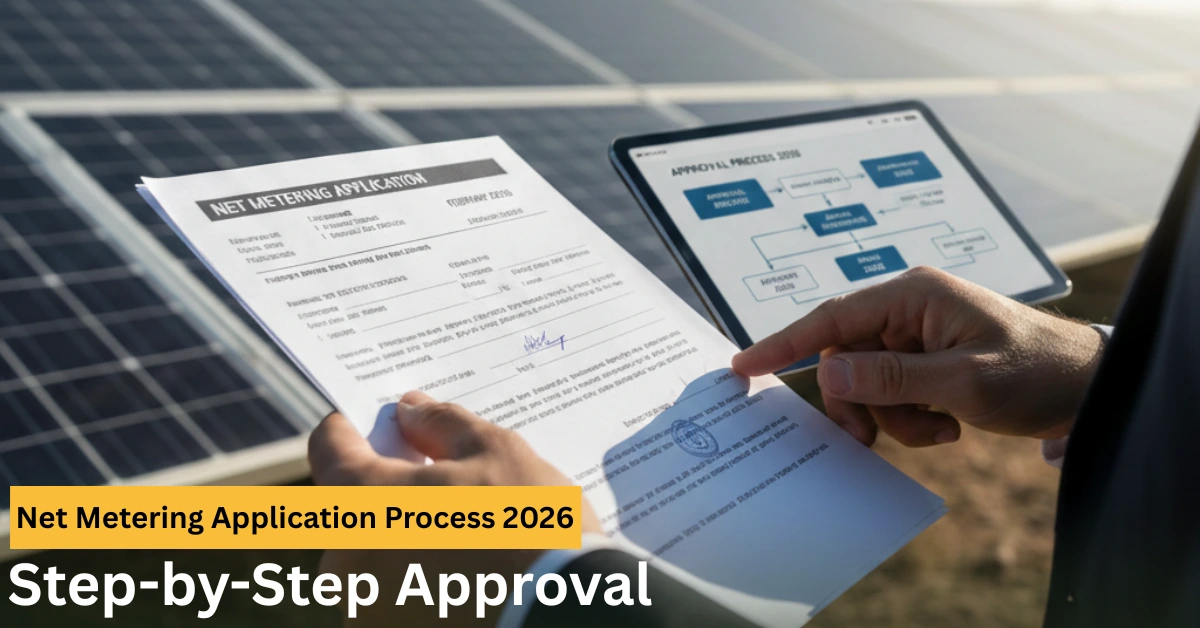
Are you looking to install a solar system and sell excess electricity back to the grid? The Net Metering Application Process 2026 has undergone significant changes in Pakistan. If your main goal is to understand how to apply, what documents you need, and what the new NEPRA regulations mean for your wallet, you are in the right place. This guide explains everything from the step-by-step application procedure to the new net billing system that replaces the old unit-for-unit adjustment. Read on to make an informed decision.
What is Net Metering?
Net Metering is a billing mechanism that allows solar system owners to export surplus electricity to the national grid. Traditionally, for every unit (kWh) you sent to the grid, you received a credit of one unit on your electricity bill. However, the 2026 regulations have changed this.
Under the new framework, net metering is now essentially a net billing system. The electricity you export is purchased at a specific National Average Energy Price, while the electricity you consume from the grid is charged at your applicable tariff rate. This is a critical change that affects the financial returns of solar investments.
Key Changes in NEPRA Net Metering Regulations 2026
The National Electric Power Regulatory Authority (NEPRA) has introduced the Net Metering Regulations 2026, replacing the 2015 framework. Here are the most important updates every solar consumer must know:
1. End of Unit-for-Unit Adjustment
Previously, if you exported 100 units and consumed 100 units, your bill was zero. Now, exports and consumption are calculated separately at different rates.
2. New Net Billing System
Electricity you supply to the grid is purchased at the National Average Energy Price (NAEP), which is typically lower than the consumer tariff you pay. This means the value of your exported electricity is less than what you buy from the grid.
3. Agreement Duration
The duration of net metering agreements is now limited to five years. Upon expiry, you can apply for a renewal for an additional five-year period.
4. Scope Extended to Biogas
The new 2026 regulations also cover biogas consumers, broadening the scope beyond just solar photovoltaic (PV) systems.
5. Interconnection Timeline
Distribution Companies (DISCOs) are now mandated to provide interconnection within 15 days of receiving a complete application. NEPRA itself is bound to issue concurrence within 7 days.
6. Load Flow Study Requirement
For systems with a capacity of 250 kW or more, a mandatory load flow study is required before approval.
7. Non-Refundable Concurrence Fee
A non-refundable fee of Rs 1,000 per kilowatt has been introduced for NEPRA’s concurrence process.
8. Interconnection Costs Borne by Prosumer
All costs related to interconnection, including bi-directional meters and any necessary grid upgrades, will be paid by the prosumer (producer-consumer).
Step-by-Step Net Metering Application Process 2026
Follow these steps to successfully apply for net metering in Pakistan under the new 2026 regulations:
Step 1: Assess Your Solar System
Before applying, ensure your solar system meets the technical requirements. Key considerations include:
- System capacity (measured in kW).
- Type of inverter (grid-tie inverter is mandatory).
- Compliance with IEEE/IEC standards.
Step 2: Gather Required Documents
Prepare the following documents for your application:
| Document | Description |
|---|---|
| CNIC Copy | National Identity Card of the applicant. |
| Electricity Bill | Latest electricity bill showing your reference number. |
| Property Ownership Proof | Allotment letter, registry, or rent agreement (with NOC from landlord). |
| System Single Line Diagram | Electrical layout prepared by your solar installer. |
| Solar Panel Specifications | Datasheet showing make, model, and wattage of PV modules. |
| Inverter Specifications | Datasheet for the grid-tie inverter with certifications. |
| Site Layout Plan | Physical location of panels and inverter on your property. |
| Board Resolution (for Companies) | If the applicant is a company, an authorized resolution is needed. |
Step 3: Submit Application to Your DISCO
Visit or contact your local Distribution Company (DISCO). Common DISCOs include:
- LESCO (Lahore Electric Supply Company)
- IESCO (Islamabad Electric Supply Company)
- FESCO (Faisalabad Electric Supply Company)
- MEPCO (Multan Electric Power Company)
- K-Electric (Karachi)
- PESCO (Peshawar Electric Supply Company)
- HESCO (Hyderabad Electric Supply Company)
Most DISCOs now have online portals for application submission. Provide your consumer reference number and upload all required documents.
Step 4: Pay Application Fees
Pay the required registration and concurrence fees. This includes:
- DISCO processing fee (varies by DISCO).
- NEPRA concurrence fee: Rs 1,000 per kW.
For a 10 kW system, the NEPRA fee alone would be Rs 10,000.
Step 5: Technical Feasibility Study
Upon receiving your application, the DISCO will schedule a site visit. An engineer will inspect:
- The installed solar system (or proposed location).
- Grid infrastructure at your location.
- Safety measures (earthing, breakers).
A technical feasibility report is submitted to the approval authority.
Step 6: Receive NEPRA Concurrence
NEPRA reviews the application and issues a concurrence letter within 7 working days. You will be notified via SMS and email.
Step 7: Sign Net Metering Agreement
Once concurrence is received, you will sign a formal Net Metering Agreement (NMA) with your DISCO. This agreement outlines:
- Billing terms (net billing rates).
- Duration (5 years, renewable).
- Rights and obligations of both parties.
Step 8: Bi-Directional Meter Installation
The DISCO will install a bi-directional (import/export) meter at your premises. This meter records:
- Units imported from the grid.
- Units exported to the grid.
Note: The cost of the meter and installation is typically borne by the applicant.
Step 9: Commissioning and Synchronization
A final commissioning test is conducted. Once passed:
- Your system is synchronized with the grid.
- You officially become a prosumer.
Congratulations! You can now generate your own electricity and export surplus to the grid.
Net Metering Billing Explained (2026)
Understanding the new billing system is crucial for calculating your savings.
How Bills Are Calculated
At the end of each billing cycle, your bill will show:
- Units Consumed (Imported): Charged at your applicable tariff (e.g., Rs 25/unit for domestic consumers).
- Units Exported: Credited at the National Average Energy Price (e.g., Rs 12-15/unit).
Example:
- You consumed 500 units from the grid @ Rs 25 = Rs 12,500.
- You exported 300 units to the grid @ Rs 14 = Rs 4,200 credit.
- Net Bill = Rs 12,500 – Rs 4,200 = Rs 8,300.
Quarterly Payment for Surplus
If your export exceeds your import, you will receive a quarterly payment from the DISCO for the surplus electricity.
Net Metering vs. Hybrid/Off-Grid Systems
| Feature | Net Metering (On-Grid) | Hybrid System | Off-Grid System |
|---|---|---|---|
| Grid Connection | Required | Optional | Not Required |
| Battery Backup | Not Included | Included | Included (Essential) |
| Export to Grid | Yes | Yes (if grid-tied) | No |
| Cost | Lower | Medium to High | Highest |
| Best For | Reducing bills | Backup during load shedding + Savings | Remote locations without grid |
For most urban consumers, net metering remains the most cost-effective solution due to lower upfront costs.
Benefits of Net Metering in 2026
Despite the changes, net metering still offers significant advantages:
1. Reduced Electricity Bills
Even with net billing, generating your own electricity significantly lowers your dependence on expensive grid power.
2. Protection Against Tariff Hikes
As electricity prices rise, your solar-generated units become more valuable. You are hedged against future increases.
3. Environmental Impact
By using solar energy, you reduce your carbon footprint and contribute to Pakistan’s renewable energy goals.
4. Increase in Property Value
Homes and businesses with solar systems often have a higher resale value.
5. Government Support
Despite the shift to net billing, the regulatory framework supports prosumers and mandates timely processing by DISCOs.
Challenges and Considerations
Lower Export Value
The main concern with the 2026 regulations is the reduced value of exported electricity. Self-consumption is now more valuable than exporting.
Upfront Costs
The cost of the bi-directional meter, interconnection fees, and possible grid upgrades can add to the initial investment.
Agreement Renewal
After five years, you will need to renew your agreement. Future regulations may change, adding uncertainty.
Tips to Maximize Your Net Metering Savings
Follow these strategies to get the most out of your solar investment:
- Prioritize Self-Consumption: Use high-power appliances (washing machine, air conditioner, iron) during peak sunlight hours to minimize exports.
- Right-Size Your System: Do not oversize. A system that matches your daytime consumption is ideal. Exporting large amounts at low rates is inefficient.
- Consider a Hybrid System: If load shedding is frequent, a hybrid system with a small battery can store energy for evening use instead of exporting during the day.
- Monitor Your System: Use smart monitoring apps to track your generation and consumption in real-time.
Frequently Asked Questions (FAQs)
1. How long does the net metering application process take?
With a complete application, the entire process can take 20-30 days. DISCOs are mandated to provide interconnection within 15 days, and NEPRA issues concurrence within 7 days.
2. What is the cost of a bi-directional meter in Pakistan?
The cost varies but is typically between Rs 15,000 to Rs 25,000 for a standard residential meter. Some DISCOs may charge additional installation fees.
3. Can I apply for net metering with an already installed solar system?
Yes, you can apply for net metering even if your system is already installed. Ensure it meets the technical requirements (grid-tie inverter, proper earthing, etc.).
4. Is net metering available for commercial consumers?
Absolutely. Commercial and industrial consumers can benefit from net metering, often with larger system sizes and proportionally higher savings.
5. What happens if my solar system generates more than I use in a month?
The surplus is carried forward as a credit, and at the end of each quarter, you receive a payment from the DISCO for the excess units at the National Average Energy Price.
6. Can I cancel my net metering agreement?
Yes, you can terminate the agreement by giving written notice to your DISCO. However, any pending dues must be settled.
Conclusion
The Net Metering Application Process 2026 in Pakistan reflects a significant shift towards a net billing model. While the unit-for-unit adjustment is gone, solar energy remains a financially sound investment, especially when you maximize self-consumption. The application process is straightforward if you have the right documents and follow the steps outlined above.
Whether you are a homeowner looking to cut bills or a business aiming for sustainable operations, net metering offers a path to energy independence. Start by contacting your local DISCO, prepare your documents, and take the first step towards harnessing the power of the sun.
Keywords: Net Metering Application Process 2026, NEPRA Net Metering Regulations 2026, How to Apply for Net Metering in Pakistan, Net Metering Documents Required, Bi-Directional Meter Pakistan, Net Billing System Pakistan, Solar System Net Metering.
Pingback: Punjab Net Billing 2026 Policy – New Rules Explained Guide