Are you planning to invest in solar energy but confused about the current rates? The Solar Unit Selling Price 2026 in Pakistan is the key factor to understand before making any purchase. Whether you are comparing per-watt costs, evaluating top brands like Longi, Jinko, or JA Solar, or budgeting for a complete system, this guide has you covered. We will explain the current market prices, why they have increased, and how to get the best value for your investment.
Understanding Solar Panel Pricing in Pakistan
Solar panel prices in Pakistan are typically quoted in PKR per watt. This is the standard unit used worldwide to compare solar panels regardless of their physical size or total wattage. The lower the per-watt price, the more cost-effective the panel.
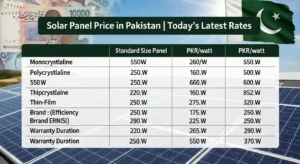
As of February 2026, the average per-watt price for solar panels in Pakistan ranges from approximately PKR 26 to PKR 45, depending on the brand, type, and efficiency.
Latest Solar Panel Prices Per Watt (February 2026)
Here is a detailed breakdown of popular solar panel brands and their current per-watt prices in the Pakistani market:
| Brand | Price Per Watt (PKR) | Type / Technology |
|---|---|---|
| JA Solar | 27 – 31 | Monocrystalline PERC |
| Jinko Solar | 29 – 35 | Monocrystalline / N-Type |
| Longi Solar | 30 – 40 | Hi-MO PERC / Bifacial |
| Canadian Solar | 30.50 – 34 | Monocrystalline PERC |
| Trina Solar | 28 – 30 | Vertex / Monocrystalline |
| Astro Energy | 28.50 – 29.25 | Monocrystalline |
| Phono Solar | 27 – 30 | Monocrystalline |
| Inverex | 30 – 32 | Monocrystalline |
| Crown | 29 – 30 | Monocrystalline |
Tier-1 vs. Tier-2 Brands
Tier-1 brands like Longi, Jinko, JA Solar, and Canadian Solar are recognized globally for their quality, efficiency, and warranty support. They are slightly more expensive but offer better long-term performance.
Tier-2 brands like Crown, Inverex, and Astro Energy are budget-friendly and popular in Pakistan. They offer good value but may have shorter warranties or lower efficiency ratings.
Why Have Solar Prices Increased in 2026?
The Solar Unit Selling Price 2026 in Pakistan is noticeably higher compared to 2025. Several global and local factors are driving this increase:
1. Higher Raw Material Costs
The global prices of essential materials used in solar panel manufacturing, such as silver, copper, and polysilicon, have risen significantly. This directly increases production costs for manufacturers.
2. Increased Import Costs
Pakistan imports the vast majority of its solar panels. Higher import duties, taxes, and currency depreciation (PKR vs. USD) have raised the landed cost for suppliers, which is passed on to consumers.
3. Strong Public Demand
With electricity prices soaring and load shedding affecting daily life, more and more Pakistanis are turning to solar. This surge in demand has created supply pressures, pushing prices upward.
4. China’s VAT Policy Change
A major global factor is China’s policy shift effective April 1, 2026. China is withdrawing export VAT exemptions on photovoltaic (PV) products. Since China is the world’s largest solar panel manufacturer, this policy is expected to trigger further price increases globally, including Pakistan.
Complete Solar System Costs in Pakistan (2026)
Beyond per-watt panel prices, consumers need to budget for a complete system. This includes the inverter, mounting structure, wiring, installation labor, and optionally, batteries.
Here is an estimated cost guide for on-grid (net metering) solar systems:
| System Size (kW) | Estimated Cost (PKR) | Suitable For |
|---|---|---|
| 1 kW | 150,000 – 200,000 | Small apartments, 1-2 fans + lights |
| 3 kW | 350,000 – 500,000 | Medium homes, 5-6 rooms, 1 AC (inverter) |
| 5 kW | 600,000 – 850,000 | Large homes, 2-3 ACs, basic commercial |
| 7 kW | 900,000 – 1,200,000 | Large homes, small shops/offices |
| 10 kW | 1,200,000 – 1,600,000 | Commercial use, large homes, multiple ACs |
| 15 kW | 1,800,000 – 2,400,000 | Large commercial, factories |
| 20 kW | 2,500,000 – 3,200,000 | Industrial, large businesses |
Note: Prices vary based on the inverter brand (e.g., Huawei, Solis, Growatt) and whether batteries are included (for hybrid/off-grid systems).
On-Grid vs. Hybrid vs. Off-Grid Systems
| System Type | Cost Comparison | Battery Included | Best For |
|---|---|---|---|
| On-Grid | Lowest | No | Net metering, bill reduction |
| Hybrid | Medium | Yes (optional) | Load shedding areas + net metering |
| Off-Grid | Highest | Yes (essential) | Remote areas without grid access |
If you live in an urban area with a reliable grid connection, an on-grid system is the most cost-effective. If you face frequent load shedding, a hybrid system with a small battery backup is recommended.
How to Calculate Your Solar System Size
To determine the right system size, follow this simple formula:
- Find your monthly units from your electricity bill.
- Divide by 120 (approximate units generated per kW per month in Pakistan).
- Round up to the nearest whole number.
Example:
- Monthly consumption: 600 units.
- 600 / 120 = 5 kW system required.
This is a basic estimate. Actual output varies based on location, panel orientation, and shading.
Comparing Solar Brands: Which One to Choose?
Choosing the right brand is crucial for long-term performance. Here is a quick comparison:
Longi Solar
- Pros: Global leader, high efficiency (21-22%), excellent warranty (25 years performance).
- Cons: Higher price.
- Best For: Homeowners prioritizing quality and longevity.
Jinko Solar
- Pros: Tier-1, good balance of price and performance, wide availability in Pakistan.
- Cons: Slightly lower efficiency than Longi.
- Best For: Budget-conscious buyers wanting Tier-1 quality.
JA Solar
- Pros: Affordable Tier-1 option, reliable, widely available.
- Cons: Slightly lower brand recognition than Longi/Jinko.
- Best For: Value seekers looking for a trusted brand.
Canadian Solar
- Pros: Excellent reputation, strong warranty, good efficiency.
- Cons: Moderately priced, not the cheapest.
- Best For: Those who want a balance of brand trust and cost.
Inverex / Crown
- Pros: Locally popular, affordable, readily available.
- Cons: Lower efficiency, shorter warranties (typically 10-12 years).
- Best For: Tight budgets, smaller installations.
Inverter Prices in Pakistan (2026)
The inverter is the heart of your solar system. Here are estimated prices for popular brands:
| Brand | Type | Capacity (kW) | Estimated Price (PKR) |
|---|---|---|---|
| Huawei | On-Grid | 5 kW | 180,000 – 220,000 |
| Solis | On-Grid | 5 kW | 100,000 – 130,000 |
| Growatt | On-Grid | 5 kW | 90,000 – 120,000 |
| Inverex | Hybrid | 5 kW | 150,000 – 200,000 |
| Infini | Hybrid | 5 kW | 130,000 – 170,000 |
Huawei is widely regarded as the best on-grid inverter due to its efficiency, reliability, and app monitoring. Solis and Growatt are excellent budget alternatives.
Return on Investment (ROI) for Solar in 2026
Despite higher upfront costs, solar remains a financially sound investment. Let’s calculate:
Scenario: A 5 kW on-grid system costing PKR 700,000.
- Monthly generation: ~600 units.
- Electricity saved: 600 x Rs 30/unit = Rs 18,000/month.
- Annual savings: Rs 18,000 x 12 = Rs 216,000/year.
- Payback period: 700,000 / 216,000 = ~3.2 years.
After 3-4 years, your electricity is essentially FREE for the next 20+ years (lifespan of panels).
Tips to Get the Best Solar Deal in 2026
Follow these tips to maximize your investment:
- Compare Multiple Quotes: Get at least 3 quotes from different installers.
- Verify Tier-1 Certification: Ask for panel datasheets and verify Tier-1 status on Bloomberg BNEF.
- Check Warranty: Ensure at least 10-year product warranty and 25-year performance warranty.
- Inspect the Inverter: Don’t compromise on the inverter; it determines system efficiency.
- Ask About After-Sales Service: Choose a company with a local service network.
- Consider Net Metering: On-grid systems with net metering offer the best ROI.
Frequently Asked Questions (FAQs)
1. What is the price of a 540W solar panel in Pakistan in 2026?
A 540W Tier-1 panel (like Longi or Jinko) costs approximately PKR 16,000 to PKR 21,000 depending on the brand and per-watt rate.
2. Are solar prices expected to increase further in 2026?
Yes, prices are expected to rise further due to China’s VAT policy change and continued currency depreciation. Investing sooner is advisable.
3. Which is the best solar panel brand in Pakistan?
Longi, Jinko, JA Solar, and Canadian Solar are considered the top Tier-1 brands. For budget options, Inverex and Crown are popular.
4. How many units does a 5 kW solar system produce per month?
A well-installed 5 kW system produces approximately 500-650 units per month in Pakistan, depending on weather and panel orientation.
5. Is it worth investing in solar in 2026 despite high prices?
Absolutely. With electricity tariffs rising and likely to increase further, the payback period is still short (3-4 years), making solar a smart long-term investment.
6. What is the lifespan of a solar panel?
Most Tier-1 panels have a 25-year performance warranty and can last 30+ years with proper maintenance.
Conclusion
The Solar Unit Selling Price 2026 in Pakistan has increased compared to previous years, but solar energy remains the most effective way to combat high electricity bills and load shedding. By understanding the current per-watt prices, comparing brands wisely, and choosing the right system size, you can make a smart investment that pays for itself within a few years.
Don’t wait for prices to rise further. Contact a reputable solar installer today, get multiple quotes, and take the first step towards energy independence. The sun is shining – it’s time to harness its power!