
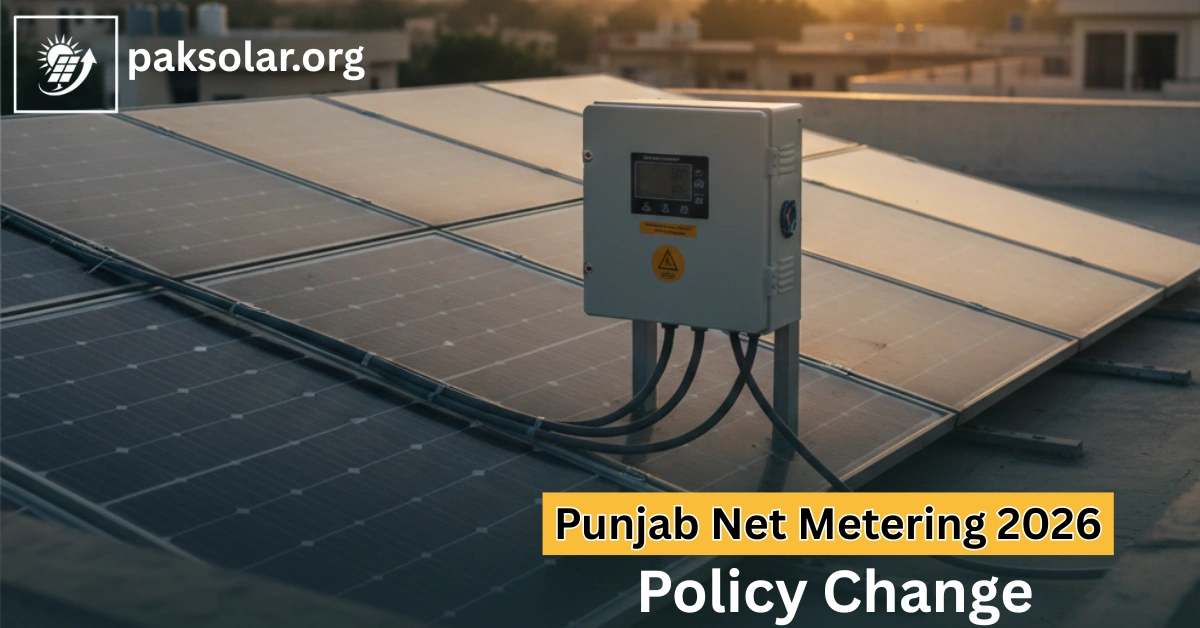
The Punjab net metering 2026 policy change marks a significant shift from the traditional “Net Metering” system to a “Net Billing” mechanism under NEPRA’s new regulations. This change means solar consumers will now pay full tariffs for electricity imported from the grid, while their surplus solar power will be purchased by the government at a strictly reduced rate of approximately Rs. 11 per unit, down from previous rates of over Rs. 20. This major policy overhaul aims to reduce capacity payments and circular debt but drastically alters the return on investment for solar owners in Punjab.
Major Changes in the Punjab Net Metering Policy 2026
The energy landscape in Pakistan is undergoing a massive transformation this year. For years, homeowners enjoyed the benefits of a 1:1 unit exchange system. However, the rapid growth of solar installations has led to grid instability and financial losses for distribution companies (DISCOs).
To address these issues, the government has introduced the Net Metering and Prosumer Regulations 2026. These regulations fundamentally change how you interact with the national grid.
End of Unit-for-Unit Exchange
Previously, the system was simple and very favorable for the consumer. If you exported 100 units to the grid and imported 100 units, your bill was effectively zero. This 1:1 offsetting is now officially over for new connections. The grid will no longer act as a free battery for your excess solar energy. You cannot simply swap a unit generated in the day for a unit consumed at night.
Introduction of Net Billing Mechanism
The new system is called Net Billing, and it works quite differently. Under this regime, there are two separate transactions for every consumer. First, you will be charged the full national tariff for every unit you pull from the grid. This applies even if you have exported more units than you consumed. Second, the units you export will be valued at a completely different, lower rate.
This “buyback” transaction happens separately and is adjusted against your bill.
Buyback Rate Reduction
The most critical part of the Punjab net metering 2026 policy change is the price drop.
In the past, buyback rates were linked to the National Average Power Purchase Price (NAPPP).
This allowed rates to hover around Rs. 21 to Rs. 27 per unit depending on fuel adjustments.
The new policy slashes this rate drastically.
New reports indicate the buyback rate is fixed around Rs. 11 per unit.
Some sources even suggest rates as low as Rs. 8.13 per unit for certain categories.
This massive reduction significantly extends the payback period of solar systems.
Impact on Existing vs. New Solar Users
The policy does not treat everyone exactly the same.
There is a clear distinction between those who already have systems and new applicants.
Understanding which category you fall into is crucial for your financial planning.
For Existing Net Metering Users
If you already have a net metering license, there is some good news.
The government is providing a “grandfathering” clause to protect your investment.
Your existing contract is valid for its remaining term, typically 7 years from issuance.
During this period, you will continue to enjoy the benefits of the old policy.
However, once this contract expires, you will likely be transitioned to the new Net Billing system.
DISCOs also reserve the right to terminate contracts early under specific grid constraint conditions.
For New Solar Applicants
For anyone applying for a solar connection in 2026, the new rules apply immediately.
Your agreement will be based on the Net Billing regulations.
The contract duration for new users has also been reduced to 5 years, renewable.
This shorter term gives the government more flexibility to adjust rates in the future.
You must calculate your return on investment (ROI) based on the Rs. 11 buyback rate.
This means a larger system might be needed to offset the same electricity bill amount.
Comparison: Old Net Metering vs. New Net Billing 2026
To make it easier to understand, here is a direct comparison.
This table highlights the fundamental differences between the two frameworks.
| Feature | Old Net Metering Policy | New Net Billing Policy 2026 |
|---|---|---|
| Offset Mechanism | 1:1 Unit Exchange ( kWh for kWh) | Separate Import & Export Billing |
| Import Rate | Off-Peak Rate | Full National Tariff (incl. Taxes) |
| Export (Buyback) Rate | ~Rs. 21 – 27 per unit | ~Rs. 11 per unit (Fixed) |
| Contract Duration | 7 Years (Renewable) | 5 Years (Renewable) |
| Banking Cycle | 3 Months / Quarterly | Monthly Settlement (Likely) |
| Payback Period | 2.5 – 3 Years | 4.5 – 5 Years |
As you can see, the financial dynamics have shifted in favor of the utility companies.
The goal is to discourage oversizing of systems simply for profit generation.
Why the Policy Changed
Many users are asking why the government made such a drastic move.
The primary reason is the rapid uncontrolled growth of distributed generation.
While green energy is good, the grid was becoming unstable.
Capacity Payments Issue
Pakistan has a capacity payment problem with Independent Power Producers (IPPs).
The government pays for power generation capacity whether it is used or not.
When affluent consumers switch to solar, they stop paying for grid electricity.
This leaves the “stranded costs” of the grid to be borne by poorer consumers.
The Punjab net metering 2026 policy change aims to distribute these costs more fairly.
Technical Grid Constraints
Our distribution transformers and lines were not designed for two-way power flow.
High voltage issues were becoming common in neighborhoods with high solar penetration.
By reducing the buyback rate, the government hopes to discourage massive exports.
They want consumers to install batteries and use their own power instead of dumping it.
Related Schemes: CM Punjab Solar Panel Scheme 2026
Despite the stricter regulations, the Punjab government is still promoting solar.
They recognize that energy costs are unbearable for the average citizen.
Roshan Gharana Scheme
Chief Minister Maryam Nawaz has launched the “Roshan Gharana” Solar Program.
This scheme targets protected consumers using between 50 to 500 units.
Under this initiative, eligible households receive a complete solar system.
The cost is covered 90% by the Punjab government and 10% by the consumer.
The repayment is structured over 5 years in easy monthly installments.
This is a separate initiative from the general net metering policy.
Even with the new billing rules, this scheme provides massive relief to low-income families.
Solar Tubewell Scheme for Farmers
Another critical area is the agricultural sector. The Punjab Solar Tubewell Scheme 2026 is designed to help farmers. Rising diesel and electricity costs have made irrigation expensive.
This scheme offers heavy subsidies to convert electric tubewells to solar power.
It aims to reduce the input costs for crops like wheat and cotton.
Strategies for Solar Users in 2026
Given the new policy, your solar strategy needs to adapt. You cannot simply install the maximum capacity and hope for a check from the utility. Here are some smart ways to maximize your savings.
1. Focus on Self-Consumption
The new “Net Billing” favors using your own power. Every unit you generate and use instantly saves you Rs. 40 – 50 (Grid Rate). Every unit you export only earns you Rs. 11. It is financially smarter to run your heavy loads during the day. Schedule your washing machines, water pumps, and ACs for sun-peak hours.
2. Install Hybrid Inverters with Batteries
Battery storage is now more attractive than ever. Instead of exporting surplus power for cheap, store it in batteries. Use this stored power during the evening peak hours (5 PM – 11 PM). This strategy, known as “Peak Shaving,” avoids the most expensive grid tariffs. Lithium-ion batteries have become cheaper and are a solid investment in 2026.
3. Right-Sizing Your System
Do not oversize your solar system aggressively. In the past, people installed 15kW systems for a 5kW load to earn money. With the buyback rate at Rs. 11, the ROI on that extra capacity is very low. Design a system that matches your actual daytime consumption and battery needs. Consult with a certified solar installer to analyze your load profile accurately.
Frequently Asked Questions (FAQs)
Here are the most common questions regarding the Punjab net metering 2026 policy change.
Q1: Will my existing net metering license be cancelled? No, existing licenses are protected for their remaining contract term (usually 7 years). You will continue under the old rates until your agreement expires.
Q2: What is the exact new solar unit price in Punjab for 2026? For new connections under Net Billing, the export (buyback) rate is approximately Rs. 11 per unit. Some specific categories may see rates as low as Rs. 8.13.
Q3: Is net metering completely finished in Pakistan? The traditional “Net Metering” (1:1 exchange) is effectively replaced by “Net Billing” for new users. You can still export power, but the financial model has changed.
Q4: How does Net Billing affect my electricity bill? Your bill will be calculated by charging you full tariff for imports and deducting the export value at the reduced rate. You will likely see higher bills compared to the old system.
Q5: Is it still worth installing solar in 2026? Yes, but the focus must shift to self-consumption. With grid electricity costing Rs. 50+ per unit, saving that cost is still a massive benefit, even if export earnings are low.
Q6: Can I switch from Net Metering to Net Billing voluntarily? There is no financial benefit to switching voluntarily. However, if you upgrade your system capacity (e.g., from 5kW to 10kW), you might be forced into the new regime.
Conclusion
The Punjab net metering 2026 policy change is a reality check for the solar industry. The era of easy profits from the grid is over. However, the core value proposition of solar energy remains intact. Grid electricity is expensive, and generating your own power is the only shield against inflation. By shifting your mindset from “selling to the grid” to “powering your home,” you can still save thousands. Adapt your usage habits, invest in battery storage, and size your system wisely. Solar is not dead; it has just evolved into a self-reliance tool rather than an investment scheme.
Stay informed, check your bills regularly, and make sure you are compliant with the new NEPRA regulations.
Pingback: What is Net Billing in Punjab 2026? New Solar Policy
Pingback: 15kW Solar System Price in Pakistan 2026 - Complete Costing
Pingback: How Did NEPRA Change Net Metering Policy in 2026? (Update)
Pingback: Net Metering Policy Latest News 2026 - NEPRA’s U-Turn
Pingback: Solar System for Home 2026 – Best Budget Options
Pingback: NEPRA Net Metering New Rules 2026 – Latest Update