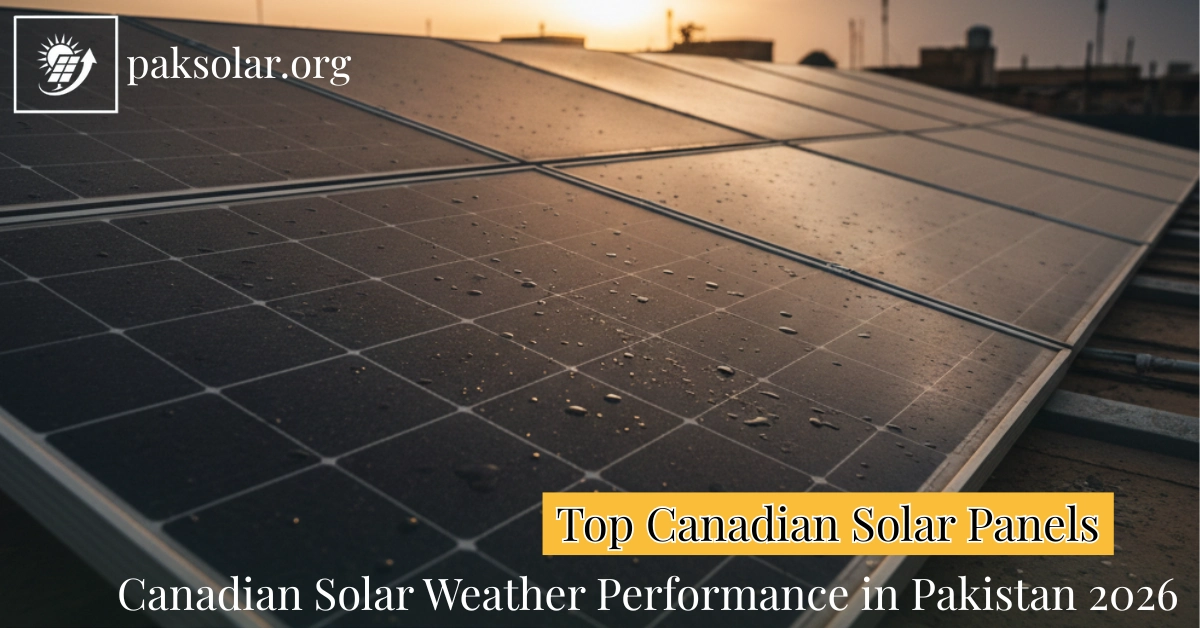
Canadian Solar Weather Performance in Pakistan 2026 generally exhibit superior performance in Pakistan’s diverse climate due to their low temperature coefficients (around -0.35%/°C) and advanced cell technologies like Half-Cut and Bifacial PERC. For a user asking “how do these panels handle our weather?”, the short answer is that they are engineered to minimize power loss during the scorching summers of Punjab and Sindh, while maintaining high efficiency during the cloudy monsoon season and low-light winter days. Their robust frame design also provides resilience against the heavy dust storms and high winds common in the region, making them a Tier-1 choice for long-term reliability in Pakistan’s harsh environment.
Introduction to Solar Challenges in Pakistan
Pakistan presents a unique set of environmental challenges for solar energy systems. Temperatures in summer frequently exceed 45°C, which can degrade the efficiency of standard panels. Dust accumulation (soiling) is a chronic issue in cities like Lahore and Karachi. “Canadian Solar Weather Performance in Pakistan 2026“, Humidity during the monsoon season tests the durability and potential induced degradation (PID) resistance of modules. Therefore, selecting a panel that is “weather-proof” is as important as the price itself.
Performance in Extreme Heat (High Temperature Coefficient)
One of the biggest misconceptions is that “more sun equals more power.” In reality, excessive heat reduces the voltage output of solar cells. Canadian Solar panels utilize Heterojunction (HJT) and TOPCon technologies to combat this. These technologies offer a lower temperature coefficient compared to conventional poly-crystalline panels.
unique Heat Resistance Features
Most standard panels lose 0.4% to 0.5% of their power for every degree rise above 25°C. Canadian Solar’s newer Hi-Ku and Bi-Ku series have brought this down to approximately 0.26% – 0.35%. This means in a 45°C heatwave, a Canadian Solar system will generate significantly more units than a generic competitor. This “heat resilience” is the primary reason for their popularity in Southern Punjab and Sindh.
Dealing with Dust and Smog (Soiling Loss)
Pakistan’s air quality index (AQI) is often poor, leading to thick layers of dust and smog on panels. Soiling can reduce system output by up to 30% if left uncleaned. Canadian Solar uses anti-reflective and anti-soiling glass coatings. These coatings make the surface smoother, preventing dust particles from sticking efficiently.
Self-Cleaning Properties
While manual cleaning is still required, the glass design aids in “self-cleaning” during light rains. The hydrophobic nature of the coating allows water droplets to roll off, carrying dust with them. This is particularly effective during the pre-monsoon dust storms. It reduces the maintenance frequency and water cost for the system owner.
Durability Against Wind and Storms
Climate change has brought more intense wind storms to Pakistan. Cheap panels often suffer from micro-cracks or frame bending under high wind loads. Canadian Solar modules are certified to withstand heavy wind loads (up to 2400 Pa). They also handle heavy snow loads (up to 5400 Pa), relevant for Northern areas like Skardu.
Frame Tecnhology
The anodized aluminum alloy frames provides structural integrity. This prevents the “flexing” of the panel during strong winds. Flexing is a major cause of micro-cracks effectively killing the cells over time. Robust clamping zones ensure the panels stay on the roof even during severe thunderstorms.
Monsoon Performance: Low Light Efficiency
The monsoon season (July-August) often worries solar owners due to cloud cover. Standard panels see a drastic drop in voltage when direct sunlight is blocked. Canadian Solar’s Half-Cut Cell Technology is a game-changer here. By cutting cells in half, the internal resistance is reduced, and the panel is split into two independent sections.
Shading Tolerance
If the bottom half of the panel is shaded by clouds or a parapet wall, the top half continues to work at 100%. This ensures that energy production doesn’t hit zero during overcast days. They absorb diffuse light (scattered sunlight) much better than older technologies. This ensures a steady trickle of power to keep batteries charged even on gray days.
Bifacial Technology in Pakistan’s Terrain
Bifacial panels generate power from both the front and back sides. In Pakistan, these are becoming popular for ground-mounted setups (e.g., tube wells). The white sandy soil or concrete roofs common in Pakistan reflect a lot of sunlight. Canadian Solar Bifacial panels can capture this reflected light (Albedo).
Albedo Gains
In optimum conditions, this can add 5% to 30% extra power generation. This is “free energy” harvested from the panel’s backside. It is highly effective in white-washed rooftops typical in Lahore and Islamabad. This technology maximizes the use of limited roof space.
Humidity and PID Protection
High humidity in coastal areas like Karachi causes Potential Induced Degradation (PID). PID is a phenomenon where high voltage and humidity cause ions to migrate, reducing performance. Canadian Solar guarantees PID-Free modules. They use high-quality encapsulants (EVA/POE) to seal the cells against moisture.
Double-Glass Modules
Their double-glass (glass-glass) modules offer superior protection. With no backsheet to degrade, moisture cannot penetrate the panel. This significantly extends the lifespan of the system in humid climates. It effectively protects the investment from the “silent killer” of solar panels.
Comparison with Competitors in Pakistan
How does Canadian Solar stack up against Longi, Jinko, and JA Solar in local conditions?
| Feature | Canadian Solar | Generic Tier-1 | Local/B-Grade |
|---|---|---|---|
| Heat Tolerance | Excellent (-0.35%/°C) | Good (-0.35%/°C) | Poor (-0.45%/°C) |
| Bifaciality | High (up to 80%) | Moderate (70%) | N/A |
| Warranty | 12 Product / 30 Perf | 12 Product / 25 Perf | No Official Warranty |
| Frame Strength | Reinforced Alloy | Standard Aluminum | Weak Recycled Metal |
| Price Point | Premium/Mid-Range | Mid-Range | Low |
Real-World Performance Feedback
Feedback from installers and users in Pakistan has been overwhelmingly positive. Users in Multan report that production peaks remain high even in June/July. Installers prefer them due to lower failure rates (RMA). The aesthetic black frame options are also popular for modern homes.
Case Study: Industrial Textile Mill
A large textile mill in Faisalabad installed Canadian Solar panels in 2021. Despite the corrosive industrial atmosphere and cotton dust, the system retained 98% efficiency after 3 years. This validates the anti-PID and anti-soiling claims. Industrial users rely on this stability for their baseload operations.
Warranty and Life Expectancy
Canadian Solar offers some of the best warranty terms available in Pakistan. Product Warranty: 12 to 15 years (Material and Workmanship). Performance Warranty: 25 to 30 years (Linear Power Output). They guarantee that the panel will not degrade more than 2% in the first year. Annual degradation is capped at around 0.55% for subsequent years.
Claiming Warranty in Pakistan
It is important to buy from authorized distributors to ensure warranty validity. Grey market (smuggled) panels do not carry these official warranties. Always check the barcode and flash test report. Authorized dealers usually handle the replacement process if a fault occurs.
Minimizing Degradation: User Tips
To get the best out of Canadian Solar panels, follow these tips. Angle Optimization: Adjust tilt angle seasonally (if possible) for winter/summer sun. Cleaning Schedule: Clean panels every 15 days in dusty areas, early morning or late evening. Water Quality: Use soft water for cleaning to avoid calcium deposits (white spots) on the glass. Inspection: Check for loose wires or “hotspots” utilizing thermal imaging once a year.
FAQs: Canadian Solar in Pakistan
Are Canadian Solar panels made in Canada?
Mostly no. While headquarters are in Canada, manufacturing is largely in China and Southeast Asia.
Which model is best for homes in Pakistan?
The HiKu6 and HiKu7 (Mono PERC) series are currently the most popular and cost-effective.
Do they work in extreme cold?
Yes, they perform exceptionally well in the cold winters of Quetta and Northern Areas.
Can they withstand hail?
Yes, they are tested for hail impact, typically handling hailstones up to 25mm at 80km/h.
Is the price difference worth it?
For a 25-year asset, the premium pays off in durability and slightly higher yields.
How do I spot a fake panel?
Verify the serial number on the Canadian Solar website or app. Check print quality of the label.
What is the average efficiency available?
Current models in Pakistan range from 21.0% to over 22.5% efficiency.
Do they require special inverters?
No, they are compatible with all standard string and hybrid inverters (Huawei, GoodWe, Sungrow, etc.).
Conclusion
When evaluating Canadian Solar weather performance in Pakistan, the verdict is clear. These panels are not just survivors; they are performers. Designed to mitigate the specific losses caused by high heat and shading, they offer a distinct advantage over cheaper alternatives. Whether you are battling the heatwaves of Sahiwal or the snowy winters of Skardu, Canadian Solar provides a balanced robust solution. For the Pakistani consumer, investing in these panels means securing a reliable energy source that will stand the test of time, weather, and a volatile grid for decades to come.