With Pakistan’s electricity crisis worsening and load-shedding lasting 8-12 hours daily in major cities, investing in solar battery backup 2026 in Pakistan has become essential for homeowners and businesses seeking energy independence. A proper solar battery backup system stores excess solar energy during the day so you have electricity available during load-shedding, at night, and during rainy days. Understanding solar battery backup 2026 options, costs, and specifications helps you choose the right system for your needs.
This comprehensive guide covers lithium battery technology, 2026 pricing in Pakistan (Rs. 150,000 to Rs. 500,000+), top brands like Narada, ITEL, PylonTech, and Knox, how to calculate battery requirements for your home, installation procedures, and why lithium batteries are now the superior choice over outdated lead-acid systems. By the end, you’ll understand exactly what solar battery backup you need and how to maximize your investment.
Why Solar Battery Backup Matters in Pakistan 2026
Pakistan faces unprecedented energy challenges making battery backup essential:
The Energy Crisis Reality:
Load-Shedding Situation:
- Lahore: 10-12 hours daily (winter worse than summer)
- Karachi: 8-10 hours daily
- Rawalpindi/Islamabad: 6-8 hours daily
- Rural areas: 12-14 hours daily
Electricity Cost Crisis:
- Rates increased 300% in 3 years (2023-2026)
- Summer bills often exceed Rs. 40,000-50,000 monthly for normal homes
- Commercial rates even higher, forcing business closures
Grid Instability:
- Frequent power surges damaging electronics
- Voltage fluctuations reducing appliance lifespan
- Blackouts lasting 30+ minutes without warning
Financial Impact of Going Solar with Battery Backup:
Scenario: 5KW Solar + 10KWh Battery System
- Initial investment: Rs. 1,200,000-1,500,000 (including batteries)
- Monthly grid electricity eliminated: Save Rs. 25,000-30,000
- Payback period: 3.5-4 years
- System lifespan: 25 years panels, 8-10 years battery
- After 4 years: 20+ years of near-free electricity
vs. Alternative: Grid electricity only without solar:
- Monthly bill: Rs. 25,000-30,000
- Annual cost: Rs. 300,000-360,000
- 10-year cost: Rs. 3,000,000-3,600,000
- Equipment wear-and-tear: Additional Rs. 100,000+
Clear Winner: Solar with battery backup saves money long-term while providing energy security
Understanding Solar Battery Technologies in Pakistan 2026
Lithium-Ion (Li-Ion) Batteries – The 2026 Standard
Chemistry: Lithium compounds (various formulations)
Advantages: ✓ 10-15 year lifespan (vs. 5 years for lead-acid) ✓ 3,000-6,000 charge cycles (vs. 500 cycles for lead-acid) ✓ 90%+ efficiency (vs. 70-80% for lead-acid) ✓ No maintenance required ✓ Fast charging capability ✓ Compact size (50% smaller than lead-acid) ✓ Lighter weight (easier installation) ✓ Better in hot climates (Pakistan’s advantage)
Disadvantages: ✗ Higher upfront cost (Rs. 150,000-250,000) ✗ Requires BMS (Battery Management System) ✗ Must be installed by trained technicians
Lithium Iron Phosphate (LiFePO₄) – Premium Option
Chemistry: Iron phosphate compound (safest lithium type)
Advantages: ✓ Safest chemistry (won’t overheat) ✓ Longest lifespan (up to 7,000+ cycles) ✓ Superior thermal stability ✓ Better for Pakistan’s hot climate ✓ More affordable than other lithium types
Disadvantages: ✗ Still more expensive than traditional batteries initially ✗ Requires proper installation
Best For: Serious users wanting maximum reliability and longevity
Lead-Acid/Tubular Batteries – Legacy Option (NOT RECOMMENDED for 2026)
While still sold in Pakistan, lead-acid is becoming obsolete:
Why Avoid: ✗ Short lifespan (3-5 years vs. 10+ for lithium) ✗ High maintenance (water top-ups, terminal cleaning) ✗ Only 500-800 charge cycles (vs. 3,000-6,000 for lithium) ✗ Heavy and space-consuming ✗ Lower efficiency in Pakistan’s heat ✗ Acid leakage risk ✗ Environmental hazard
Exception: Only use if budget absolutely prevents lithium purchase (not recommended)
Solar Battery Backup Pricing in Pakistan 2026
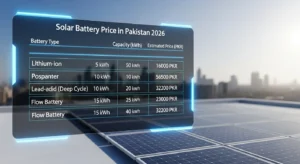
Current Market Prices (February 2026):
| Battery Type | Capacity | Price Range | Brand Examples |
|---|---|---|---|
| Entry-Level 12V Lithium | 20-50Ah | Rs. 45,000-90,000 | PowerSquare, Fronius |
| Standard 24V Lithium | 100Ah | Rs. 140,000-210,000 | Pylontech, Fixon |
| Residential 48V Lithium | 100Ah (5.12kWh) | Rs. 210,000-250,000 | Knox, ITEL, Narada |
| Premium 48V LiFePO₄ | 100Ah | Rs. 250,000-323,000 | MaxPower, CoreTECH |
| Large Residential | 200Ah (10.24kWh) | Rs. 400,000-450,000 | ITEL MaxPower |
| Commercial/3-Phase | 14-20kWh | Rs. 600,000-1,200,000+ | Sunwoda, Sungrow |
What Affects Battery Pricing:
1. Capacity (Ah or kWh)
- Higher capacity = Higher price (linear relationship)
- 100Ah doubles cost vs. 50Ah
2. Chemistry
- Standard Li-Ion: Rs. 210,000-240,000 for 100Ah
- LiFePO₄: Rs. 250,000-280,000 for 100Ah (+15-20% premium)
3. Brand Reputation
- Established brands: Narada, ITEL, PylonTech (15-20% premium)
- Newer brands: PowerSquare, CoreTECH (5-10% discount)
- Tesla Power: 25-30% premium (luxury branding)
4. Features
- WiFi monitoring: +Rs. 20,000-30,000
- Advanced BMS: +Rs. 15,000-25,000
- Wall-mounted vs floor: -Rs. 10,000-15,000
5. Warranty
- 3-year warranty: Standard
- 5-year warranty: +Rs. 30,000-50,000
- 10-year warranty: +Rs. 80,000-100,000
Top Solar Battery Brands in Pakistan 2026
Premium Brands (Highest Reliability):
1. ITEL Energy
- Price: Rs. 230,000-320,000 (100Ah)
- Lifespan: 10+ years guaranteed
- Cycles: 5,000+
- Warranty: 10 years available
- Best for: Long-term reliability seekers
- Availability: All major cities
2. Narada (Chinese Industrial Grade)
- Price: Rs. 210,000-255,000 (100Ah)
- Lifespan: 10-12 years
- Cycles: 6,000+
- Warranty: 5-10 years
- Best for: Commercial + residential
- Availability: All Pakistan
3. PylonTech
- Price: Rs. 210,000-250,000 (100Ah)
- Lifespan: 10+ years
- Cycles: 5,000+
- Warranty: 10 years
- Best for: Premium quality seekers
- Availability: All major cities
4. Knox
- Price: Rs. 220,000-300,000 (100Ah)
- Lifespan: 10+ years
- Cycles: 5,000+
- Warranty: 5-8 years
- Best for: Outdoor/waterproof systems
- Availability: All Pakistan
Mid-Range Brands (Good Value):
PowerSquare, Fixon, CoreTECH, Volnex
- Price: Rs. 140,000-230,000 (100Ah)
- Lifespan: 7-10 years
- Cycles: 3,000-5,000
- Warranty: 3-5 years
- Best for: Budget-conscious buyers
- Trade-off: Shorter warranty, fewer cycles
Important Note About Budget Brands:
Popular brands like “Ever Best,” unknown Chinese brands, or unmarked batteries: ❌ Not recommended ❌ Warranty claims complicated ❌ Lifespan often 3-5 years (not 10) ❌ Safety certification questionable ❌ Better to buy established brand
How to Calculate Your Battery Backup Needs
Step 1: Determine Your Daily Energy Usage
Track for 1 month:
- Take month-long electricity bills
- Calculate kWh consumed (shown on bill)
- Divide by 30 = Daily average consumption
- Multiply by 0.6 = Nighttime/backup energy need (60% of daytime usage typically)
Example:
- Monthly bill: 600 kWh
- Daily average: 600 ÷ 30 = 20 kWh/day
- Backup needed: 20 × 0.6 = 12 kWh overnight
Step 2: Calculate Battery Capacity Required
Formula: Backup energy need ÷ Battery efficiency (0.9)
Example:
- Backup needed: 12 kWh
- Required battery: 12 ÷ 0.9 = 13.3 kWh
- Solution: Buy two 5.12kWh batteries (total 10.24kWh) or one 13-15kWh battery
Step 3: Consider Days of Autonomy
Days of autonomy = How many days you want backup without solar generation (rainy days)
- For 2-3 day autonomy: Multiply battery need by 2-3
- For 4-5 day autonomy: Multiply battery need by 4-5
- Most Pakistanis choose 2-3 day autonomy (balances cost)
Revised Example:
- Daily backup: 12 kWh
- 2-3 days autonomy: 12 × 2.5 = 30 kWh needed
- Solution: Three 5.12kWh batteries (total 15.36kWh) or one 30kWh modular system
Installation Process for Solar Battery Backup
Step 1: Get Professional Assessment
Never DIY install batteries. Hire licensed installer because:
- High voltage (48V) risk
- Battery Management System (BMS) programming required
- Warranty voids if installed improperly
- Safety certifications needed
What to expect from installer:
- Free site assessment (2-3 hours)
- System design proposal
- Written quotation with warranty
- Installation timeline
Step 2: Prepare Installation Space
Requirements:
- Cool, dry location (ideal: 15-25°C)
- Ventilated room (batteries need air circulation)
- Near inverter (reduce wiring, minimize voltage loss)
- Fire-safe location (away from flammable materials)
- Locked/secure area (prevent tampering)
Best locations: ✓ Basement (if available and dry) ✓ Dedicated battery room ✓ Covered outdoor shelter with shade ✗ Hot attic (batteries overheat) ✗ Wet/damp basement (corrosion risk) ✗ Living areas (safety, noise)
Step 3: Installation (3-5 Hours)
Professional installer will:
- Mount batteries on wall or floor
- Install Battery Management System (BMS)
- Connect DC wiring from solar panels to batteries
- Install disconnect switches (safety)
- Program BMS settings
- Test entire system
- Commission and handover
What to observe:
- All connections tight and secure
- Color-coded wiring (red=positive, black=negative)
- Proper DC breakers installed
- Ground connection established
- Testing done live
Step 4: Post-Installation
First week:
- Monitor battery charge/discharge
- Check app/monitoring system
- Verify temperature readings
- Confirm inverter switches to battery correctly
First month:
- Check battery temperature daily
- Monitor efficiency percentages
- Test load-shedding backup (simulate power cut)
- Understand inverter controls
Battery Maintenance and Care
Monthly Tasks:
□ Monitor charge/discharge patterns via app □ Check temperature (should be 20-25°C) □ Verify inverter showing green lights □ Test battery backup (simulate outage)
Quarterly Tasks:
□ Check battery voltage readings □ Inspect for any water leakage (zero tolerance) □ Verify BMS alarm lights off □ Review energy production vs. consumption
Annually:
□ Professional inspection (optional) □ Software updates for BMS □ Test emergency shutdown procedure □ Verify warranty still valid
Never Do:
✗ Open battery case ✗ Modify BMS settings ✗ Let battery fully discharge (degrades lifespan) ✗ Expose to temperatures below 0°C or above 45°C ✗ Pour water on battery (instantly fatal)
Frequently Asked Questions
Q1: Which battery brand should I buy in Pakistan 2026?
A: For best value: ITEL or Narada (Rs. 210,000-250,000, 10-year lifespan) For maximum reliability: PylonTech or Knox (Rs. 250,000-300,000, premium features) For budget option: Fixon or CoreTECH (Rs. 140,000-200,000, shorter warranty)
Best approach: Buy from reputable seller with local after-sales support (Kamal Solar, Nizam Energy, PowerHouse Express all have nationwide presence).
Q2: Can I expand my battery capacity later?
A: Yes, if you:
- Buy modular/stackable batteries (not fixed units)
- Install inverter with expansion capacity
- Most modern inverters support 1-4 battery units
Example: Buy 2×5.12kWh now, add 2 more later when budget allows.
Q3: How does extreme Pakistan heat affect battery lifespan?
A: Lithium batteries degrade faster in heat:
- At 30°C: Full 10-year lifespan
- At 40°C: 20% lifespan reduction (8 years instead of 10)
- At 45°C+: 40% reduction (6 years instead of 10)
Solution: Ensure proper ventilation, install in coolest location, keep temperature monitored.
Q4: Will my battery backup work during load-shedding?
A: Yes, perfectly designed for it:
- When grid power cuts, inverter automatically switches to battery
- You get uninterrupted electricity from stored energy
- After battery depletes, you’ll lose power (unless solar is producing)
- Next day when solar charges battery again, you’re set
Typical scenario: Battery backup gives you 6-8 hours overnight + all-day solar production.
Q5: Is lithium battery backup worth the investment vs. generator?
A: Absolutely, lithium is superior:
| Factor | Lithium Battery | Generator |
|---|---|---|
| Operating Cost | ~Rs. 0/month | Rs. 5,000-10,000/month (fuel) |
| Lifespan | 10+ years | 5-7 years |
| Noise | 0dB (silent) | 70-80dB (very loud) |
| Emissions | Zero | Harmful exhaust |
| Maintenance | Minimal | Regular oil changes, servicing |
| Initial Cost | Rs. 250,000-400,000 | Rs. 150,000-250,000 |
| 10-year cost | Rs. 250,000-400,000 | Rs. 750,000+ (including fuel) |
Winner: Lithium battery backup is 3-4x cheaper over 10 years
Conclusion: Solar Battery Backup 2026 in Pakistan
Solar battery backup 2026 in Pakistan is no longer a luxury—it’s a necessity for energy independence and cost savings. With electricity costs rising 300% and load-shedding now a daily reality, investing in a lithium battery backup system protects your home, business, and appliances while saving Rs. 25,000-40,000 monthly in grid electricity.
Key Takeaways:
- Lithium batteries are superior to outdated lead-acid (10x longer life, no maintenance)
- 2026 pricing is affordable (Rs. 210,000-250,000 for quality 100Ah systems)
- Top brands (ITEL, Narada, PylonTech, Knox) offer 10-year warranties
- Payback period: 3.5-4 years through electricity savings
- System lifespan: 25+ years (panels) + 10-15 years (battery) = exceptional long-term value
Next Steps:
- Contact 2-3 reputable installers (Kamal Solar, Nizam Energy, Green Solar Solutions)
- Get free professional assessment
- Calculate your battery needs
- Receive quotation with warranty
- Schedule installation
- Enjoy energy independence
Stop throwing away money on expensive grid electricity during load-shedding. Invest in solar battery backup 2026 today and enjoy decades of reliable, cost-free electricity while protecting Pakistan’s environment. Your investment will pay for itself within 4 years, then provide 20+ years of near-free energy.