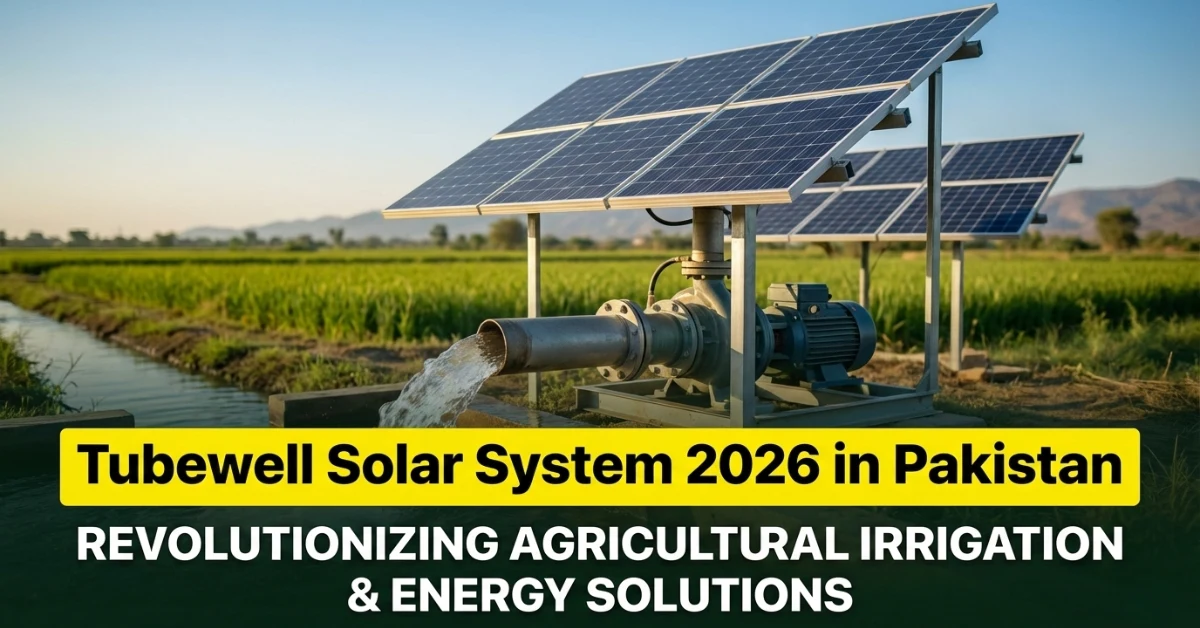
For Pakistan’s 1.5 million tube well farmers facing electricity shortages and rising diesel costs, a tubewell solar system 2026 in Pakistan represents a game-changing investment that eliminates irrigation expenses while increasing crop yields by up to 24-45%. The Punjab Solar Tubewell Scheme 2026 now offers 80% government subsidy (only 20% farmer cost) with 8,000 units available, making solar tubewell systems accessible to every farmer regardless of land size. Understanding tubewell solar system specifications, 2026 pricing (Rs. 345,000 for 3HP to Rs. 2.4 million for 25HP), installation process, and government subsidy eligibility is critical for farmers seeking to protect their crop investment from Pakistan’s unreliable grid.
This comprehensive guide covers everything—from choosing the right HP size for your land, calculating water requirements, understanding the 80% government subsidy scheme, installation procedures, and real ROI calculations showing payback in 2-3 years. Whether you’re a small farmer with 5 acres or a large operation with 50+ acres, this article explains exactly how to implement a tubewell solar system that will provide 25+ years of free, reliable irrigation.
Why Tubewell Solar Systems Are Essential in Pakistan 2026
The Agricultural Crisis Context
Pakistan’s farmers face unprecedented challenges making solar irrigation urgent:
Electricity Crisis for Farmers:
- WAPDA electricity rates for agricultural tubewells: Rs. 22-28/unit (2026)
- 5HP tubewell operating 8 hours daily: Rs. 8,000-12,000 monthly bill
- 15HP tubewell operating 12 hours daily: Rs. 25,000-35,000 monthly bill
- Seasonal peak summer rates: +40% surcharge during May-September
Unreliable Grid Supply:
- Scheduled load-shedding: 3-4 hours daily during off-peak seasons
- Peak summer load-shedding: 5-8 hours daily (May-September)
- Unscheduled outages delaying critical irrigation
- Crop losses from missed irrigation windows: 15-30% yield reduction
Water Scarcity Issue:
- Pakistan ranks among world’s most water-stressed nations
- Groundwater tables dropping 1-2 meters annually in Punjab
- 25% of cultivated land suffers from water shortage
- Solar systems with storage tanks optimize water use during peak production hours
Financial Impact for Farmers
Annual Savings Calculation: 5HP Solar Tubewell System
vs. Electricity Option:
- System cost: Rs. 540,000 (with 80% government subsidy = Rs. 108,000 farmer cost)
- WAPDA bills eliminated: Rs. 96,000-144,000 annually
- Payback period: 1-1.5 years (farmer’s actual cost)
- 25-year value: Rs. 2.4-3.6 million saved
vs. Diesel Generator Option:
- Generator cost: Rs. 200,000
- Monthly diesel (200 liters × Rs. 280): Rs. 56,000/month
- Annual diesel cost: Rs. 672,000
- Annual maintenance: Rs. 30,000
- 1-year total: Rs. 702,000
- Solar system 1-year cost: Zero
- Annual savings: Rs. 700,000+ vs. diesel
5-Year Comparison:
- Diesel: Rs. 3.5+ million
- Solar: Rs. 540,000 (or Rs. 108,000 with subsidy)
- Savings: Rs. 2.96-3.39 million
Complete Tubewell Solar System Pricing 2026 Pakistan
System Specifications & Pricing by Horsepower
| HP Size | Land Coverage | System Cost | Subsidy (80%) | Farmer Cost (20%) | Water Output |
|---|---|---|---|---|---|
| 3HP | 3-5 acres | Rs. 345,000 | Rs. 276,000 | Rs. 69,000 | 900 gallons/hour |
| 5HP | 5-10 acres | Rs. 540,000 | Rs. 432,000 | Rs. 108,000 | 1,200 gallons/hour |
| 7.5HP | 10-15 acres | Rs. 750,000 | Rs. 600,000 | Rs. 150,000 | 1,800 gallons/hour |
| 10HP | 15-20 acres | Rs. 1,420,000 | Rs. 1,136,000 | Rs. 284,000 | 2,400 gallons/hour |
| 15HP | 20-30 acres | Rs. 1,250,000-1,690,000 | Rs. 1,000,000-1,352,000 | Rs. 250,000-338,000 | 3,600 gallons/hour |
| 20HP | 30-50 acres | Rs. 1,650,000-1,900,000 | Rs. 1,320,000-1,520,000 | Rs. 330,000-380,000 | 4,800 gallons/hour |
| 25HP | 50+ acres | Rs. 2,000,000-2,400,000 | Rs. 1,600,000-1,920,000 | Rs. 400,000-480,000 | 6,000 gallons/hour |
What’s Included in Tubewell Solar System Cost?
Solar Panel Package (30-50% of cost):
- Monocrystalline panels (540-545W each, latest N-Type technology)
- Required quantity based on HP (3HP=6 panels, 5HP=10 panels, etc.)
- Rack mounting structure
- DC wiring and breakers
VFD (Variable Frequency Drive) (20-30% of cost):
- Motor controller optimizing pump efficiency
- Essential for 24-hour operation (solar production varies throughout day)
- Protects pump from voltage fluctuations
- 5kW VFD for 5HP system, scaling up with HP
Pump & Motor (20-25% of cost):
- Submersible pump (most common for tubewells)
- 3HP to 30HP motor options
- Quality brands: Grundfos, KSB, CAMC, ITT
- Usually 1-year manufacturer warranty
Mounting Structure (5-10% of cost):
- L2 Structure (recommended): Ground-level, easier maintenance
- Pole Mounting Structure: Elevated, better ventilation, higher cost (+Rs. 300,000-400,000)
- Galvanized steel, weather-resistant
- Allows panel angle adjustment for seasonal optimization
Installation & Labor (5-10% of cost):
- Professional installation by certified technicians
- Electrical connections and safety systems
- Testing and handover
- Training for farmer on operation/maintenance
How to Calculate the Right HP for Your Land
Formula: Motor Horsepower = Flow × Depth / 3,960 × Efficiency
Step 1: Determine Water Requirement
| Crop | Daily Water Need | Per Acre |
|---|---|---|
| Wheat (winter) | 2-4 inches/season | 50,000 gallons/season |
| Cotton (summer) | 4-6 inches/season | 100,000+ gallons/season |
| Rice | 6-8 inches/season | 150,000+ gallons/season |
| Sugarcane | 4-5 inches/season | 120,000 gallons/season |
| Vegetables | 3-4 inches/season | 80,000 gallons/season |
Step 2: Calculate System Size
- 5-acre cotton farm requiring 100,000 gallons/season (600 gallons/day during 150-day growing season)
- Operating pump 10 hours daily
- Required flow rate: 600 ÷ 10 = 60 gallons/hour minimum
- Required HP: (60 × 100 feet well depth) / (3,960 × 0.75) = 2HP theoretical
- Reality check: Add 50% buffer = 3-5HP recommended (accounts for pressure losses, peak demand)
Step 3: Select System
- 5 acres = 5HP system (Rs. 540,000 = Rs. 108,000 with subsidy)
- System produces 1,200 gallons/hour
- At 10 hours peak sun: 12,000 gallons/day
- More than sufficient for 5-acre cotton farm
Punjab Solar Tubewell Scheme 2026: Complete Subsidy Details
Scheme Overview
Government Initiative: Launched by CM Maryam Nawaz to transition 1.5 million farmers from diesel/grid electricity to solar.
Key Features: ✓ 8,000 solar tubewells with 80% government subsidy ✓ Farmers pay only 20% upfront, rest in installments ✓ Phase 1 deadline: January 31, 2026 (currently being extended) ✓ Applications via agriculture.punjab.gov.pk ✓ 25% units reserved for tenant farmers
Eligibility Criteria
Land Ownership: ✓ Own at least 1 acre agricultural land in Punjab ✓ Land must have registered tubewell or capability for one ✗ Land in urban areas (Lahore, Karachi city limits) ✗ Industrial zones
CNIC & Residency: ✓ Valid CNIC ✓ Permanent resident of Punjab ✓ Can apply remotely (online, no office visit required)
Tenant Eligibility: ✓ YES – Tenants can apply ✓ Required: 11-month lease agreement ✓ Required: Patwari verification stamp ✓ 25% of scheme units reserved for tenants
Previous Subsidy: ✗ Cannot apply if already received tubewell subsidy ✓ Can apply if switched from diesel to grid (not subsidized before)
Application Process (Online)
Step 1: Register on Portal
- Visit agriculture.punjab.gov.pk
- Create account with CNIC, email, phone
- Receive OTP verification
Step 2: Fill Application Form Fields required:
- Land details (acres, location, crops)
- Water source (depth of existing tubewell)
- IBAN (bank account for subsidy disbursement)
- Annual income (affects subsidy tier slightly)
- Tenant documentation (if applicable)
Step 3: Upload Documents
- CNIC (front and back)
- Land ownership document or lease agreement
- Recent utility bill (address proof)
- Bank account details
- Passport photo (digital copy)
Step 4: Submit & Receive Ballot Number
- Application submitted
- You receive unique ballot/reference number
- Balloting process determines selection (quota-based per district)
Step 5: Notification & Payment
- Once selected, you’re notified
- Choose vendor from approved list
- Pay 20% upfront to vendor
- Government transfers 80% subsidy directly
Step 6: Installation
- Vendor installs system (5-7 days)
- System tested and handed over
- Technical support from vendor
Financial Breakdown Example: 5HP System
Total system cost: Rs. 540,000
With Punjab Solar Tubewell Scheme subsidy:
- Government pays: Rs. 432,000 (80%)
- You pay only: Rs. 108,000 (20%)
Payment options:
- Full 20% upfront (Rs. 108,000)
- OR through Kissan Card (if eligible)
- OR through agricultural bank loans
After installation:
- Zero electricity bills for 25 years
- Annual maintenance: Rs. 6,000-10,000 (cleaning, wiring checks)
Installation Process: 7-10 Days
Pre-Installation
Site Assessment (Day 1, 2 hours):
- Vendor visits your farm
- Inspects existing tubewell or proposed location
- Measures water depth (critical for motor sizing)
- Checks roof/ground space for panels
- Determines best mounting location (south-facing, shade-free)
- Provides system design and quotation
Document Verification (Day 2-3):
- Submit required documents
- Vendor verifies with government
- Approval process (usually 2-3 days)
Installation Execution (Days 4-9)
Day 1: Structural Preparation
- Level installation site
- Install mounting structure (L2 or pole)
- Dig/prepare electrical conduit trenches
- Install grounding system
Day 2-3: Panel Installation
- Mount solar panels on structure
- Connect panels in series/parallel per design
- Install DC wiring with breakers
- Safety testing (no load yet)
Day 4: Equipment Installation
- Install VFD near pump location
- Connect VFD to panels and pump
- Install battery backup (if included)
- AC wiring to storage tank or direct to pump
Day 5: Pump Connection
- Connect motor to pump
- Prime system (fill with water)
- Connect to storage tank (if used)
- Test water flow at various pressure levels
Day 6: Testing & Commissioning
- Full load testing (pump at maximum capacity)
- Solar production testing (check output throughout day)
- Safety system testing (emergency shutdowns)
- Tank filling test (if tank system)
Day 7: Final Handover
- System commissioned officially
- Farmer training on operation
- Maintenance schedule explained
- Vendor contact for after-sales support
- Documentation provided
Frequently Asked Questions
Q1: Which HP solar tubewell should I choose for my land size?
A: Use this quick guide:
- 1-3 acres: 3HP system (Rs. 345,000)
- 3-5 acres: 5HP system (Rs. 540,000)
- 5-10 acres: 7.5HP system (Rs. 750,000)
- 10-15 acres: 10HP system (Rs. 1,420,000)
- 15-25 acres: 15HP system (Rs. 1,250,000+)
- 25+ acres: 20-25HP system (Rs. 1,650,000-2,400,000)
Best practice: Oversizeby 50% from theoretical calculation. A 3-acre farm needing 2HP should buy 3HP for peak summer demand and pressure.
Q2: Can I get the 80% subsidy if I’m a tenant farmer?
A: Yes! 25% of the 8,000 units are reserved specifically for tenants. You need:
- Valid CNIC
- 11-month lease agreement signed by landowner
- Patwari verification stamp on lease
- Apply on agriculture.punjab.gov.pk same as landowners
Tenants have equal eligibility—don’t hesitate to apply.
Q3: How long does payback take with the government subsidy?
A: For typical 5HP system:
- Your cost: Rs. 108,000 (20% of Rs. 540,000)
- Monthly WAPDA savings: Rs. 8,000-12,000
- Payback period: 9-13 months (less than 1 year!)
Without subsidy:
- Your cost: Rs. 540,000
- Monthly savings: Rs. 8,000-12,000
- Payback: 4-5 years
The subsidy makes ROI extraordinarily fast.
Q4: What maintenance does a tubewell solar system need?
A: Minimal maintenance:
- Monthly: Visual inspection, check for dust
- Quarterly: Panel cleaning (water spray sufficient)
- Annually: Professional check, wiring inspection, VFD testing
- Cost: Rs. 6,000-10,000 yearly
- No water top-ups (unlike diesel generators)
- No oil changes (unlike diesel)
Solar systems are 10x easier to maintain than generators.
Q5: What happens if clouds/rain prevents solar generation?
A: Two solutions:
Option 1: Direct System (No Storage)
- Solar-powered pump works during sunlight
- During rain/night: pump doesn’t operate
- Requires careful scheduling
- Suitable for crops with flexible watering (wheat, cotton)
Option 2: System with Storage Tank
- Solar charges during day
- Gravity-fed from tank at night
- Works 24/7
- Higher upfront cost (+Rs. 50,000-100,000 for tank)
- Suitable for crops needing precise watering (vegetables, fruit trees)
Most farmers choose Option 1 (direct) for costs savings, scheduling irrigation around sunny days.
Conclusion: Tubewell Solar System 2026 in Pakistan
A tubewell solar system 2026 in Pakistan is no longer optional for farmers—it’s the economic and environmental necessity that will define agricultural profitability in coming decades. With the Punjab Solar Tubewell Scheme providing 80% government subsidy, payback in under 1.5 years, and 25+ year lifespan, farmers switching from diesel or WAPDA faces a decision that will literally make or break their agricultural business.
Key Facts:
- 8,000 units available with up to 80% government subsidy (Phase 1: January 31, 2026)
- Farmer cost: Only 20% (Rs. 108,000 for 5HP system)
- Payback: 9-13 months with subsidy savings
- Annual savings: Rs. 96,000-144,000 per system
- 25-year value: Rs. 2.4-3.6 million saved per farmer
- Maintenance: Minimal, unlike diesel generators
Action Steps:
- Calculate your land size and required HP (above formula)
- Visit agriculture.punjab.gov.pk
- Fill online application (30 minutes)
- Upload CNIC, land proof, bank details
- Wait for balloting (lottery-based selection)
- Pay 20% upfront upon selection
- Install within 7-10 days
- Start saving from day one
For Pakistan’s 1.5 million tubewell farmers, the era of expensive electricity and diesel has ended. The era of free solar irrigation has begun. Don’t miss the Punjab Solar Tubewell Scheme 2026—apply now while quota remains available.