Choosing between monocrystalline vs polycrystalline panels 2026 represents one of the most critical decisions in designing your home solar system. While both technologies convert sunlight to electricity reliably, the differences in efficiency, cost, temperature performance, and long-term value are significant enough to impact your system’s return on investment by PKR 100,000-300,000 over 25 years.
This comprehensive guide reveals the scientific differences between monocrystalline (single-crystal silicon) and polycrystalline (multi-crystal silicon) solar panels, compares 2026 Pakistan pricing for each technology, analyzes real-world performance in Pakistan’s climate, and provides the complete framework for choosing the optimal panel type for your specific situation. Whether you’re installing a 3kW home system or a 50kW+ commercial array, this article equips you with expert knowledge to make a confident, informed decision that maximizes your energy generation and financial returns.
The Science: Understanding Monocrystalline vs Polycrystalline Construction
Monocrystalline Panels: Single-Crystal Silicon Architecture
Monocrystalline solar panels are manufactured using high-purity silicon grown into single, continuous crystals. The manufacturing process (Czochralski method) involves:
- Crystal Growth: A seed crystal of silicon is placed in molten pure silicon
- Ingot Formation: The crystal grows in cylindrical (boule) shape
- Slicing: The cylinder is sliced into thin wafers
- Cell Assembly: Individual cells are combined into complete panel
Result: Electrons move freely through uniform, single-crystal structure with minimal obstruction.
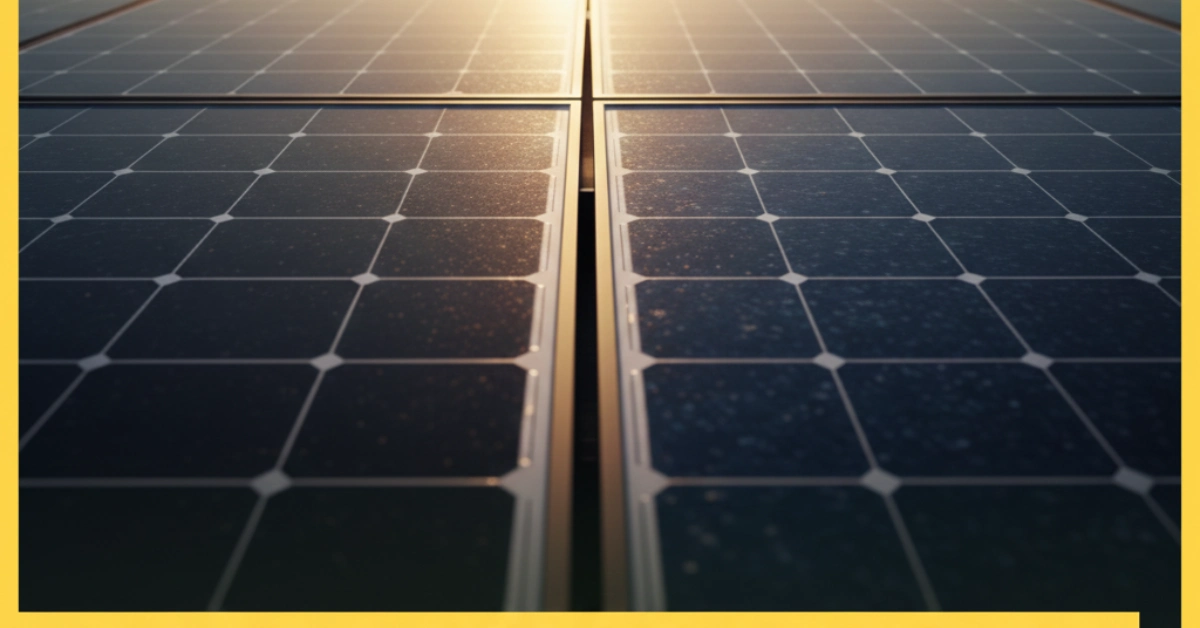
Visual Identification: Black or dark blue uniform color with rounded corners (remnants of cylindrical ingot slicing)
Polycrystalline Panels: Multi-Crystal Silicon Architecture
Polycrystalline solar panels use silicon fragments melted together rather than single-crystal ingots:
- Silicon Melting: Multiple silicon fragments are melted together
- Casting: Molten silicon poured into square molds
- Cooling: Multiple crystals form as silicon cools (creating grain boundaries)
- Cell Assembly: Wafers cut into individual cells for panel construction
Result: Electrons face obstacles at crystal grain boundaries, reducing electron mobility.
Visual Identification: Characteristic blue color (sometimes speckled) with rectangular shape and no rounded corners
Head-to-Head Comparison: Complete Feature Matrix
| Feature | Monocrystalline | Polycrystalline | Winner |
|---|---|---|---|
| Efficiency Rating | 18-22% (up to 25% latest tech) | 15-18% (up to 20% newer options) | Mono (3-5% advantage) |
| 2026 Pakistan Price/Watt | PKR 32-40 | PKR 28-32 | Poly (10-15% cheaper) |
| Per-System Cost (5kW) | PKR 185,000-230,000 | PKR 140,000-160,000 | Poly (20-25% lower) |
| Temperature Coefficient | -0.35%/°C (excellent) | -0.45%/°C (acceptable) | Mono (better in heat) |
| Performance at 50°C | 82.5% efficiency | 77.5% efficiency | Mono (5% advantage) |
| Low-Light Performance | Excellent (less electron resistance) | Good (more crystal boundaries) | Mono |
| Degradation Rate/Year | 0.3-0.5% | 0.4-0.7% | Mono (slower loss) |
| Space Efficiency | 220-230W per m² | 160-180W per m² | Mono (35% more) |
| Aesthetic Appearance | Sleek black (premium look) | Blue speckled (basic look) | Mono |
| Durability/Lifespan | 25-40 years | 20-35 years | Mono |
| Warranty Period | 10-12 years + 25-30 year performance | 10 years + 25 year performance | Mono |
| Installation Labor | Fewer panels = less labor | More panels = more labor | Mono |
2026 Pakistan Pricing: Complete Cost Breakdown
Current Market Prices (February 2026)
Monocrystalline Panels:
- Budget monocrystalline (local brands): PKR 32-34/watt
- Mid-range (Canadian Solar, Astronergy): PKR 34-36/watt
- Premium (LONGi, Jinko, Trina): PKR 36-40/watt
- Ultra-premium (N-Type, latest tech): PKR 38-42/watt
Polycrystalline Panels:
- Budget polycrystalline: PKR 26-28/watt
- Mid-range (Crown, Premier): PKR 28-30/watt
- Premium polycrystalline: PKR 30-32/watt
- (Note: High-quality poly increasingly rare as industry shifts toward mono)
Total System Cost Comparison (5kW Installation, Pakistan 2026)
Monocrystalline System (9 × 600W panels):
- Panels: 9 × PKR 21,600 (600W @ 36/watt) = PKR 194,400
- Inverter: PKR 120,000
- Mounting/Wiring/Installation: PKR 80,000
- Total: PKR 394,400
Polycrystalline System (14 × 380W panels):
- Panels: 14 × PKR 9,880 (380W @ 26/watt) = PKR 138,320
- Inverter: PKR 120,000
- Mounting/Wiring/Installation: PKR 90,000 (more panels = more labor)
- Total: PKR 348,320
Cost Difference: Polycrystalline costs PKR 46,080 (13%) less upfront
Performance in Pakistan’s Climate: Real-World Advantages
Temperature Performance (Critical for Pakistan)
Pakistan’s summer temperatures (45-50°C in interior Sindh/Punjab) create significant performance differences:
Monocrystalline Performance at 50°C:
- Base efficiency: 21%
- Temperature loss: -0.35%/°C × 25°C = -8.75%
- Actual output: 21% × 91.25% = 19.16% efficiency
Polycrystalline Performance at 50°C:
- Base efficiency: 17%
- Temperature loss: -0.45%/°C × 25°C = -11.25%
- Actual output: 17% × 88.75% = 15.09% efficiency
Real-world implication: At extreme Pakistani heat, monocrystalline maintains 27% superior efficiency vs polycrystalline—substantial daily power difference.
Low-Light/Cloudy Weather Performance
Pakistan’s monsoon season (June-August) reduces peak sun hours to 3-4. Monocrystalline’s superior electron mobility provides 8-10% better performance in partial cloud cover vs polycrystalline.
Dust Storm Resilience
Pakistan’s frequent dust storms (particularly interior Sindh) create performance challenges. Monocrystalline’s 98%+ light absorption vs polycrystalline’s 95% gives monocrystalline edge in dust-affected environments.
(Internal link suggestion: link to your article on “solar panel performance in Pakistan’s climate”)
Space Requirements: Land Use Comparison
Roof Space Needed (5kW System Example)
Monocrystalline Option:
- 9 panels × 2.3m² each = 20.7 m² total
- Suitable for: Standard residential roofs (most homes: 30-50 m² available)
Polycrystalline Option:
- 14 panels × 2.1m² each = 29.4 m² total
- Suitable for: Larger roofs or ground installations
Implication: Monocrystalline fits urban/suburban homes; polycrystalline requires more space (advantage for rural properties with land).
Degradation & Lifespan: 25-Year Financial Impact
Performance Retention Over Time
Monocrystalline Panel (Initial 21% efficiency):
- Year 1: 20.79% (slight first-year drop)
- Year 10: 19.95% (95% retained)
- Year 25: 18.9% (90% retained)
- Year 40: 17.85% (85% retained)
Polycrystalline Panel (Initial 17% efficiency):
- Year 1: 16.78% (similar first-year drop)
- Year 10: 15.81% (93% retained)
- Year 25: 14.45% (85% retained)
- Year 40: 13.09% (77% retained)
25-Year Energy Advantage: Monocrystalline generates approximately 8-10% more total energy due to slower degradation, offsetting higher initial cost.
Which Panel Type for Different Pakistan Scenarios?
Scenario 1: Urban Home with Limited Roof Space
Recommendation: MONOCRYSTALLINE
Reasoning:
- 20-25 m² average roof space (monocrystalline fits)
- High temperature environment (monocrystalline excels)
- Aesthetic preference for sleek appearance
- Long-term value matters more than upfront cost
Best brands: LONGi, Jinko, Canadian Solar (all available PKR 36-40/watt)
Scenario 2: Agricultural/Rural Property with Ample Land
Recommendation: POLYCRYSTALLINE (or Monocrystalline for future upgrade)
Reasoning:
- Abundant space available (50+ m² common)
- Space efficiency irrelevant
- Budget-conscious approach acceptable
- Installation footprint manageable
Best brands: Crown, Premier Energy (local manufacturing, PKR 26-30/watt)
Scenario 3: Commercial 50kW+ Installation
Recommendation: MONOCRYSTALLINE
Reasoning:
- Roof/land space typically limited in commercial
- Per-watt cost less critical for large systems
- Performance optimization valuable (extra 5% output = 2.5kW additional capacity)
- Long-term system reliability crucial
Best brands: LONGi, Jinko, Trina (wholesale pricing available)
Scenario 4: Budget Constrained Residential
Recommendation: POLYCRYSTALLINE
Reasoning:
- Upfront cost difference: PKR 40,000-50,000 (significant for families on budget)
- Still generates substantial savings (even at 17% efficiency)
- ROI acceptable (5-7 year payback vs. 4-5 for mono)
- Technology proven and reliable
2026 Technology Trends: Latest Panel Innovations
N-Type Monocrystalline (2026 Frontier Technology)
What’s New:
- N-type silicon cells (electron donors) vs. traditional P-type (electron acceptors)
- Efficiency: 23-25% (vs. standard 21%)
- Temperature coefficient: -0.35%/°C (same excellent performance)
- Cost premium: PKR 38-45/watt
Adoption in Pakistan: Limited availability but increasing (LONGi Hi-MO X10, Jinko N-type options appearing)
Bifacial Technology (Available Now)
- Capture reflected light from rear surface (ground albedo)
- 10-30% additional output in optimal conditions (white surfaces, elevated mounting)
- Price premium: PKR 2-4/watt
TOPCon (Tunneling Oxide Passivated Contact)
- Advanced architecture improving electron collection
- Efficiency: 23-25%
- Cost: PKR 38-42/watt
- Leading manufacturers (Canadian Solar, Longi) deploying in 2026
Complete FAQ: Monocrystalline vs Polycrystalline 2026
Q1: Is monocrystalline always better than polycrystalline?
A: “Better” depends on your priorities. Monocrystalline excels in efficiency, temperature performance, and aesthetics—superior for space-constrained installations and extreme heat. Polycrystalline wins on affordability and space availability. For Pakistan’s climate, monocrystalline is technically superior but polycrystalline remains viable if budget is tight. Neither is “wrong”—context determines best choice.
Q2: Why is polycrystalline still manufactured if monocrystalline is superior?
A: Three reasons: (1) Cost advantage (polycrystalline manufacturing cheaper), (2) Suitable for large installations where space is abundant, (3) Market segments where budget constraints prevent monocrystalline affordability. Globally, monocrystalline now dominates (>85% market share in 2026), but polycrystalline remains relevant for cost-sensitive applications.
Q3: Can I mix monocrystalline and polycrystalline panels in same system?
A: Technically possible but not recommended. Different electrical characteristics (voltage, current) create impedance mismatch, reducing overall system efficiency by 2-5%. If mixing unavoidable, install separate MPPT controllers for each panel type to optimize independently. Most installers recommend all same type for simplicity and optimal performance.
Q4: Will polycrystalline panels be phased out by 2030?
A: Unlikely completely, but market share will continue declining. As manufacturing costs converge and monocrystalline becomes less premium, polycrystalline demand shrinks for new installations. However, large-scale utility solar might continue using polycrystalline in some applications. For residential Pakistan, monocrystalline is becoming standard.
Q5: How much more electricity does monocrystalline generate in Pakistan’s heat?
A: In Pakistan’s typical 45-50°C summer conditions, monocrystalline generates approximately 5-8% more electricity daily due to superior temperature coefficient (-0.35%/°C vs. -0.45%/°C). Annual advantage accumulates to 15-20% higher total generation over full year, making monocrystalline increasingly valuable in Pakistan’s climate.
Q6: Should I buy expensive “premium” monocrystalline or budget monocrystalline?
A: Premium brands (LONGi, Jinko, Trina, Canadian Solar) cost PKR 36-40/watt vs. budget monocrystalline at PKR 32-34/watt—4-6 PKR/watt difference. For 5kW system, this is PKR 18,000-27,000 cost difference. Premium brands offer better long-term value due to superior warranties, documented reliability in Pakistan, and slightly higher efficiency (21% vs. 20%). If budget permits, premium monocrystalline provides better security and peace of mind.
Q7: What’s the impact if I choose wrong panel type?
A: Choosing polycrystalline when monocrystalline would suit your situation better means: (1) Higher installation costs (more panels, more labor), (2) Faster degradation (0.5-0.7% annually), (3) Lower output in Pakistan heat, (4) Potentially shorter lifespan (3-5 years difference). Real impact: PKR 20,000-50,000 additional cost over system life. Not catastrophic, but suboptimal.
Conclusion: Monocrystalline vs Polycrystalline Panels 2026
The monocrystalline vs polycrystalline panels 2026 decision is fundamentally about balancing upfront cost against long-term performance. Monocrystalline panels, with 18-22% efficiency, superior temperature tolerance, and slower degradation, are clearly superior technology for Pakistan’s extreme climate. Polycrystalline panels, at 15-18% efficiency, remain functional and economical for budget-constrained buyers with ample installation space.
For most Pakistani homeowners: Monocrystalline is the recommended choice. The PKR 40,000-50,000 additional upfront investment pays back through superior energy generation within 4-5 years, then provides 5-10% additional revenue for remaining 20+ year lifespan. In Pakistan’s 45-50°C summers and dusty conditions, monocrystalline’s efficiency advantage compounds year after year.