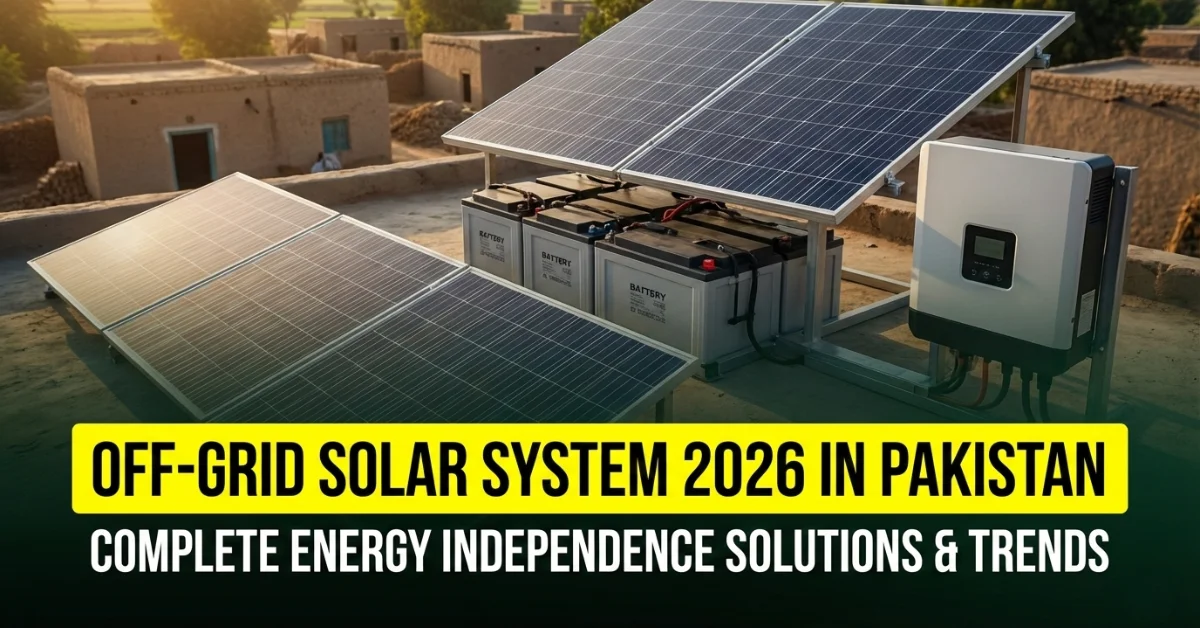
For the millions of Pakistanis living in rural areas without reliable grid access, and the millions more frustrated with 8-12 hours of daily load-shedding, an off-grid solar system 2026 in Pakistan offers complete energy independence and freedom from the national grid’s unpredictable power supply. Unlike hybrid systems that maintain grid connection as backup, off-grid solar systems work completely standalone—generating, storing, and managing electricity entirely from solar panels and batteries. This comprehensive guide explains exactly what off-grid solar systems are, who they’re ideal for, 2026 pricing (Rs. 250,000 to Rs. 1,600,000+ depending on capacity), component requirements, installation process, and real-world performance in Pakistan’s unique climate conditions.
Whether you’re a farmer needing irrigation, a remote homeowner without grid access, or someone seeking complete energy independence from Pakistan’s failing electricity system, this article provides everything you need to understand and implement an off-grid solar system that will provide decades of reliable electricity.
What is an Off-Grid Solar System?
Definition and How It Works
An off-grid solar system, also called a “standalone system,” operates completely independently from WAPDA, LESCO, K-Electric, or any local electricity grid. Instead of relying on the national grid for any power, your home or business generates, stores, and uses its own electricity.
Basic Operation:
- Solar panels generate electricity during daylight hours
- Inverter converts DC power to AC for household use
- Excess energy is stored in batteries for nighttime and cloudy days
- System operates 24/7 using sun-generated electricity
- Battery backup provides power even when panels aren’t generating
Key Difference from Other Systems:
| System Type | Grid Connection | Battery Backup | Best For |
|---|---|---|---|
| On-Grid | ✓ Connected | ✗ No battery | Urban areas with stable grid |
| Hybrid | ✓ Connected | ✓ With battery | Urban/semi-urban wanting backup |
| Off-Grid | ✗ Not connected | ✓ Critical (only power source) | Rural areas, complete independence |
Who Needs Off-Grid Solar Systems in Pakistan 2026?
Ideal Users:
1. Remote Rural Homes
- Areas 5+ km from nearest grid line
- Mountainous regions (North Pakistan)
- Desert areas (Balochistan)
- Coastal remote locations
- Benefit: Only viable electricity source
2. Agricultural Farmers
- 80% of Pakistan’s 1.5 million tube wells operate off-grid
- Farmers switching from diesel pumps to solar (34% reduction in agricultural grid demand in 2024)
- Solar irrigation provides water during day, storage for peak use times
- Cost saving: Eliminates expensive diesel fuel
3. Homes in Chronic Load-Shedding Areas
- Lahore, Karachi during peak season (10-12 hours daily cuts)
- Small towns with poor grid reliability
- Businesses tired of 6+ hour daily outages
- Benefit: Guaranteed continuous power
4. Industrial/Commercial Operations
- Factories needing 24/7 power supply
- Mobile towers (telecom infrastructure)
- Water treatment plants
- Cold storage facilities
- Cost saving: Eliminates expensive diesel generators
Off-Grid Solar System Components Explained
1. Solar Panels (PV Modules)
Function: Convert sunlight to electricity
2026 Pakistan Market:
- 540-585W capacity per panel standard
- Price: Rs. 55-70 per watt
- MOnocrystalline most common (higher efficiency)
- N-Type technology gaining popularity (20-22% efficiency)
What You Need: For different system sizes:
- 3KW system: 6 panels (540W each)
- 5KW system: 10 panels
- 10KW system: 18-20 panels
- Off-grid often requires 40-50% more panels than grid systems (to charge batteries)
2. Battery Bank (The Most Expensive Component)
Why Batteries are Critical: Off-grid systems live or die by battery capacity—batteries are your only power source at night and during cloudy days.
Battery Options:
Lead-Acid Batteries (Outdated, not recommended for 2026)
- Cost: Rs. 30,000-50,000 per unit
- Lifespan: 3-5 years only
- Maintenance: Weekly water top-ups
- Cycles: 300-500 only
- Verdict: Obsolete for off-grid; frequent replacement needed
Lithium-Ion Batteries (2026 Standard)
- Cost: Rs. 140,000-250,000 per 10KWh unit
- Lifespan: 10-15 years
- Maintenance: Zero (no water needed)
- Cycles: 3,000-6,000 (10x better than lead-acid)
- Efficiency: 90%+
Example: 10KWh lithium battery needed for average 5KW system:
- Cost: Rs. 200,000-250,000 (single unit)
- OR Rs. 100,000-125,000 per 5KWh unit × 2
- Lifespan: 10-15 years
- Daily degradation: <0.1% per charge cycle
3. Inverter/Charger (System Brain)
Function: Converts DC (from panels) to AC (for appliances) AND manages battery charging
Off-Grid Inverters are Different: They must:
- Manage battery charging rate
- Provide backup power when solar insufficient
- Handle peak loads
- Prioritize critical loads (essential vs. non-essential)
2026 Pricing in Pakistan:
- 3KW off-grid inverter: Rs. 40,000-60,000
- 5KW off-grid inverter: Rs. 60,000-90,000
- 10KW off-grid inverter: Rs. 120,000-180,000
- Premium brands (Luminous, ITEL, Growatt): +20-30% premium
Top Brands in Pakistan 2026: ✓ ITEL Power ✓ Luminous (Indian, widely available) ✓ Growatt (Chinese, affordable) ✓ MaxPower ✓ Sungrow
4. Mounting Structure (Underestimated Cost)
Function: Securely attaches panels to roof/ground
Costs in Pakistan 2026:
- Residential (10-15 panels): Rs. 25,000-40,000
- Agricultural field mount: Rs. 40,000-80,000 (larger, wind-resistant)
- Tracker systems (auto-adjust): Rs. 80,000-150,000
Why Quality Matters:
- Wind speeds in Pakistan can exceed 60 km/h
- Seasonal variations (monsoon in Punjab/Sindh)
- Prevents water leaks into roof
- Safety critical—falling panels = catastrophic
5. Wiring, Breakers, Safety Equipment
Essential for Safety:
| Component | Cost | Purpose |
|---|---|---|
| DC Wiring (6mm² min) | Rs. 8,000-12,000 | Power from panels to battery |
| AC Wiring | Rs. 5,000-8,000 | From inverter to home |
| DC Breakers (125A) | Rs. 3,000-5,000 | Protects against over-current |
| AC Breakers | Rs. 2,000-3,000 | Home circuit protection |
| Surge Protectors | Rs. 4,000-7,000 | Protects from lightning/spikes |
| Earthing System | Rs. 3,000-5,000 | Safety critical |
| Isolation Switch | Rs. 1,500-2,500 | Emergency shutdown |
Never Skimp: Poor wiring is Pakistan’s #1 cause of solar system failures and fires.
Off-Grid Solar System Pricing 2026 Pakistan: Complete Breakdown
Complete System Costs (Installed, Ready to Use):
| System Size | Panel Capacity | Battery Storage | Total Price | Best For |
|---|---|---|---|---|
| Small | 3KW | 10KWh | Rs. 300,000-400,000 | Small rural home |
| Medium | 5KW | 15KWh | Rs. 450,000-600,000 | Average home |
| Large | 10KW | 30KWh | Rs. 800,000-1,200,000 | Farm, large family |
| Commercial | 15KW+ | 50KWh+ | Rs. 1,400,000-1,600,000+ | Factory, irrigation |
Why Off-Grid Costs MORE Than Hybrid:
Price Comparison: 5KW System
On-Grid (no battery):
- Panels + Inverter + Wiring = Rs. 250,000-300,000
- No batteries = Massive savings
Hybrid (partial battery):
- Panels + Inverter + 10KWh Battery = Rs. 450,000-550,000
Off-Grid (full battery capacity):
- Panels + Inverter + 15-20KWh Battery = Rs. 550,000-700,000
- Difference: Batteries account for 30-40% of total cost
Installation Process for Off-Grid Systems
Step 1: Site Assessment & Design (2-3 hours)
Professional installer visits and:
- Measures roof space/ground area
- Checks sun exposure (shadow analysis)
- Assesses load requirements (what appliances you’ll run)
- Determines battery backup needs (days of autonomy)
- Provides written system design
Step 2: Material Procurement (5-7 days)
Installer sources:
- Solar panels (locally or imported)
- Battery system
- Inverter
- Mounting structure
- Electrical components
- Installation hardware
Step 3: Structural Preparation (1-2 days)
- Roof inspection and reinforcement (if needed)
- Mounting structure installation (concrete pads or roof rails)
- Electrical conduit laying
- Grounding system installation
Step 4: Panel Installation (1-2 days)
- Mount panels securely
- Connect panels in series/parallel per design
- Install DC wiring with proper breakers
- Test DC voltage before battery connection
Step 5: Battery Installation (1 day)
- Place battery unit in cool, dry location (basement/dedicated room best)
- Install battery management system (BMS)
- Connect DC wiring from panels and inverter
- Program BMS settings
Step 6: Inverter Installation (1 day)
- Mount inverter near batteries (minimize voltage loss)
- Connect DC inputs from batteries and panels
- Connect AC outputs to home breaker panel
- Test all switches and connections
Step 7: System Testing & Handover (1 day)
- Simulate cloud conditions (test battery supply)
- Load-test (run full household draw)
- Test emergency shutdown
- Train owners on system operation
- Commission system officially
Total Installation Time: 7-10 days from site assessment to handover
Off-Grid Solar Performance in Pakistan’s Climate
Regional Performance Variations:
Lahore (Punjab Plain)
- Annual solar irradiance: 4.5-5.0 kWh/m²/day
- Winter production: 60-70% of summer
- Smog season (Oct-Feb): 20-30% production loss
- 5KW system daily output: 20-25 kWh summer, 12-15 kWh winter
Karachi (Coastal)
- Annual irradiance: 5.2-5.8 kWh/m²/day (highest in Pakistan)
- Extremely consistent year-round
- Humidity/salt air minimal impact on panels
- 5KW system daily output: 25-30 kWh year-round
Northern Areas (Himalayas)
- Winter snow completely blocks panels (3-4 months)
- Summer exceptionally good (6+ kWh/m²/day)
- Requires manual snow removal
- System needs 6-8 months oversizing for 12-month operation
Agricultural Areas (Sindh/Balochistan)
- Extremely consistent solar resource
- Dust increases cleaning frequency
- 5KW system: 24-27 kWh daily average
Frequently Asked Questions
Q1: How many days can an off-grid system run without sunlight?
A: Depends on battery capacity:
- 10KWh battery, 10KWh daily use = 1 day autonomy
- 30KWh battery, 10KWh daily use = 3 days autonomy
- Most systems designed for 2-3 days autonomy (balances cost)
If no sun for 4+ days (rare in Pakistan except north), system cannot operate. You must oversize for worst-case scenario.
Q2: What happens if I run out of battery power?
A: The system powers off completely. Unlike grid-connected systems, there’s no backup—you depend entirely on:
- Panels recharging battery tomorrow
- Manual generator use (some owners keep diesel backup)
- Rationing loads to extend battery life
This is why off-grid requires discipline and monitoring.
Q3: Can I add more batteries later to expand storage?
A: Yes, if you:
- Buy modular/stackable battery systems (most modern systems support this)
- Purchased properly-sized inverter/charger with expansion capacity
- Have physical space for additional batteries
Example: Buy 2×10KWh initially, add 2 more later = 40KWh total.
Q4: Is off-grid cheaper than staying on the grid long-term?
A: After 5-7 years, yes—significantly:
10-year cost comparison (5KW system):
- Grid electricity only: Rs. 3.5-4 million (at current rates)
- Off-grid system: Rs. 600,000 initial + Rs. 0 operating = Rs. 600,000 total
- Savings: Rs. 3 million+ over 10 years
Break-even: 5-6 years in high load-shedding areas, 8-10 years in stable grid areas.
Q5: What maintenance does an off-grid system need?
A:
- Monthly: Check battery voltage/temperature, panel cleanliness
- Quarterly: Full system inspection
- Annually: Battery capacity test, inverter diagnostics
- Lithium batteries: Essentially zero maintenance
- Lead-acid batteries (if used): Weekly water top-ups, terminal cleaning
Modern lithium systems require minimal maintenance—mostly monitoring via app.
Conclusion: Off-Grid Solar System 2026 in Pakistan
An off-grid solar system 2026 in Pakistan represents the ultimate energy independence—complete freedom from Pakistan’s failing grid, rising electricity costs, and chronic load-shedding. Whether you’re a farmer transitioning 1.5 million tube wells to solar (reducing agricultural grid demand by 34% in 2024), a remote homeowner without grid access, or someone seeking absolute energy security, an off-grid solar system provides decades of reliable, cost-free electricity.
Key Takeaways:
- Off-grid costs Rs. 250,000-1,600,000 depending on system size (batteries are 30-40% of cost)
- Lithium batteries are now standard (10-15 year lifespan vs. 3-5 for lead-acid)
- Payback period: 5-7 years through electricity savings (vs. grid costs)
- System lifespan: 25+ years for panels, 10-15 years for batteries
- Performance varies by region: Karachi best (most consistent), North challenging (snow), Lahore good (despite smog)
- Installation takes 7-10 days with professional certified installers
- 2026 is optimal for off-grid adoption: Technology mature, prices stable, installer availability excellent
Next Steps:
- Contact 2-3 reputable off-grid installers (Urban Energy, Paksolar, Gravity Engineering Solutions)
- Get free site assessment and system design
- Request written quotation with 5-10 year warranty
- Verify battery chemistry (lithium recommended over lead-acid)
- Schedule installation
- Start 25+ years of energy independence
Stop depending on Pakistan’s unreliable grid. Invest in an off-grid solar system 2026 and gain complete energy independence while saving Rs. 3+ million over 10 years. The sun shines free in Pakistan—capture it with a modern off-grid system.