
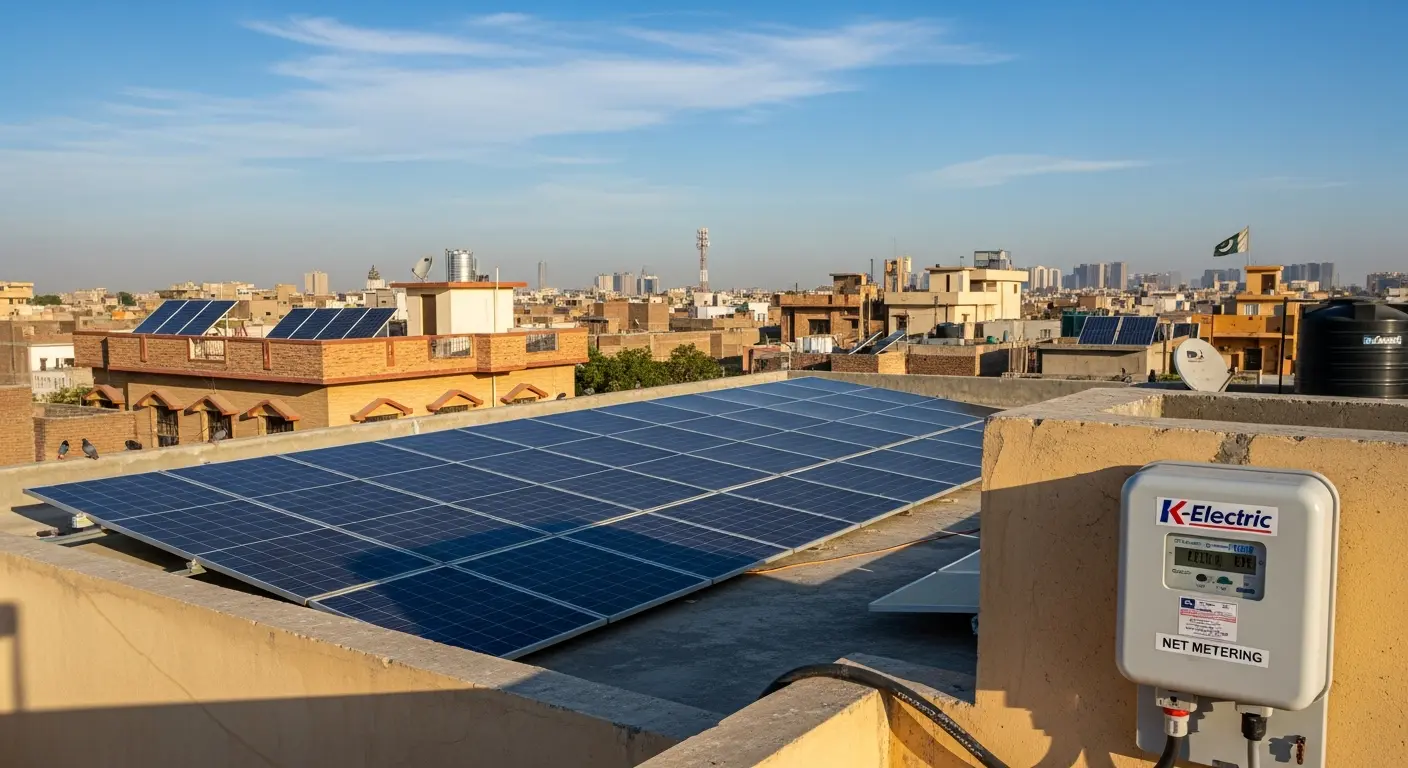
An On-Grid Solar Systems in Pakistan 2026 has become the most practical and affordable solution for millions of Pakistanis facing unprecedented electricity crises and soaring grid tariffs. Unlike off-grid or hybrid systems that require expensive batteries, on-grid systems connect directly to your local electricity grid—allowing you to generate clean power, use it immediately, and sell any surplus electricity back to the grid through net metering.
But here’s what you need to understand: With recent policy changes in 2026, the economics of on-grid solar have fundamentally shifted. The buyback rates have decreased, the system sizing rules have tightened, and smart metering requirements have changed. This means that choosing the right on-grid system today requires completely different thinking than it did just 12 months ago.
What Exactly Is an On-Grid Solar System?
The Basic Concept Explained Simply
An On-Grid Solar Systems in Pakistan 2026, also called a grid-tied or grid-connected solar system, is elegantly simple in concept but sophisticated in execution. Your solar panels generate direct current (DC) electricity from sunlight. This DC power flows to a specially designed inverter that converts it into alternating current (AC)—the same type of electricity that powers your lights, fans, and air conditioners.
Here’s where it gets interesting: any electricity your solar panels generate but you don’t immediately use flows back into the national electricity grid. Through a process called net metering, your electricity meter runs backward, giving you credits that offset your future electricity consumption when you draw power from the grid (typically at night or on cloudy days).
Think of it this way: the grid itself becomes your battery. During the day, you’re a generator exporting power. At night, you’re a consumer importing power. The difference—your net consumption—is what you pay for each month.
Key Components of an On-Grid Solar System
Unlike more complex hybrid or off-grid systems, on-grid solar has remarkably few components:
1. Solar Panels (PV Modules) Convert sunlight into DC electricity. A typical residential system uses 8-20 panels rated between 250-550 watts each.
2. On-Grid Inverter (String Inverter or Micro-Inverter) Converts DC power from panels into AC power compatible with your home’s electrical system and the national grid. This is the critical component that enables two-way power flow and communicates with the grid.
3. Meter (Two-Way or Smart Bi-Directional) Records both electricity consumed from the grid and electricity exported to the grid. New smart meters (mandated since 2025) provide real-time digital reading of both directions.
4. Wiring, Breakers & Safety Equipment AC and DC cables, DC combiner box, AC breaker, surging protective devices (SPDs), and earthing equipment ensure safe operation.
5. Mounting Structure & Installation Materials Aluminum racking system, bolts, clamps, and conduit that securely attach panels to your roof or ground.
Notably absent: Batteries. This is what makes on-grid systems significantly cheaper than hybrid or off-grid alternatives.
How On-Grid Solar Systems Actually Work: The Complete Process
Understanding the mechanics helps you appreciate why this technology is revolutionary for Pakistan.
Step 1: Solar Generation (Daytime – Peak Generation)
What Happens: Your solar panels absorb sunlight and convert it into DC electricity. On a clear day in Pakistan, a 5kW system generates approximately 15-20 kWh of electricity between 8 AM and 4 PM (peak generation hours).
Simultaneous Consumption: While your panels generate electricity, your home/business simultaneously uses power for:
- Air conditioning
- Refrigeration
- Water heaters
- Lighting (if needed)
- Electronic appliances
Net Result: If your consumption equals 10 kWh while your system generates 20 kWh, the excess 10 kWh flows backward through your electricity meter to the grid.
Step 2: Two-Way Power Flow (The Net Metering Magic)
What Happens: Your electricity meter, which used to spin in only one direction (measuring consumption), now spins backward when you export power. Modern smart meters track both directions separately, providing precise accounting of:
- Electricity imported from grid (kWh)
- Electricity exported to grid (kWh)
- Net consumption (difference between the two)
Behind the Scenes: The inverter and grid-protection equipment continuously monitor voltage, frequency, and power quality to ensure safe, seamless power flow in both directions. This happens automatically—you don’t need to do anything.
Step 3: Night Time & Cloudy Days (Night-Time Consumption)
What Happens: When your solar panels aren’t generating (nighttime or heavy overcast), your home draws power from the grid as usual. Your meter measures this consumption and tallies it against your export credits.
The Financial Calculation: If you exported 100 kWh to the grid during the month (earning credits) and consumed 80 kWh from the grid at night (incurring charges), your net consumption is 20 kWh.
Step 4: Monthly Billing Under Net Metering
Old System (2015-2024): Every kWh you exported was credited at approximately Rs. 27/kWh (equal to the grid rate). If you generated 100 kWh and consumed 80 kWh, you’d receive credits worth Rs. 20 (100-80 = 20 kWh credit at Rs. 27).
New System (2025 onwards): Export credits are now calculated at a reduced rate. Under the new Prosumer Regulations 2025:
- Export rate: Rs. 11.30-13/kWh (varies by DISCO)
- Import rate: Rs. 42-48/kWh (your actual tariff)
- This creates a significant “arbitrage gap” favoring self-consumption over export
Critical Understanding: Under the new policy, you’re financially incentivized to use as much solar power as possible immediately, rather than exporting it to the grid. The ROI still works, but the calculation has fundamentally changed.
The 2025-2026 Policy Changes Every Pakistani Needs to Know
This is where most online guides become dangerously outdated. The regulatory landscape in Pakistan has transformed dramatically.
What Changed in 2025 (NEPRA Prosumer Regulations 2025)
On December 17-18, 2025, Pakistan’s National Electric Power Regulatory Authority (NEPRA) introduced sweeping changes through the draft Prosumer Regulations 2025, which replace the previous 2015 Net Metering Regulations. Here are the substantive changes:
| Policy Element | Previous (2015-2024) | New (2025 onwards) | Impact on Consumers |
|---|---|---|---|
| Export Buyback Rate | Rs. 27/kWh (approximately NAPP) | Rs. 10-13/kWh (proposed) | 50-63% reduction in export income |
| System Sizing Limit | 1.5x sanctioned load (unlimited oversizing) | 1x sanctioned load (exact match) | Can’t build oversized systems for export profits |
| Agreement Duration | 7 years | 5 years | Faster transition to new terms |
| Smart Metering | Older digital/analog meters acceptable | Smart bi-directional meters mandatory | Real-time tracking but no efficiency improvement |
| Transformer Capacity Cap | No limit | 80% of transformer capacity | Prevents grid overloading at local level |
| Grandfathering Clause | N/A | Existing consumers protected until agreement expiry | Existing systems continue at old rates until 2026-2032 |
What This Means for New On-Grid Installations
Before January 2025: A household with a 10 kW sanctioned load could install a 15 kW solar system, generate substantial surplus, and profit from high export rates.
After January 2025: That same household can install maximum 10 kW, and surplus power exports earn only Rs. 10-13/kWh instead of Rs. 27/kWh.
The Strategic Implication: The “export-oriented” on-grid system model is now economically disadvantaged. The new model favors “self-consumption-oriented” systems where you match solar generation to your actual consumption patterns.
Existing Consumers Are Protected (For Now)
Critical Good News: If you installed an on-grid system before January 2025 and have a valid net metering agreement, you’re protected by a grandfathering clause. Your system continues operating under the old rules (Rs. 27/kWh buyback) until your 7-year agreement expires (2026-2032 depending on installation date).
When It Changes: After your contract expires, you’ll transition to the new Prosumer Regulations 2025 rates and sizing limits.
What About the Rumored Further Changes?
Pakistan’s government has discussed even stricter changes, including:
- Possible transition to “gross metering” (selling all generation at fixed rate, buying all consumption at full retail rate)
- Additional fixed charges on net-metered bills
- Possible capacity fees for prosumers
Current Status: These remain under consideration but haven’t been formally approved. The regulations released in December 2025 represent the official framework, though further modifications may occur.
On-Grid System Costs in Pakistan: Realistic 2026 Pricing
Competitor sites quote cost ranges that are dangerously outdated or misleading. Here’s the complete breakdown based on February 2026 market data.
Detailed Component Cost Analysis
| Component | Per Unit Cost | 5kW System Total | 10kW System Total | Notes |
|---|---|---|---|---|
| Solar Panels (per watt) | Rs. 27-39/watt | Rs. 135,000-195,000 | Rs. 270,000-390,000 | Tier-1 brands only (Longi, Jinko, Canadian, Trina) |
| On-Grid Inverter | Rs. 8,000-18,000/kW | Rs. 40,000-90,000 | Rs. 80,000-180,000 | MPPT technology preferred |
| Smart Bi-Directional Meter | Rs. 15,000-25,000 | Rs. 15,000-25,000 | Rs. 15,000-25,000 | Mandatory under new regulations |
| Wiring & Breakers | Rs. 3,000-5,000/kW | Rs. 15,000-25,000 | Rs. 30,000-50,000 | Safety-critical component |
| Mounting Structure | Rs. 2,000-3,500/kW | Rs. 10,000-17,500 | Rs. 20,000-35,000 | Aluminum racking, stainless fasteners |
| Installation Labor | Rs. 15,000-30,000/kW | Rs. 75,000-150,000 | Rs. 150,000-300,000 | Certified installer required |
| Permitting & Approval | Flat fee | Rs. 10,000-15,000 | Rs. 15,000-20,000 | Varies by DISCO region |
| TOTAL (Without Tax Exemption) | — | Rs. 700,000-1,067,500 | Rs. 1,450,000-1,975,000 | Range reflects brand/quality variation |
| TOTAL (With Tax Exemption) | — | Rs. 595,000-905,000 | Rs. 1,232,500-1,677,500 | 18% sales tax exemption applies |
Why Choose On-Grid Over Hybrid or Off-Grid?
This comparison clarifies why on-grid systems dominate Pakistan’s solar market.
On-Grid vs. Hybrid vs. Off-Grid: Complete Comparison
| Feature | On-Grid | Hybrid | Off-Grid |
|---|---|---|---|
| Grid Connection | Required & always connected | Connected but with battery backup | Not connected to grid |
| Initial Cost | Rs. 595K-905K (5kW) | Rs. 900K-1.4M (5kW) | Rs. 1.2M-2M+ (5kW) |
| Daytime Power Supply | 100% solar | 100% solar + grid | 100% solar |
| Night Time Power | Grid supply | Battery backup (4-12 hours) | Battery backup (must be sized for 24-48 hours) |
| Load-Shedding Protection | ❌ None (system stops) | ✅ Yes (battery continues) | ✅ Yes (battery continues) |
| Backup During Grid Outage | ❌ No | ✅ Yes (limited hours) | ✅ Yes (full autonomy) |
| Export/Income Generation | ✅ Yes (net metering) | ✅ Yes (excess only) | ❌ No option |
| Maintenance | Minimal (cleaning only) | Low (annual checks) | Moderate (battery maintenance) |
| Battery Replacement Cost | N/A | Rs. 300K-500K (year 10) | Rs. 600K-1M (year 10) |
| ROI Timeline | 4-6 years | 6-9 years | 8-12 years |
| Best For | Urban homes with stable grid | Unstable grid areas wanting backup | Remote areas, no grid access |
When On-Grid Makes Perfect Sense
✅ You live in a city or town with reasonably stable grid supply Even with load-shedding, on-grid systems provide better economics because you still have grid access most of the time.
✅ You can shift major consumption to daytime (new strategic necessity) Under 2025 policies, on-grid systems now favor self-consumption. If you can use ACs, heaters, or appliances during peak solar hours, on-grid economics improve significantly.
✅ You want maximum financial return on investment On-grid systems cost 40-50% less than equivalent hybrid systems, dramatically improving ROI despite lower export rates.
✅ You already have a hybrid or off-grid system and want to add grid connection Many Pakistanis are retrofitting existing systems to enable net metering, maximizing value of existing investments.
When On-Grid Might Not Be Ideal
❌ You experience 8+ hours of daily load-shedding If your grid is unavailable most of the day, on-grid systems can’t provide backup. Hybrid or off-grid becomes necessary.
❌ You need 24/7 backup power for critical loads If you run a medical facility, data center, or critical industrial process, you need battery backup. On-grid alone is insufficient.
❌ You live in an area with frequent complete grid failures If your DISCO network is extremely unreliable, a hybrid system provides the security you need.
The Complete Step-by-Step Installation Process for On-Grid Systems
Understanding what to expect helps you monitor quality and avoid delays.
Phase 1: Initial Assessment & Quotation (Days 1-3)
Site Visit: A certified solar engineer visits your property to:
- Assess roof condition, orientation, and sun exposure
- Identify potential shading from trees or neighboring buildings
- Determine structural capacity and reinforcement needs
- Review existing electrical panel and load capacity
- Calculate annual electricity consumption (from bills)
System Design: Engineer recommends specific system size (typically 60-100% of annual consumption for self-consumption strategy under new policies).
Cost Estimate: Detailed quotation including component brands, warranties, installation timeline, and payment terms.
Timeline: 1-2 days including site visit and design
How Much Money Will You Actually Save with On-Grid Solar?
This section provides realistic financial projections based on 2026 costs and policy.
Critical New Reality: The Export Rate Matters Less Than Before
Under the old policy, focusing on exports made sense. Under the new policy, self-consumption is king.
Example Scenario:
- Grid electricity costs: Rs. 45/kWh (weighted average including fixed charges)
- Export rate: Rs. 11.30/kWh (new policy)
- Arbitrage advantage of self-consumption: Rs. 33.70/kWh
This means every kWh you use immediately saves Rs. 45 (avoiding grid purchase), but every kWh you export earns only Rs. 11.30. The incentive to self-consume has tripled.
25-Year Savings Calculation (Realistic Scenario)
Assumptions:
- 5 kW on-grid system
- Current grid consumption: 150 kWh/month = 1,800 kWh/year
- Average electricity tariff: Rs. 45/kWh (current blended rate)
- System covers 80% of consumption (designed for new policy)
- Annual tariff increase: 7% (conservative, based on recent history)
- System degradation: 0.4% annually
- Installation cost: Rs. 750,000
- Maintenance: Rs. 5,000 annually (cleaning, inspections)
Year-by-Year Analysis:
| Year | Annual Generation | Annual Consumption | Annual Self-Consumption | Export (minimal) | Grid Import (20%) | Grid Cost | Solar Savings | Cumulative Savings |
|---|---|---|---|---|---|---|---|---|
| Year 1 | 6,000 kWh | 1,800 kWh | 1,440 kWh | 160 kWh | 360 kWh | Rs. 18,900 | Rs. 64,800 | Rs. 64,800 |
| Year 5 | 5,880 kWh | 2,098 kWh | 1,678 kWh | 220 kWh | 420 kWh | Rs. 28,050 | Rs. 75,510 | Rs. 364,650 |
| Year 10 | 5,640 kWh | 2,435 kWh | 1,948 kWh | 292 kWh | 487 kWh | Rs. 38,750 | Rs. 87,660 | Rs. 787,000 |
| Year 15 | 5,424 kWh | 2,827 kWh | 2,261 kWh | 389 kWh | 566 kWh | Rs. 51,240 | Rs. 101,745 | Rs. 1,350,000 |
| Year 20 | 5,200 kWh | 3,283 kWh | 2,626 kWh | 518 kWh | 657 kWh | Rs. 68,100 | Rs. 118,170 | Rs. 2,100,000+ |
| Year 25 | 4,976 kWh | 3,812 kWh | 3,050 kWh | 692 kWh | 762 kWh | Rs. 90,450 | Rs. 137,250 | Rs. 2,850,000+ |
Best On-Grid Solar Brands Available in Pakistan 2026
Not all solar brands are created equal. Quality varies dramatically.
Tier-1 Panel Manufacturers (Recommended)
Longi Solar Panels
- Price: Rs. 35-39/watt
- Efficiency: 20-22%
- Degradation: 0.2% annually (best-in-class)
- Warranty: 25 years performance, 15 years workmanship
- Availability: Excellent in Pakistan
- Why Choose: World’s largest solar manufacturer, proven reliability in hot climates, superior performance degradation curve
Jinko Solar Panels
- Price: Rs. 30-35/watt
- Efficiency: 19-21%
- Degradation: 0.35% annually
- Warranty: 25 years performance, 12 years workmanship
- Availability: Very good in Pakistan
- Why Choose: Best value-for-money option, growing market share in Pakistan, reliable performance
Canadian Solar Panels
- Price: Rs. 36-42/watt
- Efficiency: 20-22%
- Degradation: 0.3% annually
- Warranty: 25 years performance, 15 years workmanship
- Availability: Good in major cities
- Why Choose: Excellent performance in hot climate, trusted by commercial installers, premium quality
Trina Solar Panels
- Price: Rs. 32-38/watt
- Efficiency: 19-21%
- Degradation: 0.4% annually
- Warranty: 25 years performance, 15 years workmanship
- Availability: Good in major cities
- Why Choose: Balanced quality/price, expanding distribution in Pakistan
Tier-1 Inverter Manufacturers
Huawei (SUN2000 Series)
- Price: Rs. 60,000-120,000 (5-10kW models)
- Efficiency: 97-98%
- Features: WiFi monitoring, anti-islanding, grid support
- Warranty: 10 years standard, 25 years option
- Why Choose: Advanced monitoring, excellent grid integration, highly reliable
ABB (PVI-3.0-OUTD to PVI-10.0-OUTD)
- Price: Rs. 65,000-130,000 (5-10kW models)
- Efficiency: 96-98%
- Features: Robust design, excellent thermal management
- Warranty: 10 years standard, 20 years option
- Why Choose: Industrial-grade reliability, trusted by commercial installers
SMA (Sunny Boy Series)
- Price: Rs. 70,000-140,000
- Efficiency: 96-98%
- Features: Advanced diagnostics, remote management
- Warranty: 10 years
- Why Choose: German engineering, premium reliability, excellent technical support
Goodwe Series
- Price: Rs. 40,000-90,000
- Efficiency: 95-97%
- Features: WiFi monitoring, compact design
- Warranty: 10 years
- Why Choose: Affordable option with solid performance, growing support network in Pakistan
Avoid: Off-brand inverters from unknown manufacturers, inverters without warranty documentation, inverters older than 3 years (second-hand)

Pingback: How to Clean Solar Panels for Maximum Output & Safety Pro
Pingback: Solar Panel Cost in Pakistan 2026 - Full Cost Breakdown
Pingback: Off Grid Solar System Pakistan 2026- Complete Guide & Prices
Pingback: Net Metering Solar Panel Prices Reduction 2026 (Click Now)