
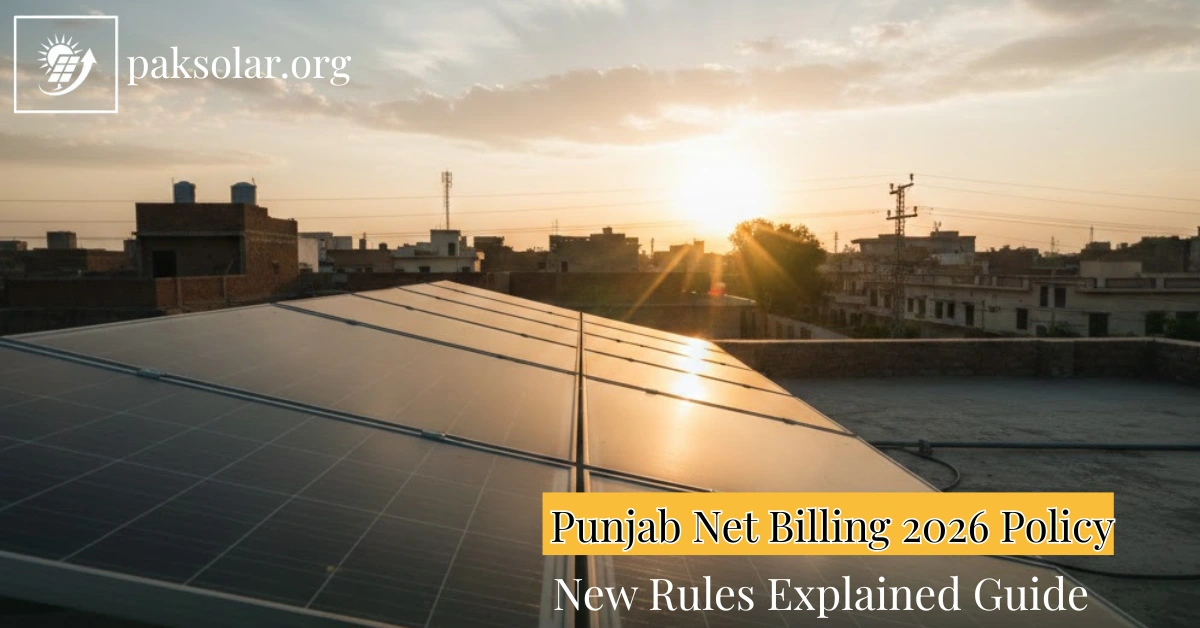
The Punjab Net Billing 2026 Policy represents a fundamental shift in how solar energy producers interact with the national grid, transitioning from a “unit-for-unit” exchange to a “cost-for-value” mechanism. Under the new National Electric Power Regulatory Authority (NEPRA) regulations, the traditional Net Metering system is being replaced by Net Billing, where electricity exported to the grid is purchased by the government at the National Average Energy Price (NAEP)—usually significantly lower than the tariff charged for consumed electricity.
This change is designed to reduce the financial burden on distribution companies (DISCOs) caused by capacity payments, but it has sparked widespread concern among consumers regarding the reduced Return on Investment (ROI) for solar installations. For homeowners and businesses in Punjab, this means that instead of merely offsetting units, you are now essentially selling power at a wholesale rate and buying it back at a retail rate, making efficient energy management and system sizing more critical than ever before.
What is the Punjab Net Billing 2026 Policy?
The Punjab Net Billing 2026 Policy is a regulatory framework introduced to manage the growing influx of distributed solar generation.
It modifies the agreement between solar consumers and power distribution companies (DISCOs) like LESCO, MEPCO, and GEPCO.
The core of this policy is the shift regarding how “excess” electricity is treated financially.
Previously, policies favored the consumer to encourage adoption, but the new framework shifts focus to grid sustainability.
It is crucial to understand that this policy applies to new connections and potentially renewable contracts.
Core Objectives of the Policy
The government aims to mitigate the rising circular debt in the energy sector.
By lowering the buy-back rate, the utility companies aim to reduce their payouts to solar owners.
It also seeks to balance the grid load by discouraging oversized solar systems installed purely for profit.
Another objective is to standardize the energy rates across different categories of consumers.
Finally, it aims to prepare the grid for a more competitive energy market structure in the future.
Net Metering vs. Net Billing: Key Differences
Understanding the distinction between Net Metering and Net Billing is vital for every solar owner.
In Net Metering, the grid acts like a battery that stores your excess units for later use.
If you export 100 units and import 100 units, your net bill is essentially zero (excluding taxes).
In Net Billing, the transaction is monetary, not volumetric.
You sell your 100 export units at a lower price (e.g., Rs. 27).
You buy your 100 import units at a higher price (e.g., Rs. 60).
The difference in price means you will likely owe money to the utility even if generation equals consumption.
Comparison Table: Net Metering vs. Net Billing
| Feature | Net Metering (Old Model) | Net Billing (2026 Model) |
|---|---|---|
| Concept | Unit-for-Unit Exchange | Monetary Transaction |
| Export Rate | Same as Off-Peak Tariff | National Average Energy Price (NAEP) |
| Import Rate | Applicable Tariff | Applicable Tariff (Higher) |
| Bill Settlement | Units are netted off first | Export value deducted from Import cost |
| ROI Period | 3-4 Years | 5-7 Years (Estimated) |
| Profitability | High | Low to Moderate |
Financial Implications for Solar Owners
The most significant impact of the 2026 policy is on the financial savings of solar system owners.
Under the previous regime, a 10kW system could virtually eliminate electricity bills.
With Net Billing, the value of your exported energy drops effectively by 30-40%.
This means that to achieve the same “zero bill” status, you might need a larger system or battery storage.
The “payback period”—the time it takes to recover installation costs—extends significantly.
Buying vs. Selling Rates
Currently, the grid electricity tariff for domestic users can go upwards of Rs. 65 per unit (inclusive of taxes).
Under Net Billing, the government might buy your solar units at the NAEP, which could be around Rs. 22-27.
This creates a “price wedge” of nearly Rs. 40 per unit.
Every unit you export and re-import later creates a financial loss compared to self-consumption.
This incentivizes using solar power while it is being generated (during the day).
Impact on New vs. Existing Connections
A major area of confusion is whether this policy applies retrospectively.
Existing Net Metering Users
Generally, laws are not applied retrospectively to existing legally binding contracts.
Consumers with active Net Metering licenses usually have a 3, 5, or 7-year term protected.
However, once the license expires or needs renewal, they may be forced to switch to Net Billing.
It is vital to check the specific expiry date on your NEPRA generation license.
Some analysts warn that amendments could allow DISCOs to migrate users sooner.
New Applicants in 2026
All new applications filed after the notification date will fall under the Net Billing regime.
New users must calculate their feasibility based on the new rates, not the old success stories.
This might lead to a slowdown in new solar installations in the residential sector.
However, industrial users might still find it viable due to high daytime consumption matching generation.
Why the Government Introduced This Policy
The government defends the policy change as a necessary economic adjustment.
Capacity Payment Issues
DISCOs pay Independent Power Producers (IPPs) based on installed capacity, not just usage.
When consumers move to solar, grid demand drops, but capacity payments remain fixed.
This forces the remaining grid users (often the poor) to bear higher costs per unit.
Net Billing attempts to recover some of this “fixed cost” revenue from solar owners.
Grid Instability Risks
Unregulated injection of solar power can cause voltage fluctuations and frequency issues.
Pakistan’s grid infrastructure is aging and struggles to handle massive reverse flows.
By reducing the incentive to export, the government hopes to limit grid strain.
This serves as a “soft cap” on the total amount of distributed generation capacity.
Strategies to Maximize Savings Under Net Billing
Adapting to the Punjab Net Billing 2026 Policy requires a change in consumption behavior.
Increase Self-Consumption
The golden rule under Net Billing is: Don’t Export, Consume.
Run heavy loads like ACs, washing machines, and water pumps during peak sun hours (10 AM – 3 PM).
Every unit consumed directly from solar saves you Rs. 65 (the import rate).
Every unit exported only earns you Rs. 27 (the export rate).
Shift your lifestyle to match the sun.
Hybrid Systems and Batteries
Battery storage becomes much more attractive under Net Billing.
Instead of exporting excess noon energy for cheap, store it in batteries.
Use that stored energy during the evening peak hours when grid rates are highest.
While batteries are expensive, the widening gap between buy/sell rates improves their feasibility.
Hybrid inverters allow you to blend solar, battery, and grid power efficiently.
The Role of Smart Monitoring
To navigate this new billing landscape, real-time data is essential.
Old green meters only showed total import/export at the end of the month.
Smart WiFi-enabled inverters allow you to see generation vs. consumption second-by-second.
You can automate appliances to turn on when excess solar is available.
This “load management” prevents cheap exports to the grid.
Criticisms and Public Reaction
The policy has faced severe backlash from various stakeholders in Punjab.
Solar Industry Concerns
Vendors fear a crash in demand for solar panels and inverters.
Thousands of jobs in the installation and maintenance sector could be at risk.
The Pakistan Solar Association has lobbied against these drastic rate cuts.
They argue it contradicts the national goal of increasing renewable energy share.
Consumer Outrage
Middle-class families who invested life savings into solar feel betrayed.
Social media campaigns have highlighted the unfairness of changing rules mid-game.
Critics argue that the government is punishing citizens for finding a solution to the energy crisis.
There are fears that this will discourage future green investments.
Future Outlook for Solar in Punjab
Despite the policy hurdles, the solar sector in Punjab is unlikely to die.
The grid electricity prices are projected to keep rising due to fuel costs and IMF conditions.
Even with Net Billing, solar remains cheaper than grid electricity in the long run.
The market will likely shift towards “self-consumption systems” rather than “export-heavy systems.”
We may see a rise in “Zero Export” devices that prevent power from going to the grid entirely.
Steps to Apply for Net Billing in 2026
If you still decide to proceed, here is the updated process.
- Select a Certified Installer: Only AEDB-certified vendors can process your file.
- Feasibility Analysis: Your vendor will calculate the system size based on the new ROI.
- Application Submission: Submit the application to your local DISCO (e.g., LESCO) subdivision.
- Technical Review: The SDO/XEN will review the transformer capacity in your area.
- NOC Issuance: If capacity allows, a No Objection Certificate is issued.
- Meter Installation: A bi-directional meter (green meter) is installed.
- License Generation: NEPRA issues the generation license under the Net Billing regime.
FAQs: Punjab Net Billing 2026
Will my existing Net Metering contract be cancelled?
Currently, existing contracts are protected for their valid term (usually 5-7 years).
Is solar still worth it in 2026?
Yes, but the payback period has increased from 3 years to approximately 5-6 years.
Can I opt out of Net Billing?
You can choose to go “Off-Grid” effectively, but you need significant battery backup.
What is the current buy-back rate?
It is pegged to the National Average Energy Price, fluctuating between Rs. 22 and Rs. 27.
Does this apply to commercial users?
Yes, the policy applies to domestic, commercial, industrial, and agricultural consumers.
Can I expand my existing system?
Expanding your system might trigger a new contract under the new Net Billing rules.
How do I calculate my new bill?
(Import Units x Tariff) – (Export Units x NAEP) = Net Bill Payable.
Are hybrid inverters better now?
Absolutely. Hybrid inverters with batteries allow you to hoard your cheap solar power.
Will the policy change again?
Energy policies in Pakistan are volatile; further amendments are always possible.
Who regulates these prices?
NEPRA (National Electric Power Regulatory Authority) determines the tariffs and rates.
Conclusion
The Punjab Net Billing 2026 Policy marks the end of the “golden era” of lucrative solar returns but signals the beginning of a mature, sustainable energy market. While the shift from Net Metering to Net Billing undeniably reduces the immediate financial benefits for consumers, it addresses critical structural issues within the national grid. For the average user, the strategy must shift from “maximizing exports” to “optimizing self-consumption.” Solar power is no longer a money-printing machine but remains a vital shield against inflation and rising electricity costs. By understanding these new rules, investing in battery storage, and managing load intelligently, residents of Punjab can still secure their energy independence in 2026 and beyond.
![Read more about the article How Did NEPRA Change Net Metering Policy in 2026? [Official Update]](https://paksolar.org/wp-content/uploads/2026/02/Sportsurge-Premier-League-Streams-26-300x157.webp)