
Pakistan faces one of the most challenging electricity crises in South Asia, with rolling blackouts, soaring electricity rates, and an aging grid infrastructure. With over 2 million Pakistani households now turning to solar energy, understanding solar inverter types in Pakistan has become essential knowledge for homeowners and businesses alike.
But here’s the thing—not all solar inverters are created equal. An inverter isn’t just a passive device that converts DC power to AC power. It’s the “brain” of your entire solar system, determining how efficiently your panels generate electricity, how long your system lasts, and ultimately, how much money you’ll save on your electricity bills over 20+ years.
What is a Solar Inverter and Why Does It Matter?
Before diving into the different types of solar inverters, let’s understand the fundamental role they play in your solar energy system.
A solar inverter is an electrical device that converts direct current (DC) electricity—the type generated by your solar panels—into alternating current (AC) electricity—the type used by your home appliances, lights, and the national grid. Without an inverter, solar panels cannot power anything useful in your home.
But inverters do much more than just convert electricity. Quality solar inverters also:
- Monitor system performance in real-time through smart monitoring apps
- Optimize power output using advanced tracking technologies like MPPT (Maximum Power Point Tracking)
- Provide safety features including arc fault protection and automatic grid disconnection
- Synchronize with the electrical grid to enable net metering programs
- Manage battery storage for backup power during outages (in hybrid systems)
- Handle voltage fluctuations common in Pakistan’s unstable grid
This is why choosing the right inverter type for Pakistan’s unique climate and grid conditions is critically important.
Main Categories of Solar Inverters
Solar inverters are classified into two primary systems: technology-based and application-based. Understanding both categories is essential for making an informed decision.
Technology-Based Classification of Solar Inverters
Solar inverters can be categorized based on their internal technology architecture. This classification determines how they connect to solar panels and convert power.
String Inverters (Most Common in Pakistan)
What they are: String inverters are the most widely used solar inverter type in Pakistan and globally. In a string inverter system, multiple solar panels are connected in series (a “string”) to create higher voltage output. Multiple strings can be connected in parallel to the single string inverter, which then converts all the DC power to AC power in one location.
How they work: In a typical 5kW string inverter installation in Pakistan, you might have 12-16 solar panels connected together in 2-4 strings. Each string feeds into the inverter, usually installed near your main electrical panel or on an external wall of your home. The inverter continuously monitors voltage and current from all panels, applies MPPT technology to extract maximum power, and converts everything to 230V AC power compatible with Pakistani homes.
Key characteristics:
- Single point of conversion from DC to AC
- Typically rated from 1kW to 10kW for residential use
- Lower cost compared to microinverters
- Easier installation with fewer electrical connection points
- Relies on a single MPPT controller
Advantages of string inverters in Pakistan:
- Most affordable option – Prices range from PKR 38,000 to PKR 80,000 depending on capacity
- Proven technology – Widely used for 20+ years globally with proven reliability
- Easier maintenance – Only one device to monitor and service
- Standardized warranties – Most brands offer 5-10 year warranties (local providers often offer 7-10 years)
- Simple troubleshooting – If there’s a problem, you know exactly where to look
- Wide brand availability – Leading Pakistani brands like Inverex, Knox, and Growatt all offer excellent string inverters
- Compatibility – Works well with the existing grid infrastructure in Pakistan
Disadvantages of string inverters in Pakistan:
- Shading issues – If one panel in a string is shaded (common in Pakistani cities with tall buildings), the entire string’s output drops significantly
- Panel mismatch problems – If panels of different wattages or ages are strung together, efficiency suffers
- Limited expansion – Adding new panels later often requires replacing the entire inverter if current capacity is exceeded
- No individual panel monitoring – You can’t see which specific panel is underperforming
- Hot spot risk – Shaded panels can overheat under partial shading conditions
Best for: String inverters are ideal for most Pakistani homeowners with unshaded roofs, consistent weather conditions, and moderate system sizes (3-8kW). They’re the most cost-effective choice for families wanting simple, reliable solar systems.
Microinverters (Emerging in Pakistan)
What they are: Microinverters are small devices, typically weighing 1-2 kg, that install directly under each solar panel on your roof. Unlike string inverters that convert power from multiple panels at once, each microinverter converts power from a single panel independently. This means a 10-panel system would have 10 microinverters.
How they work: Each panel’s DC output connects directly to its microinverter mounted on the roof. The microinverter converts the DC power to AC right at the source, then sends AC power down to your electrical panel. This distributed architecture means each panel is optimized independently, regardless of what neighboring panels are doing.
Key characteristics:
- Installed under each solar panel (distributed inverters)
- Panel-level MPPT optimization
- Can vary in wattage from 250W to 400W per unit
- AC power transmission from roof to electrical panel
- Networked monitoring of individual panels
Advantages of microinverters in Pakistan:
- Superior shading tolerance – If one panel is shaded, only that panel’s output is affected; others operate at full capacity
- Individual panel monitoring – You see exactly which panel is performing well and which is underperforming
- Easy expansion – Want to add 2-3 more panels? Just add the corresponding microinverters; no need to replace the main inverter
- Better with partial shading – Ideal for homes with irregular shading patterns from trees, buildings, or chimneys
- Optimal for roof complexities – Works great with multi-angle roofs or roofs with obstructions
- Longer lifespan potential – Distributed architecture means no single point of failure
- Modular redundancy – System continues working even if one microinverter fails
Disadvantages of microinverters in Pakistan:
- Higher initial cost – PKR 120,000-200,000 for a 5kW system (30-50% more expensive than string inverters)
- Limited brand availability – Few Pakistani companies stock microinverters; mostly imported
- Rooftop accessibility issues – Repairs require roof access to individual units
- AC wiring complexity – Requires AC cabling from roof to electrical panel (potentially more installation work)
- Harder to find local technicians – Microinverter repairs require specialized knowledge not yet common in Pakistan
- Long-term warranty support – Unclear if imported brands will service units after 5-10 years in Pakistan
Best for: Microinverters suit Pakistani homes with partial shading, complex roof angles, or plans to expand systems later. They’re ideal for urban apartments with neighboring buildings causing shade, though the high cost makes them a premium choice.
Power Optimizers (Hybrid Approach)
What they are: Power optimizers represent a middle ground between string inverters and microinverters. These are DC-DC converters that install under each panel (like microinverters) but only optimize the voltage; actual DC-to-AC conversion happens at a central inverter (like string inverters).
How they work: Each panel has a power optimizer underneath that maximizes the DC power from that panel and feeds it to a string. Multiple optimized strings then connect to a central inverter. This combines the panel-level optimization of microinverters with the efficiency of string inverters.
Key characteristics:
- DC-to-DC converters at each panel
- DC power transmission to central inverter
- Per-panel MPPT capabilities
- Central inverter handles final DC-to-AC conversion
- Modular and expandable like microinverters
Advantages of power optimizers in Pakistan:
- Shading tolerance – Better than string inverters but not quite as good as microinverters
- Lower cost than microinverters – PKR 80,000-140,000 for 5kW systems
- Simpler installation – Uses DC wiring like string systems but with optimizers
- Easier maintenance – Central inverter easier to service than individual microinverters
- Better expandability – Easier than string inverters, less complex than microinverters
- Hybrid scalability – Add panels and optimizers incrementally
Disadvantages of power optimizers in Pakistan:
- Rarely available – Pakistani market hasn’t widely adopted this technology yet
- Higher cost than string systems – 20-30% premium over basic string setups
- Technical complexity – Requires specialized knowledge for installation and troubleshooting
- Limited ecosystem – Few complementary products and monitoring solutions available
- Fewer local support options – Hard to find trained technicians in Pakistan
Best for: Power optimizers work well for tech-savvy users with moderate shading issues and decent budgets who want a middle-ground solution. However, this technology is still emerging in Pakistan, so local support is limited.
Application-Based Classification of Solar Inverters
Beyond technology types, solar inverters are classified based on how they interact with Pakistan’s electrical grid and backup power needs. This classification is crucial for determining which system matches your actual energy situation.
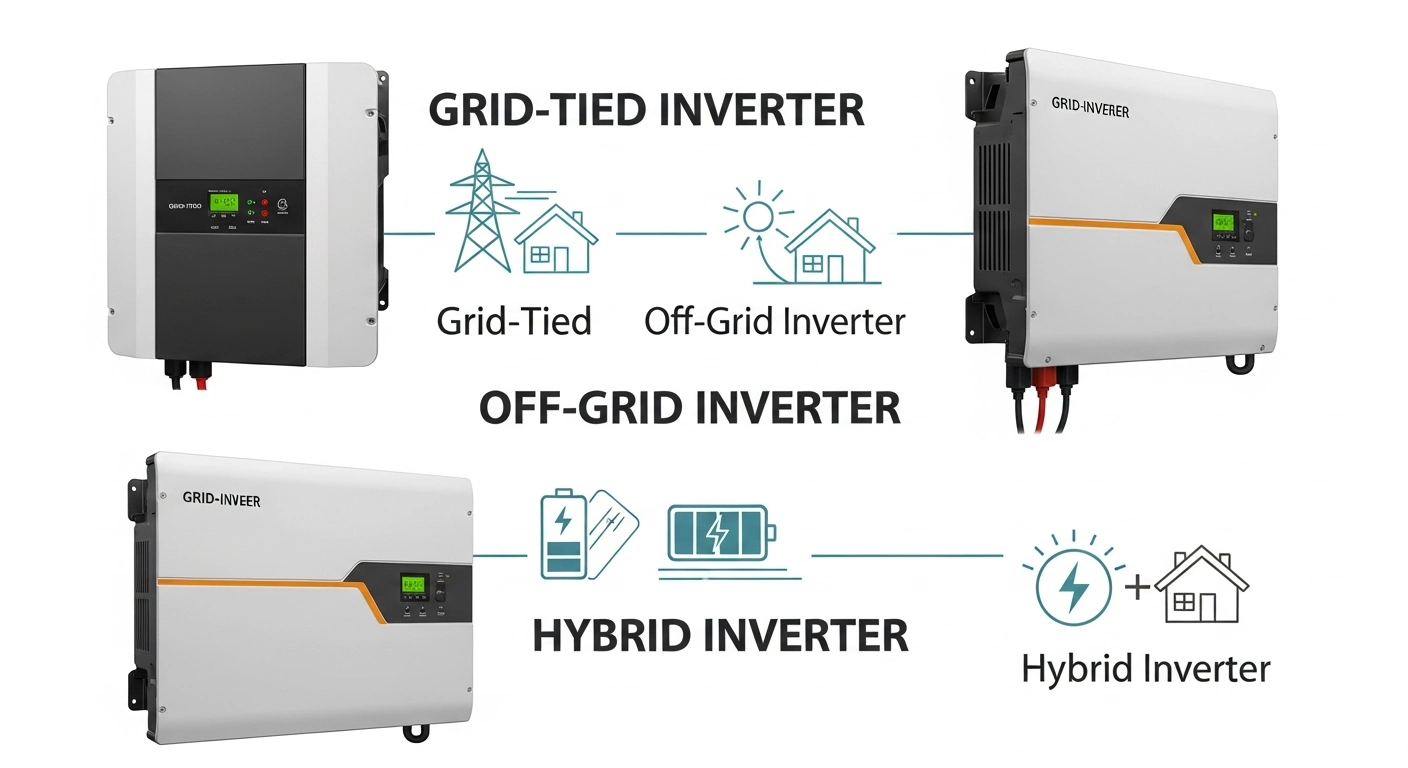
On-Grid (Grid-Tied) Inverters
What they are: On-grid inverters, also called grid-tied or grid-connected inverters, are designed to work exclusively with the utility grid (WAPDA in most of Pakistan). These inverters convert solar DC power to AC power that matches the grid’s frequency (50Hz in Pakistan) and voltage (230V single-phase or 400V three-phase).
How they work: Your solar panels generate DC electricity throughout the day. The on-grid inverter converts this to AC power that powers your home first. If your solar system produces more electricity than you’re currently using, the excess automatically feeds back into the grid. This happens without any batteries or manual switching. When the sun sets and your panels stop producing, the grid automatically supplies your electricity.
Key characteristics:
- Designed for grid synchronization (50Hz, 230V or 400V AC)
- No battery storage capability
- No backup power during grid outages
- Simplest design among all inverter types
- Highest efficiency rates (up to 98.6%)
- Net metering compatible
Advantages of on-grid inverters in Pakistan:
- Most affordable option – PKR 38,000-60,000 for 5kW residential systems
- Highest efficiency – Less conversion stages means minimal power loss
- Simplest installation – Straightforward connection to main electrical panel
- Smallest physical footprint – Takes up minimal wall space in your home
- Net metering eligibility – Can generate income through WAPDA’s net metering program
- Lowest maintenance – No batteries or complex components
- Best for savings – Fastest payback period (typically 4-6 years in Pakistan)
- Wide availability – Every solar provider in Pakistan stocks these
Disadvantages of on-grid inverters in Pakistan:
- No backup during outages – When grid goes down (frequent in Pakistan), system automatically shuts down for safety
- Requires stable grid – Voltage fluctuations can damage the inverter if not well-protected
- Cannot use at night – Completely dependent on grid availability
- No energy independence – Still vulnerable to rising electricity rates and grid failures
- Net metering uncertainty – Government policies on net metering rates and regulations keep changing
- Load shedding incompatibility – Cannot power your home during scheduled outages
Best for: On-grid inverters are perfect for Pakistani homes in areas with relatively stable grid supply and reasonable electricity costs, where the primary goal is reducing electricity bills. They suit users comfortable with being grid-dependent and wanting the fastest ROI.
Real-world example in Pakistan: A typical Karachi household with stable electricity supply (3-4 hours daily available) might install a 5kW on-grid system with Growatt inverter. During sunny hours (10 AM – 4 PM), the system generates 20-25 kWh daily, powering the home while feeding excess to WAPDA. Evening time, grid provides electricity. Annual savings: PKR 60,000-80,000 depending on system design.
Off-Grid (Standalone) Inverters
What they are: Off-grid inverters are designed for solar systems that operate completely independently from the utility grid. These systems must include battery storage to provide power when the sun isn’t shining.
How they work: Solar panels charge a battery bank during sunny hours. The off-grid inverter draws power from these batteries to power your home 24/7, regardless of grid availability. Advanced inverters use smart charging algorithms to maintain optimal battery health and charge management.
Key characteristics:
- Designed for standalone operation (no grid connection)
- Requires battery storage (lead-acid or lithium-ion)
- Manages battery charging and load distribution
- Operates at fixed voltage (48V, 96V, or 192V DC typical)
- Includes charge controllers for optimized battery charging
- No grid synchronization needed
Advantages of off-grid inverters in Pakistan:
- Complete energy independence – Never dependent on grid; works during all outages
- Ideal for rural areas – Areas without reliable grid access (parts of Balochistan, Sindh, KPK)
- Industrial backup applications – Factories and businesses avoiding production losses from outages
- Long-term protection – Hedges against future electricity price increases
- Environmental benefit – 100% clean energy usage
- No monthly electricity bill – Significant long-term savings
- Flexible load management – Ability to prioritize critical loads during cloudy days
Disadvantages of off-grid inverters in Pakistan:
- Very high initial investment – PKR 250,000-500,000+ for complete system with batteries
- Requires large battery bank – Expensive to maintain and eventually replace (PKR 100,000-300,000)
- Battery maintenance burden – Regular monitoring, water top-ups (lead-acid), and cycling management
- Limited autonomy – System capacity must cover cloudy days (3-5 days in winter)
- Shorter lifespan – Battery degradation is the limiting factor (batteries last 5-8 years typically)
- Complex design – Requires professional system sizing and installation
- Load restrictions – Cannot run heavy-duty appliances simultaneously if battery is small
- Regular replacement costs – Battery replacement every 5-8 years adds significant recurring costs
Hybrid Inverters (The Pakistani Favorite)
What they are: Hybrid inverters represent the best of both worlds, combining on-grid and off-grid capabilities. These inverters seamlessly switch between grid power and battery backup, optimizing for maximum savings and reliability. They’re increasingly the most popular choice in Pakistan.
How they work: During the day, excess solar power charges a battery bank while powering your home. The inverter intelligently manages charging to maximize battery lifespan. If grid power is available, it can charge batteries during off-peak hours (if available) or prioritize home usage. When grid fails (load shedding), batteries automatically power your home. When batteries are depleted, the inverter can charge them from grid power if you have surplus credit.
Key characteristics:
- Integrates on-grid and off-grid operation
- Manages both grid and battery power sources
- Includes built-in charge controller for battery management
- Supports both lead-acid and lithium batteries
- Automatic switching between grid and battery power
- Smart load management during low battery periods
Advantages of hybrid inverters in Pakistan:
- Solves Pakistan’s specific problems – Handles both rising electricity costs AND frequent load shedding
- Flexible battery integration – Start without batteries, add them later as budget allows
- Reduced battery requirement – Only need 1-2 days of autonomy, not 3-5 days like off-grid
- Smart energy management – Inverter learns your consumption patterns and optimizes charging
- Maximum cost savings – Combines on-grid efficiency with off-grid security
- Grid still available as backup – Batteries + Grid + Solar = triple safety net
- Future-proof – Works with net metering expansion and battery costs declining
- Government incentives – Many Pakistani renewable programs offer tax breaks for hybrid systems
- Scalable approach – Install small battery first, expand later as budget allows
Disadvantages of hybrid inverters in Pakistan:
- High initial cost – PKR 140,000-250,000 for inverter alone (plus batteries)
- More complex installation – Requires professional system design and wiring
- Battery still needs replacement – Even smaller batteries need replacing every 5-8 years
- Requires regular monitoring – Battery health and charging cycles need oversight
- Technical expertise required – Setup and troubleshooting more involved than simple on-grid
- Space requirements – Battery storage needs dedicated, temperature-controlled space
- Compatibility with existing systems – May not work with all current electrical setups without modifications
Comparison Table: Solar Inverter Types in Pakistan
| Feature | String Inverter | Microinverter | On-Grid | Off-Grid | Hybrid |
|---|---|---|---|---|---|
| Initial Cost (5kW) | PKR 38,000-60,000 | PKR 120,000-200,000 | PKR 38,000-60,000 | PKR 200,000-350,000 | PKR 140,000-200,000 |
| Battery Required | No | No | No | Yes (mandatory) | Yes (optional) |
| Grid Dependent | Yes | Yes | Yes | No | Partially |
| Performance in Shade | Poor | Excellent | Poor | Excellent | Good |
| Expansion Easy | Difficult | Very Easy | Difficult | Moderate | Moderate |
| Efficiency Rating | 96-97% | 96-97% | 97-98.6% | 92-94% | 94-96% |
| Warranty (Years) | 5-10 | 10-15 | 5-10 | 5-10 | 5-10 |
| Maintenance | Minimal | Low | Minimal | High | Moderate |
| Installation Complexity | Simple | Moderate | Simple | Complex | Moderate-Complex |
| Backup During Outage | No | No | No | Yes | Yes |
| Best for Pakistan | Budget-conscious | Shaded areas | Stable grid areas | Remote areas | Most homeowners |
| Payback Period | 4-6 years | 5-7 years | 4-6 years | 8-12 years | 6-8 years |
Popular Solar Inverter Brands & Types in Pakistan (2025-2026)
Understanding which brands specialize in which inverter types helps guide your purchase:
Top Pakistani Brands
Inverex (Nitrox, Veyron, Yukon Series) Type: String, Hybrid, On-Grid | Price: PKR 50,000-180,000 Strength: Excellent customer service, local support, MPPT technology, warranty backed by local presence Best for: Most Pakistani homeowners wanting local support
Knox Solar Type: Hybrid, On-Grid | Price: PKR 70,000-150,000 Strength: Rising popularity, affordable pricing, good warranty, specifically designed for Pakistan’s needs Best for: Budget-conscious buyers wanting reliable performance
Top International Brands Available in Pakistan
Growatt (Global Leader) Type: String, Hybrid, On-Grid | Price: PKR 45,000-180,000 Strength: Excellent mobile app monitoring, advanced MPPT, proven reliability, good local support growing Best for: Tech-savvy users wanting best monitoring capabilities
Huawei (Premium Choice) Type: String, Hybrid, On-Grid | Price: PKR 80,000-250,000 Strength: AI-powered optimization, highest efficiency (98.6%), advanced features, excellent warranty Best for: Large systems and commercial installations
SMA Solar Technology Type: String, Hybrid | Price: PKR 100,000-300,000 Strength: German engineering, industry standard, premium quality, excellent warranty Best for: Users prioritizing reliability over cost
Fronius (Austrian Quality) Type: String, Hybrid | Price: PKR 120,000-320,000 Strength: Transformerless design, excellent monitoring platform, premium reliability Best for: Premium installations with high reliability requirements
Solis (Value Leader) Type: On-Grid, Hybrid | Price: PKR 50,000-160,000 Strength: High efficiency, compact design, good price-performance ratio Best for: Budget-conscious buyers wanting quality
Sungrow (Scalable Solutions) Type: String, Hybrid, Industrial | Price: PKR 60,000-500,000+ Strength: Massive range from 1kW to 500kW, proven reliability, industrial-grade Best for: Large-scale commercial and industrial installations
Solar Inverter Sizing: Critical for Success
Choosing the correct inverter capacity (wattage) is crucial. An undersized inverter wastes your solar panel potential; an oversized one is unnecessary expense.
How to Size Your Inverter
Step 1: Calculate daily energy consumption Add up all your appliances and their daily usage hours. Example: 2 ACs (3000W × 6 hours) + Refrigerator (400W × 24 hours) + Lighting (500W × 8 hours) = 28.8 kWh/day
Step 2: Determine solar array size needed Pakistan receives 4-5.5 peak sun hours daily. To generate 28.8 kWh/day: 28.8 ÷ 4.5 = 6.4 kW solar array needed
Step 3: Choose inverter capacity Select inverter at 80-100% of array size: 6.4 kW array = 5-6.4 kW inverter
Critical rule: Your inverter capacity should never exceed 1.25× your panel capacity due to grid regulations and safety standards.

Pingback: What is Net Billing in Solar 2026? Must-Know Rules