
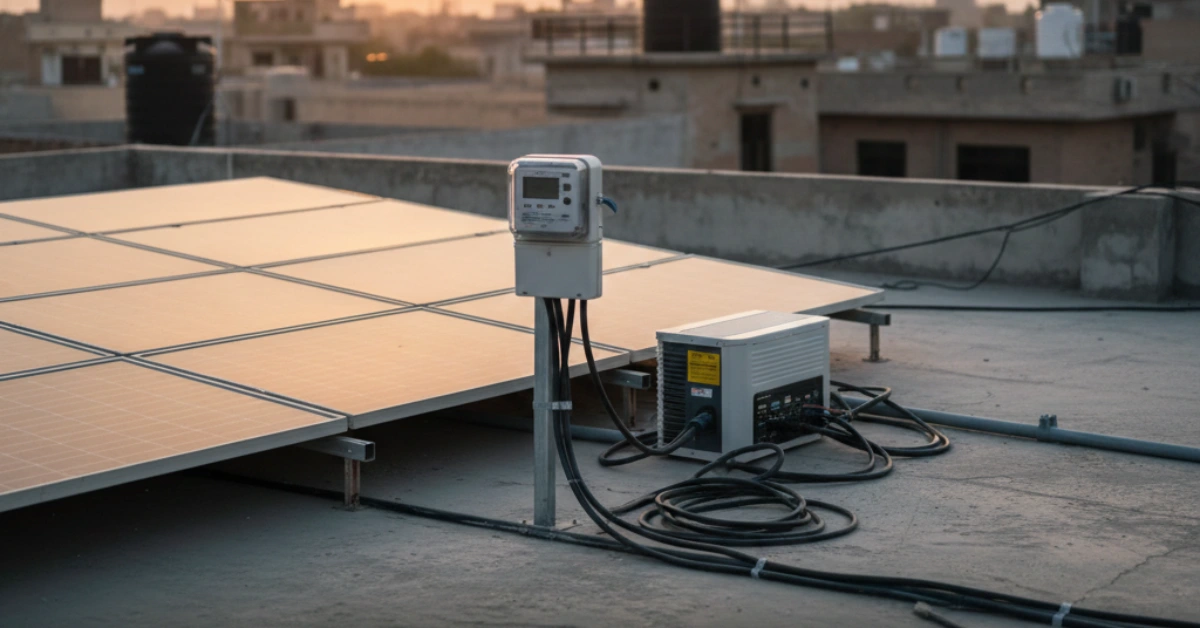
The solar net metering setup 2026 in Pakistan has become more streamlined yet increasingly complex due to NEPRA’s updated Prosumer Regulations replacing the 2015 framework. This comprehensive guide walks you through every step of installing and activating a solar net metering system in 2026, from initial solar panel installation through DISCO approval to final meter activation. Whether you’re a homeowner in Lahore looking to reduce electricity bills or a business owner in Karachi seeking commercial solar net metering, this article provides the complete roadmap for successful setup.
Understanding the current 2026 net metering requirements—including the transition to gross metering with updated export rates (PKR 11.30/unit vs. previous rates), 5-year agreement terms, and DISCO-specific procedures across LESCO, IESCO, FESCO, K-Electric, and others—ensures your installation complies with all regulations and achieves maximum financial returns.
What Is Solar Net Metering? Understanding the 2026 System
Net Metering Definition: How It Works
Solar Net Metering Setup 2026 In Pakistan is a billing mechanism allowing solar system owners to feed excess electricity back to the national grid and receive credits or payments for that energy. Unlike traditional one-way electricity flow (grid → home), net metering enables two-way flow:
The Net Metering Flow Process:
- Generation: Solar panels generate electricity during daylight hours
- Self-consumption: Home appliances consume generated power (priority)
- Excess export: Surplus electricity flows to grid
- Import at night: Grid supplies power when solar generation stops
- Units settlement: Monthly bill credits generated units against consumed units
- Final billing: You pay only for “net” consumption (consumption – generation)
Practical example (Pakistan 2026):
- Monthly solar generation: 350 units
- Monthly home consumption: 250 units
- Net credit: 100 units (exported to grid)
- Grid consumption nights/cloudy days: 100 units
- Net settlement: 100 – 100 = 0 units
- Monthly electricity bill: Only fixed charges, no energy costs
2026 Policy Update: Critical Changes from 2015 Framework
Major Transition: 2015 Net Metering → 2026 Prosumer Regulations
NEPRA notified the Prosumer Regulations 2026 (finalized in February 2026), making significant changes:
| Policy Element | 2015 Net Metering | 2026 Prosumer System | Impact |
|---|---|---|---|
| Billing Method | Unit-for-unit exchange | Gross metering with export rate | New calculation system |
| Export Rate | Rs 25-26/unit | Rs 11.30/unit | 55-60% rate reduction |
| Contract Duration | 7 years | 5 years | Shorter commitment |
| Capacity Limit | Up to 1MW allowed | Limited to sanctioned load | Smaller systems approved |
| Rate Adjustment | Fixed for contract | NEPRA can revise | Rate instability |
| Payment Timing | Monthly credit | Quarterly settlement | Cash flow impact |
| Existing Contracts | N/A | Grandfathered at old rates until expiry | 466,000 users protected temporarily |
Critical caveat: Existing net metering contracts (before February 9, 2026) remain protected at original rates. Only NEW applications after February 9, 2026, follow new prosumer regulations.
(link to your article on “NEPRA net metering regulations 2026 changes explained“)
Solar Net Metering Setup 2026: Complete Step-by-Step Process
Step 1: Install Solar System (Before Net Metering Application)
Critical requirement: You must have a functioning grid-tied or hybrid solar system BEFORE applying for net metering. This system must:
Technical Requirements:
- Minimum capacity: 1 kW (residential minimum)
- Maximum capacity: 1 MW
- Grid-connected inverter (not off-grid)
- Proper electrical wiring meeting IEC/IEEE standards
- Three-phase electricity connection (for most systems)
- Safe DC/AC protection systems (breakers, earthing, isolators)
Installation timeline: 1-2 weeks (5-10 working days)
Cost breakdown (5kW example, Pakistan 2026):
- Solar panels (9 × 600W): PKR 180,000-220,000
- Grid-tied inverter: PKR 120,000-150,000
- Mounting structure: PKR 40,000-60,000
- Wiring/breakers/earthing: PKR 30,000-50,000
- Professional installation labor: PKR 25,000-35,000
- Total: PKR 395,000-515,000
Installer requirement: Must use AEDB (Alternative Energy Development Board) certified installer. Uncertified installers’ systems receive automatic rejection.
Step 2: Engage AEDB-Certified Solar Company
Critical rule: You CANNOT directly apply for net metering in Pakistan. NEPRA regulations require intermediation through AEDB-certified solar companies.
Why AEDB certification required:
- Only AEDB-registered companies can submit valid net metering applications
- NEPRA reviews company credentials, not individual applications
- Certified companies handle documentation, DISCO coordination, approvals
- Uncertified installers’ applications automatically rejected
Finding AEDB-certified provider:
- Search AEDB official website (aedb.gov.pk) for approved installer list
- Verify certification status directly with AEDB
- Confirm installer has local DISCO working relationships (critical for smooth processing)
- Get references from 3+ previous net metering installations
Step 3: Prepare Technical Documentation
Your solar company prepares complete documentation required for DISCO submission:
Essential documents (2026 standard):
- System Design & Technical Specifications
- Single-line diagram
- Load calculations
- Inverter specifications
- Panel manufacturer details
- Protection system design
- Ownership/Property Documents
- Original electricity bill copy (latest)
- CNIC (Computerized National Identity Card) of applicant
- Property ownership proof (deed/lease agreement)
- Undertaking from property owner (if renting)
- NOC (No Objection Certificate) from building manager (if apartment)
- Safety & Compliance Certificates
- Electrical installation compliance certificate
- Load feasibility report from DISCO
- Transformer capacity verification
- System grounding report
- IEC/IEEE standards compliance statement
- Application Forms
- Official DISCO net metering application form
- Technical questionnaire (DISCO-specific)
- Undertaking for NEPRA compliance
Step 4: Submit Application to DISCO
Your certified solar company submits complete application to your local DISCO:
DISCO submission process:
- Submit physically at DISCO office OR
- Submit through authorized representative (usually your solar company)
- Request submission receipt/acknowledgment
- Confirm receipt within 48 hours via email/phone
Key DISCOs in Pakistan (all processing net metering in 2026):
- LESCO (Punjab – Lahore): +92-42-111-123-456
- IESCO (Islamabad): +92-51-111-123-456
- FESCO (Faisalabad): +92-41-111-123-456
- GEPCO (Gujranwala): Contact via LESCO
- K-Electric (Karachi): +92-21-111-123-456
- PESCO (Peshawar): +92-91-111-123-456
- MEPCO (Multan): +92-61-111-123-456
- HESCO (Hyderabad): +92-222-111-123-456
- SEPCO (Sukkur): Contact via HESCO
- QESCO (Quetta): Contact via provincial authority
Step 5: DISCO Technical Evaluation (7-10 Days)
After submission, DISCO initiates evaluation:
DISCO’s assessment process:
- Document review (2-3 days):
- Verify completeness
- Check for missing items
- Identify deficiencies
- Technical evaluation (3-5 days):
- Load flow calculations
- Grid compatibility assessment
- Transformer capacity check
- Protection system review
- Notification (1-2 days):
- Approval OR rejection notice via email/SMS
- If rejected: reasons and correction requirements listed
- If approved: proceed to site inspection scheduling
Common rejection reasons (avoid these):
- Uncertified installer (automatic rejection)
- Missing documents (incomplete application)
- System capacity exceeds sanctioned load (2026 new rule)
- Transformer capacity insufficient for system size
- Non-compliant safety equipment
- CNIC/property documents unclear or expired
Step 6: System Installation & DISCO Inspection (10-20 Days)
Upon approval, proceed with installation:
Installation phase:
- System installation (5-7 days):
- Mount panels on roof
- Install inverter
- Complete electrical connections
- Install breakers, isolators, earthing
- Pre-inspection preparation (2-3 days):
- Complete system testing
- Verify all connections
- Document final photos
- Ready for DISCO inspection
- DISCO site inspection (1 day):
- Inspector verifies physical installation
- Checks electrical safety compliance
- Tests system functionality
- Compares actual installation to approved design
- Issues inspection report (pass/fail)
Inspection timeline: DISCO schedules within 7-15 days of approval. Coordinate inspection date with your solar company.
Step 7: Bidirectional Meter Installation (7-15 Days)
Upon inspection approval, DISCO installs net metering meter:
Net metering meter specifications:
- Type: Bidirectional AMI (Advanced Metering Infrastructure) meter
- Function: Measures electricity flowing TO grid AND FROM grid
- Recording: Real-time data stored in meter memory
- Readings: Accessible via DISCO portal or physical meter check
Meter installation process:
- DISCO schedules meter installation (5-7 day notice typical)
- Professional technician installs bidirectional meter (replaces existing meter)
- System tested to confirm proper functioning
- Meter sealed and registered in DISCO’s database
- Installation certificate provided
Cost of bidirectional meter:
- Meter cost: PKR 15,000-25,000 (paid to DISCO)
- Installation: Included in DISCO fee
- Processing fee: PKR 500-1,500 (varies by DISCO)
Step 8: Energy Purchase Agreement Signing (3-5 Days)
Final step before activation:
Agreement details:
- Contract period: 5 years (2026 standard, 7 years for existing customers)
- Export rate: PKR 11.30/unit (2026 rate for new systems, higher for existing)
- Settlement period: Monthly/quarterly depending on DISCO
- Termination clause: Conditions for early termination
- Rate revision: NEPRA reserve right to adjust rates
Signing process:
- DISCO provides draft agreement
- Review agreement terms
- Sign agreement in presence of DISCO official
- Receive signed copy for records
Complete Timeline: Total Net Metering Setup Duration
| Phase | Days | Cumulative | Activities |
|---|---|---|---|
| Phase 1: Solar Installation | 7-14 | 7-14 | Panel/inverter installation, testing |
| Phase 2: Application Submission | 1-3 | 8-17 | Document preparation, DISCO submission |
| Phase 3: DISCO Screening | 7-10 | 15-27 | Document review, deficiency notification |
| Phase 4: Technical Evaluation | 10-15 | 25-42 | Load flow analysis, capacity check |
| Phase 5: Site Inspection | 7-15 | 32-57 | DISCO inspection scheduling and inspection |
| Phase 6: Meter Installation | 7-15 | 39-72 | Bidirectional meter procurement and install |
| Phase 7: Agreement & Activation | 3-5 | 42-77 | Agreement signing, system activation |
| TOTAL TIMELINE | 42-77 days | 42-77 days | Complete net metering setup |
Reality check: Most straightforward residential applications (5-10kW) achieve activation within 45-60 days with professional AEDB-certified installer handling all documentation.
FAQ: Solar Net Metering Setup 2026
Q1: Can I install solar panels myself and apply for net metering?
A: No. NEPRA regulations require AEDB-certified installers exclusively. DIY or unlicensed installer systems receive automatic rejection. The DISCO verifies installer certification before approving any application. Investment in certified installation (PKR 25,000-35,000 labor) is mandatory for net metering eligibility.
Q2: How much will my complete net metering setup cost in 2026?
A: 5kW system total cost breakdown: Solar equipment PKR 395,000-515,000 + DISCO meter PKR 15,000-25,000 + application/processing fees PKR 2,000-5,000 + meter installation included = Total PKR 412,000-545,000. Additional optional costs: hybrid battery (PKR 600,000-1,200,000 if adding backup power).
Q3: Will my monthly electricity bill become zero after net metering activation?
A: Depends on system sizing and consumption patterns. Perfectly matched systems (solar generation = consumption) result in zero energy charges. However, “fixed charges” (service charges, maintenance) typically remain PKR 1,000-3,000 monthly. Also, under new 2026 gross metering, export rate (PKR 11.30/unit) is lower than import rate (PKR 30-40/unit), so perfect offset requires different calculation than under 2015 rules.
Q4: What happens if my system produces more electricity than I use?
A: Excess generation is exported to grid. DISCO credits your account at export rate (PKR 11.30/unit under new rules). Credits accumulate monthly and offset future grid consumption. Unused credits may roll over to following month depending on DISCO policy. Some DISCOs settle unused annual credits as cash payment; others forfeit them. Confirm settlement policy with your DISCO.
Q5: Can my net metering contract be terminated before 5 years?
A: Theoretically yes, but with penalties. Breaking a 5-year net metering agreement typically incurs 20-30% early termination fee on remaining contract value. However, contract violation by DISCO (failure to credit units, meter malfunction) allows termination without penalty. Review agreement terms carefully before signing—early exit is expensive.
Conclusion: Solar Net Metering Setup 2026
The solar net metering setup 2026 process in Pakistan has become more structured yet requires careful navigation through updated NEPRA regulations and DISCO-specific procedures. The complete installation—from solar panel setup through bidirectional meter activation—typically spans 42-77 days with professional AEDB-certified installers managing all approvals.
Key success factors: (1) Use only AEDB-certified solar companies; (2) Prepare complete documentation with no missing items; (3) Understand new 2026 prosumer regulations (export rate PKR 11.30/unit, 5-year contracts); (4) Coordinate directly with your local DISCO; (5) Budget PKR 412,000-545,000 for complete 5kW residential setup.
Despite new rate reductions under 2026 prosumer regulations, net metering remains economically viable in Pakistan—typical residential systems achieve 4-6 year payback with ongoing 18-20 year savings. Install today, comply with regulations, and begin generating your own renewable energy while earning credits on excess generation.

![Read more about the article How Did NEPRA Change Net Metering Policy in 2026? [Official Update]](https://paksolar.org/wp-content/uploads/2026/02/Sportsurge-Premier-League-Streams-26-300x157.webp)