
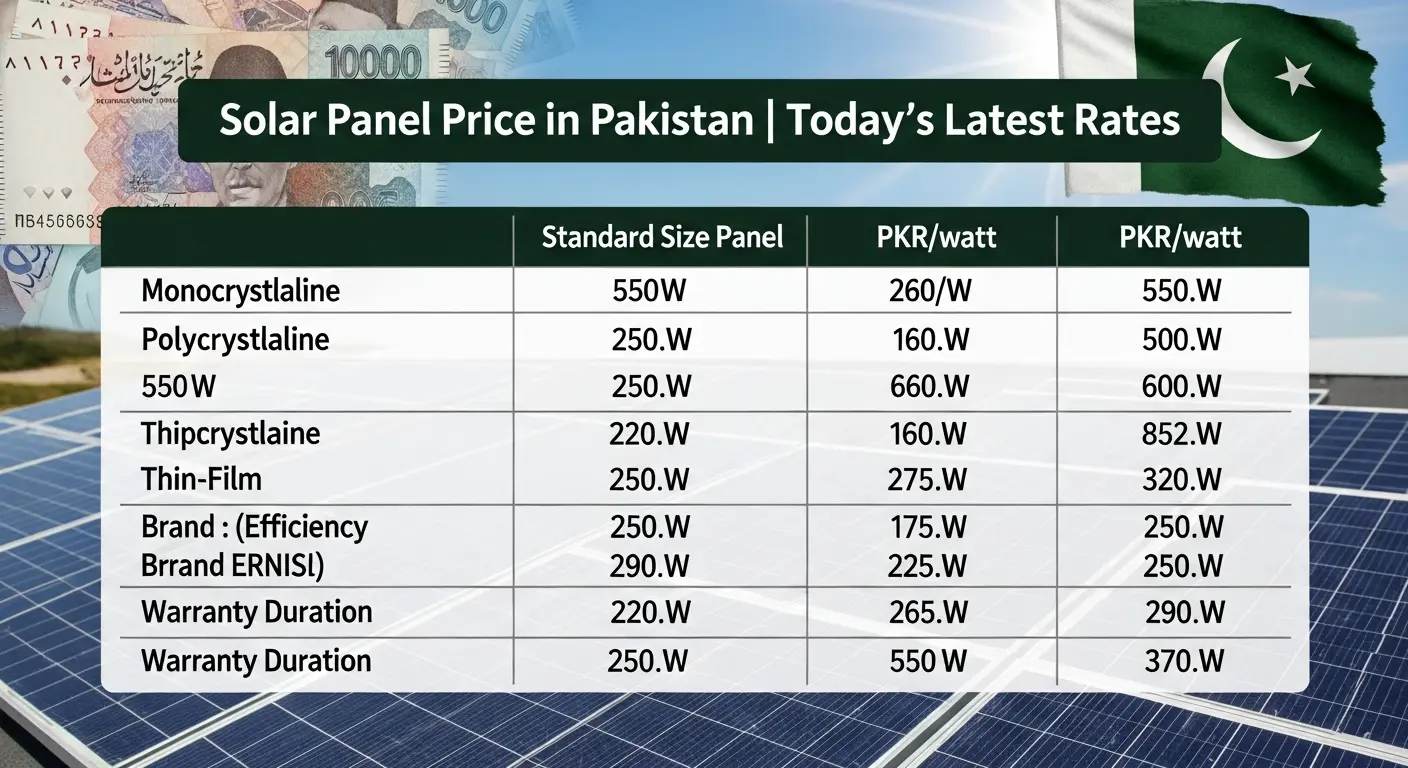
With electricity bills in Pakistan reaching unprecedented levels—averaging Rs. 25–50 per unit depending on your location and consumption slab—more Pakistani homeowners and businesses are asking the crucial question: What’s the actual solar panel price in Pakistan?
The answer is more complex than a single number. Solar panel prices in Pakistan vary dramatically based on brand, panel type, system size, quality grade, and whether you’re buying individual panels or a complete installation. As of January 2025, solar panel costs range from Rs. 27 to Rs. 40 per watt for high-quality A-grade panels from Tier-1 manufacturers, while complete solar system installations (5kW to 10kW) run between Rs. 660,000 to Rs. 1,800,000 depending on configuration.
This comprehensive guide breaks down every pricing factor, brand comparison, regional variations, and ROI calculations that Pakistani solar buyers need to make informed decisions. Whether you’re a homeowner in Lahore, a business owner in Karachi, or a farmer in Sindh, you’ll find actionable pricing information specifically tailored to Pakistan’s solar market.
If you have a small roof or limited space, a 1kW setup is the perfect entry point. You can find the latest 1000W Solar Panel Price in Pakistan 2026 in our updated pricing guide to see how affordable starting with solar can be.
Understanding Solar Panel Price in Pakistan: The Fundamentals
How Solar Panel Pricing is Calculated
Solar panels in Pakistan are priced primarily per watt (Rs./W), making it easy to compare across brands and system sizes. This per-watt pricing reflects the panel’s capacity to generate electricity under standard test conditions.
To calculate the total panel cost for a system:
Total Panel Cost = System Capacity (kW) × 1,000 × Per-Watt Price
For example, a 5kW system at Rs. 30 per watt costs: 5 × 1,000 × 30 = Rs. 150,000 for panels alone.
However, panel cost is only one component of your total installation. A complete solar system also includes:
- Inverter (Rs. 180,000–500,000 depending on type and capacity)
- Mounting structure and hardware (Rs. 25,000–100,000)
- Wiring, breakers, and electrical components (Rs. 15,000–40,000)
- Installation labor (Rs. 20,000–60,000)
- Net metering registration (Rs. 5,000–15,000, if applicable)
- Batteries (only for hybrid/off-grid systems)
This means panels typically represent 30–40% of your total system cost, with the inverter being the second-largest expense at 20–30%.
Price Per Watt vs. Price Per Panel: What’s the Difference?
Most solar suppliers quote prices per watt because it standardizes comparison across different panel sizes. However, when shopping, you’ll also see price per panel.
Example: A 580-watt panel priced at Rs. 30 per watt costs: 580 × 30 = Rs. 17,400 per panel
Understanding this conversion helps you:
- Compare quotes from different suppliers accurately
- Calculate total costs for different system sizes
- Identify overpriced or underpriced offerings
Always ask suppliers for per-watt pricing to ensure you’re comparing apples to apples, especially since panel wattages vary (400W, 500W, 580W, 620W models exist).
Current Solar Panel Prices in Pakistan by Grade and Type
As of January 2025, solar panel pricing in Pakistan varies significantly by quality grade and technology type.
A-Grade vs. B-Grade Panels: The Price Difference
| Criteria | A-Grade Panels | B-Grade Panels |
|---|---|---|
| Per-Watt Price | Rs. 27–40 | Rs. 18–26 |
| Efficiency | 21–23% | 18–20% |
| Warranty | 12–25 years | 5–10 years |
| Lifespan | 25–30 years | 15–20 years |
| Defects | None (certified perfect) | Minor visual defects, slightly lower output |
| Recommended For | Residential & commercial long-term | Short-term projects, budget-conscious |
| Price Difference | Baseline | 25–35% cheaper |
| Long-term ROI | Excellent (higher energy output) | Moderate (frequent replacements needed) |
Industry Recommendation: A-grade panels are strongly recommended for Pakistani installations, as they deliver:
solar panels are performing at peak efficiency. Most 5kW systems in Pakistan now use 9 to 10 high-wattage plates. You can read our detailed guide on what are the best and most efficient solar panels to optimize your generation.
- 20–30% higher energy output over their lifespan
- Better performance in Pakistan’s hot climate (efficiency doesn’t degrade as quickly)
- Longer warranties that provide peace of mind
- Superior cost per kWh when calculated over 25 years
Many Pakistani installers now recommend avoiding B-grade panels entirely, as the initial 25–35% savings are often negated by lower output and higher maintenance needs over 15–20 years.
Solar Panel Technology Types and Their Prices
Pakistan’s solar market offers three primary panel technologies:
Monocrystalline Solar Panels
Made from single-crystal silicon, monocrystalline panels are the efficiency leaders.
- Per-Watt Price: Rs. 30–40 (highest)
- Efficiency: 21–23%
- Appearance: Black color, small square cells, sleek design
- Best For: Limited roof space, maximum energy output
- Market Share in Pakistan: 85% of new installations
Monocrystalline dominates Pakistan because homeowners prefer maximum efficiency given rooftop space constraints. Most brands sold in Pakistan (Longi, Jinko, Canadian, JA Solar) manufacture premium monocrystalline panels.
Polycrystalline Solar Panels
Made from multiple silicon crystals, polycrystalline panels offer good efficiency at lower cost.
- Per-Watt Price: Rs. 24–32 (moderate)
- Efficiency: 18–20%
- Appearance: Blue color, multiple crystal structure visible
- Best For: Budget-conscious projects with ample roof space
- Market Share in Pakistan: 12% of installations
Polycrystalline is becoming less common in Pakistan as monocrystalline prices have dropped significantly. Most new customers opt for mono due to superior efficiency and declining price premiums.
Thin-Film Solar Panels
Made from thin layers of photovoltaic material, these panels are lightweight and flexible.
- Per-Watt Price: Rs. 20–28 (lowest)
- Efficiency: 15–18% (lowest)
- Appearance: Dark brown or black, uniform surface
- Best For: Flexible installations, low-light performance
- Market Share in Pakistan: <3% of installations
Thin-film panels rarely appear in Pakistan’s residential market due to low efficiency and space limitations. They’re occasionally used for special applications requiring flexibility.
Verdict: Monocrystalline A-grade panels are the clear choice for Pakistani installations, offering the best long-term value despite slightly higher upfront costs.
Solar Panel Prices by Brand in Pakistan (January 2025)
The brand you choose significantly impacts both price and reliability. Pakistan’s solar market features Tier-1 international manufacturers and some emerging local brands.
Tier-1 Global Brands (Recommended)
These manufacturers have global certifications, proven field performance in Pakistan, and strong warranty support.
Longi Solar
- Per-Watt Price: Rs. 32–40
- Popular Models: Hi-MO 6 series (580W), Hi-MO X (600W)
- Efficiency: 22–23%
- Warranty: 12-year product, 25-year performance
- Why It’s Popular: Most popular brand in Pakistan due to consistent quality, strong warranty, and excellent after-sales service
- Typical Panel Cost: 580W panel = Rs. 17,480–23,200
Jinko Solar
- Per-Watt Price: Rs. 30–32
- Popular Models: Tiger series (550W–620W), Bifacial panels
- Efficiency: 21–23%
- Warranty: 12-year product, 25-year performance
- Why It’s Popular: Competitive pricing, rising market share, excellent efficiency
- Typical Panel Cost: 580W panel = Rs. 17,400–18,560
Canadian Solar
- Per-Watt Price: Rs. 31–34
- Popular Models: HiKu series (580W–620W), Bifacial options
- Efficiency: 22–23%
- Warranty: 12-year product, 25-year performance
- Why It’s Popular: Premium quality, excellent durability in Pakistan’s hot climate, strong reputation
- Typical Panel Cost: 580W panel = Rs. 18,000–21,000
JA Solar
- Per-Watt Price: Rs. 27–31
- Popular Models: Mono series (400W–600W), JAM series
- Efficiency: 20–22%
- Warranty: 12-year product, 25-year performance
- Why It’s Popular: Best value for money, excellent efficiency, competitive pricing
- Typical Panel Cost: 580W panel = Rs. 15,660–17,980
Trina Solar
- Per-Watt Price: Rs. 28–33
- Popular Models: Vertex series (400W–600W), Bifacial panels
- Efficiency: 21–23%
- Warranty: 12-year product, 25-year performance
- Why It’s Popular: Excellent efficiency, competitive pricing, growing market presence in Pakistan
- Typical Panel Cost: 580W panel = Rs. 16,240–19,140
| Brand | Price Range (Rs./W) | Best For | Market Position |
|---|---|---|---|
| Longi | 32–40 | Premium quality seekers | #1 in Pakistan |
| Canadian Solar | 31–34 | Hot climate performance | #2 premium choice |
| Trina | 28–33 | Balanced quality/price | Rising market share |
| Jinko | 30–32 | Good efficiency | Competitive |
| JA Solar | 27–31 | Budget-conscious buyers | Best value option |
Emerging Local and Regional Brands
Crown Solar
- Per-Watt Price: Rs. 25–30
- Warranty: 10-year product, 25-year performance
- Suitable For: Budget installations, agricultural use
- Note: Domestic brand, lower market recognition, but improving quality
Inverex Solar (Pakistani company)
- Per-Watt Price: Rs. 30–33
- Warranty: 10-year product, 25-year performance
- Suitable For: Pakistani buyers preferring local brands
- Note: Inverex is known for inverters; their panel quality is improving
Important Note: When comparing prices, always verify that quotes include certified, documented A-grade Tier-1 panels. Some suppliers quote lower prices using B-grade panels or unbranded products that may not be genuine.
Complete Solar System Prices in Pakistan (January 2025)
Most Pakistanis don’t buy individual panels—they install complete systems. Here’s what complete installations cost by system size:
3kW Solar System (Small Residential)
Best for: Small homes, 2–3 room apartments
Components:
- 5–6 solar panels (600W+ each)
- 3kW on-grid or hybrid inverter
- Mounting structure and wiring
- Installation and net metering
Price Breakdown:
| Component | Cost (Rs.) |
|---|---|
| Solar Panels (3kW) | 90,000–120,000 |
| On-Grid Inverter (3kW) | 85,000–120,000 |
| Mounting & Structure | 30,000–45,000 |
| Wiring & Electrical | 15,000–25,000 |
| Installation Labor | 15,000–25,000 |
| Net Metering Registration | 5,000–10,000 |
| Total (On-Grid) | 240,000–345,000 |
| Batteries (if hybrid) | 150,000–300,000 |
| Total (Hybrid) | 390,000–645,000 |
Daily Energy Production: 12–15 units Monthly Savings: Rs. 3,600–6,000 (on electricity bills) Payback Period: 5–7 years (on-grid), 8–10 years (hybrid)
5kW Solar System (Standard Residential)
Best for: Average Pakistani home, 4–6 room house
Components:
- 9–10 panels (580W each)
- 5kW on-grid inverter or hybrid inverter
- Complete mounting, wiring, and installation
- Net metering setup
Price Breakdown:
| Component | Cost (Rs.) |
|---|---|
| Solar Panels (5kW) | 150,000–200,000 |
| On-Grid Inverter (5kW) | 140,000–180,000 |
| Mounting & Structure | 40,000–60,000 |
| Wiring & Electrical | 20,000–35,000 |
| Installation Labor | 20,000–40,000 |
| Net Metering Registration | 5,000–15,000 |
| Total (On-Grid) | 660,000–780,000 |
| Hybrid Inverter | 180,000–240,000 |
| Batteries (4–6 units) | 200,000–350,000 |
| Total (Hybrid) | 810,000–1,000,000 |
Daily Energy Production: 20–25 units Monthly Savings: Rs. 6,000–10,000 Payback Period: 4–6 years (on-grid), 6–9 years (hybrid)
10kW Solar System (Large Residential/Commercial)
Best for: Large homes, small businesses, agricultural pump systems
Components:
- 18–20 panels (580W each)
- 10kW on-grid or hybrid inverter
- Heavy-duty mounting and 3-phase wiring
- Installation and net metering
Price Breakdown:
| Component | Cost (Rs.) |
|---|---|
| Solar Panels (10kW) | 300,000–400,000 |
| On-Grid Inverter (10kW) | 250,000–350,000 |
| Mounting & Structure | 80,000–120,000 |
| Wiring & Electrical Components | 40,000–60,000 |
| Installation Labor | 40,000–70,000 |
| Net Metering & Misc. | 10,000–20,000 |
| Total (On-Grid) | 1,200,000–1,500,000 |
| Hybrid Inverter | 300,000–450,000 |
| Battery Bank (8–10 units) | 400,000–700,000 |
| Total (Hybrid) | 1,800,000–2,300,000 |
Daily Energy Production: 40–50 units Monthly Savings: Rs. 12,000–20,000+ Payback Period: 3–5 years (on-grid), 6–8 years (hybrid)
System Type Comparison: On-Grid vs. Hybrid vs. Off-Grid
| Factor | On-Grid | Hybrid | Off-Grid |
|---|---|---|---|
| Total Cost (5kW) | Rs. 660–780k | Rs. 810–1,000k | Rs. 900–1,200k |
| Backup During Load-Shedding | No | Yes | Yes |
| Net Metering Possible | Yes | Yes | No |
| Complexity | Low | Medium | High |
| Maintenance | Minimal | Moderate | High (batteries) |
| Best For | Cities with reliable grid | Uncertain grid areas | Remote locations |
| Market Popularity in PK | 75% | 20% | 5% |
Solar Inverter Prices in Pakistan (A Major Cost Component)
The inverter is typically the second-largest expense in your solar system after panels. Understanding inverter pricing is critical.
Inverter Types and Prices
On-Grid Inverters (Most Common)
- Function: Converts DC to AC, connects directly to national grid
- Capacity Range: 3kW–15kW
- Price Range: Rs. 85,000–350,000
- Brands: Goodwe, Solis, Fronius, SMA, Sunsynk
- Best For: Urban areas with stable grid connection
- 3kW Model: Rs. 85,000–120,000
- 5kW Model: Rs. 140,000–180,000
- 10kW Model: Rs. 250,000–350,000
Hybrid Inverters (Growing Market)
- Function: Works with grid AND batteries, switches automatically
- Capacity Range: 3kW–10kW
- Price Range: Rs. 140,000–450,000
- Brands: Goodwe, Solis, Huawei, Fox-ESS, Growatt, Sunsynk
- Best For: Areas with load-shedding, unreliable grid
- 3kW Model: Rs. 140,000–180,000
- 5kW Model: Rs. 180,000–240,000
- 10kW Model: Rs. 300,000–450,000
Off-Grid Inverters (Rare in Pakistan)
- Function: Standalone operation, requires batteries
- Capacity Range: 3kW–10kW
- Price Range: Rs. 150,000–400,000
- Best For: Remote areas without grid connection
- Note: Rarely installed in Pakistan due to high battery costs
Popular Inverter Brands in Pakistan:
- Goodwe (Chinese) – Best value, widely available, Rs. 85–350k
- Solis (Chinese) – Excellent quality, growing popularity, Rs. 90–360k
- Fronius (Austrian) – Premium quality, high cost, Rs. 150–500k
- Huawei (Chinese) – Advanced features, good warranty, Rs. 120–400k
- Sunsynk (Local/South African) – Designed for African climate (similar to Pakistan)
- Growatt (Chinese) – Budget-friendly, Rs. 80–300k
- Knox (Pakistani) – Local brand, affordable, Rs. 70–280k
- Inverex (Pakistani) – Local manufacturer, Rs. 85–350k
Solar Battery Prices in Pakistan (2025)
As net metering rates decline (now Rs. 11/unit from previous Rs. 25.98/unit), batteries are becoming essential for maximizing solar ROI.
Battery Type Pricing
Lead-Acid Tubular Batteries (Traditional, Still Common)
- Capacity: 150–250Ah
- Voltage: 12V (24V and 48V banks possible)
- Price Per Battery: Rs. 50,000–80,000
- Lifespan: 5–7 years
- Cycle Life: 1,500–2,000 cycles
- Best For: Budget-conscious, moderate backup needs
- System Cost Example (5kW with 4 batteries): Rs. 200,000–320,000
Lithium-Ion Batteries (Modern, Growing Fast)
- Capacity: 100–200Ah
- Voltage: 48V systems (more efficient than 12V)
- Price Per Unit: Rs. 180,000–400,000 (depending on capacity)
- Lifespan: 10–15 years
- Cycle Life: 5,000–10,000+ cycles
- Best For: Long-term investment, maximum uptime
- System Cost Example (5kW, 10kWh storage): Rs. 600,000–1,000,000
- Brands: BYD, CATL, LiFePO₄ brands, Tesla Powerwall
- Note: Lithium prices dropped 40–50% since 2023 in Pakistan
LiFePO₄ Batteries (Safest Lithium Option)
- Capacity: 100–300Ah
- Voltage: 48V (most efficient)
- Price Per Unit: Rs. 200,000–450,000
- Lifespan: 15–20+ years
- Cycle Life: 8,000–15,000+ cycles
- Best For: Premium long-term solutions
- Safety: Best thermal stability, safest chemistry
- Note: Becoming affordable in Pakistan; many installers recommend these for hybrid systems
GEL and AGM Batteries (Middle Ground)
- Price Per Unit: Rs. 60,000–100,000
- Lifespan: 7–10 years
- Note: Less common in Pakistan; hybrids usually choose lead-acid or lithium
Complete Hybrid System Battery Example
A typical 5kW hybrid system with 8–10 hours backup might use:
Option 1: Lead-Acid (Budget)
- 6 × 12V 250Ah batteries = Rs. 300,000–480,000
- Inverter: Rs. 180,000–240,000
- Total Battery Investment: Rs. 480,000–720,000
Option 2: Lithium (Modern)
- 1 × 48V 10kWh lithium system = Rs. 500,000–800,000
- Inverter: Rs. 200,000–300,000
- Total Battery Investment: Rs. 700,000–1,100,000
The Shift: 2025 is a turning point. Lithium battery prices have fallen below lead-acid costs per kWh of usable energy, making lithium the better long-term choice despite higher upfront costs.
Price Trends and Future Outlook (2025–2026)
Understanding where prices are headed helps you decide whether to buy now or wait.
Solar Panel Price Trends
Historical Context (2018–2025):
- 2018: Rs. 60–70 per watt
- 2021: Rs. 45–55 per watt (first major decline)
- 2023: Rs. 32–40 per watt (sharp drop due to global oversupply)
- 2025: Rs. 27–40 per watt (current range)
Why Prices Fell So Dramatically:
- Global oversupply: China manufactured more panels than the world could absorb
- Manufacturing efficiency: Production costs dropped 70% over a decade
- Competition: Hundreds of Chinese manufacturers competing fiercely
- Technology advancement: Higher-efficiency cells cheaper to produce

Pingback: Solar Panel Price in Pakistan Today - Fresh Rates