Are you tired of skyrocketing electricity bills in Pakistan? With power tariffs reaching record highs and load-shedding becoming an everyday reality, thousands of Pakistanis are switching to solar energy. But here’s the big question everyone asks: What is the actual Solar Panel Price in Pakistan today?
This comprehensive guide reveals the latest solar panel prices, hidden costs, brand comparisons, and insider tips to help you make the smartest solar investment. Whether you’re planning a small 3kW home system or a large commercial installation, you’ll find everything you need right here.
Latest Solar Panel Price in Pakistan (February 2026)
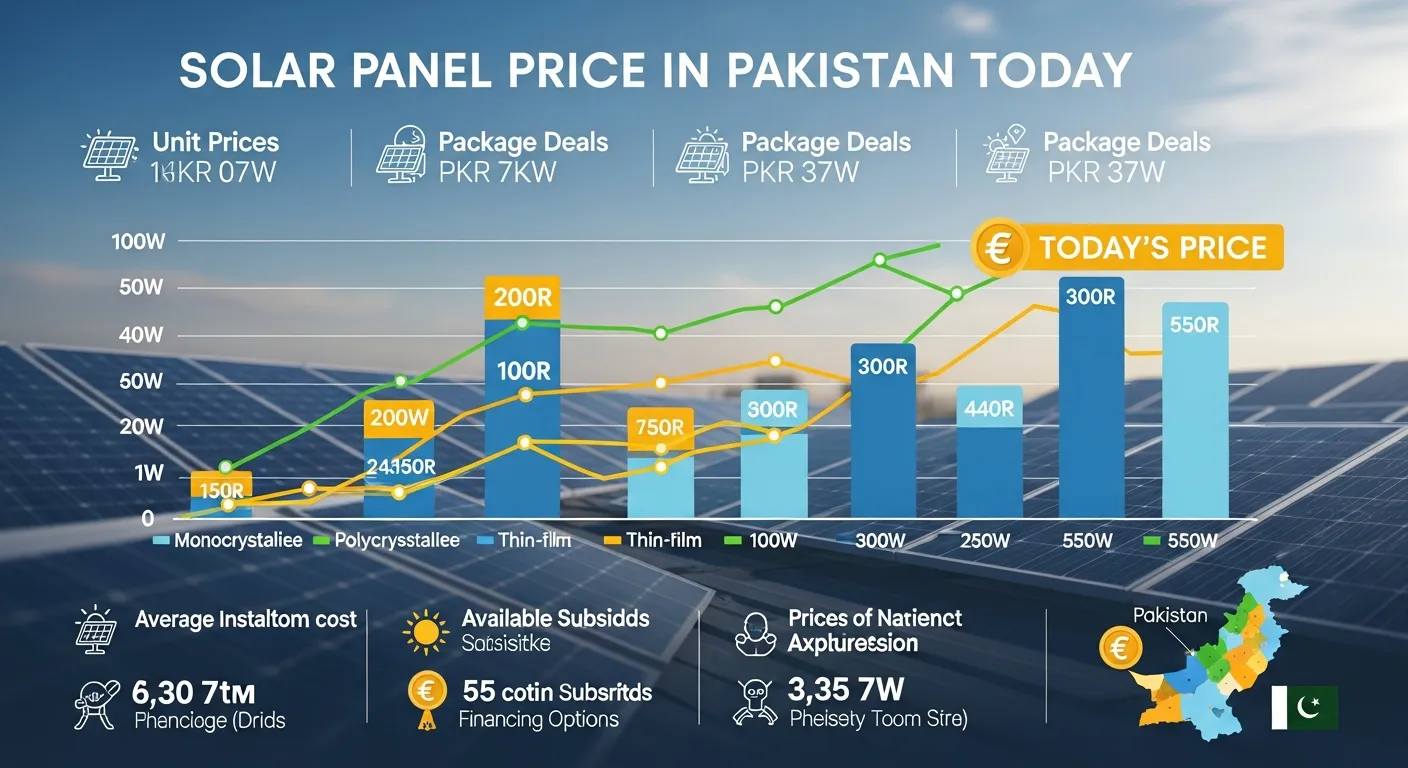
Solar Panel Price in Pakistan today have experienced significant changes in early 2026. As of February 2026, solar panel prices range from PKR 27 to PKR 40 per watt, depending on the brand, technology, and grade.
Breaking News: Recent Price Surge
In Feb 2026, Solar Panel Price in Pakistan today jumped dramatically across Pakistan. According to market reports, popular Chinese solar panels increased by approximately PKR 5,000 per panel. Here’s what happened:
- 585-watt panels: Now PKR 20,000-21,000 (previously PKR 16,000-17,000)
- 645-watt panels: Now PKR 24,000-25,000 (previously PKR 20,000)
- 720-watt panels: Now PKR 30,000-35,000 (previously PKR 22,000-25,000)
This price increase stems from rising global silver and copper prices, increased manufacturing costs in China, and import taxes on Chinese solar equipment. Additionally, solar battery prices have increased by approximately 10% in the past month.
Top Solar Panel Brands & Prices in Pakistan (2026)
When it comes to quality and reliability, Tier-1 brands dominate Pakistan’s solar market. Here’s a detailed breakdown of the most popular brands and their current prices:
Premium Tier-1 Solar Panel Brands
| Brand | Price Per Watt | Popular Models | Panel Price Range | Technology Type |
|---|---|---|---|---|
| Longi Solar | PKR 32-40 | HiMO7 605W, 585W | PKR 19,000-23,000 | N-Type, TOPCon |
| Jinko Solar | PKR 30-35 | N-Type 580-585W | PKR 16,675-21,000 | N-Type, Mono PERC |
| Canadian Solar | PKR 31-37 | TOPCon 580W+ | PKR 18,000-22,000 | TOPCon, Bifacial |
| JA Solar | PKR 30-34 | 550-580W | PKR 16,300-20,000 | Half-Cut, Mono |
| Trina Solar | PKR 31-35 | N-Type 580W+ | PKR 18,000-21,000 | N-Type, TOPCon |
| Astronergy | PKR 29-33 | N-Type 580W | PKR 16,965-19,500 | N-Type, TOPCon |
Budget-Friendly Options
| Panel Type | Price Per Watt | Suitability | Warranty Period |
|---|---|---|---|
| A-Grade Polycrystalline | PKR 27-30 | Residential (large roof space) | 10-15 years |
| B-Grade Panels | PKR 20-26 | Off-grid, remote locations | Limited/None |
| Local Brands | PKR 22-28 | Budget-conscious buyers | 5-10 years |
Important Note: While B-grade panels may seem attractive due to lower prices, they often come with cosmetic defects, reduced efficiency, and no warranty. For long-term reliability, always choose documented A-grade Tier-1 panels.
Understanding Solar Panel Technologies in Pakistan
Not all solar panels are created equal. The technology inside your panel determines its efficiency, lifespan, and performance in Pakistan’s climate. Let’s break down the main types:
Monocrystalline Solar Panels
Efficiency: 17-22% | Lifespan: 25+ years | Appearance: Uniform black color
Monocrystalline panels are the most efficient and popular choice in Pakistan, especially in urban areas with limited roof space. Made from single-crystal silicon, they perform exceptionally well in Pakistan’s hot climate.
Advantages:
- Highest efficiency among all panel types
- Space-efficient – produces more power per square meter
- Better performance in high temperatures
- Sleek, modern appearance
- Longer lifespan with 25+ year warranties
Disadvantages:
- Higher initial cost (PKR 30-40 per watt)
- More fragile during transportation and installation
- Performance drops slightly if partially shaded
Best For: Homeowners in Karachi, Lahore, Islamabad with limited roof space who want maximum output and long-term reliability.
Polycrystalline Solar Panels
Efficiency: 15-17% | Lifespan: 20-25 years | Appearance: Blue, speckled look
Polycrystalline panels are manufactured by melting multiple silicon crystals together. They offer a good balance between cost and performance, making them popular for larger installations.
Advantages:
- More affordable (PKR 27-30 per watt)
- Good efficiency for the price point
- Durable and widely available in Pakistan
- Suitable for larger roof spaces
Disadvantages:
- Lower efficiency than monocrystalline
- Requires more roof space for same output
- Slightly more temperature-sensitive
- Less aesthetically pleasing
Best For: Budget-conscious homeowners with ample roof space, agricultural installations, and small commercial setups.
N-Type TOPCon Solar Panels
Efficiency: 21-24% | Lifespan: 30+ years | Appearance: Black with advanced cell design
N-Type TOPCon (Tunnel Oxide Passivated Contact) represents the latest solar technology, offering superior efficiency and longevity.
Advantages:
- Industry-leading efficiency (21-24%)
- Exceptional performance in hot climates
- Lower degradation rate (0.4% per year vs 0.7% for standard panels)
- Better low-light performance
- 30+ year lifespan
Disadvantages:
- Higher cost (PKR 33-40 per watt)
- Limited availability from some brands
- Premium pricing may not suit all budgets
Best For: Premium installations where maximum efficiency and long-term performance are priorities, ideal for net metering systems.
PERC Solar Panels
Efficiency: 18-20% | Lifespan: 25+ years
PERC (Passivated Emitter and Rear Cell) technology adds a reflective layer on the back of solar cells, capturing more sunlight and improving efficiency. Available in both monocrystalline and polycrystalline versions.
Advantages:
- Enhanced efficiency compared to standard panels
- Better performance in cloudy conditions
- Works well in Pakistan’s monsoon season
- Competitive pricing
Disadvantages:
- Slightly more expensive than non-PERC panels
- May experience potential-induced degradation in high humidity
Best For: Areas with variable weather conditions, including cities experiencing frequent clouds or seasonal variations.
Bifacial Solar Panels
Efficiency: 20-25% (with ground reflection) | Technology: Dual-sided energy capture
Bifacial panels can capture sunlight from both front and back surfaces, increasing total energy output by 10-30% depending on installation conditions.
Advantages:
- Increased energy production from reflected light
- Excellent for ground-mounted systems
- Durable construction
- Better ROI in optimal conditions
Disadvantages:
- Higher installation costs
- Requires specific mounting setups
- Benefits depend on reflective surface below
- More expensive than standard panels
Best For: Large commercial installations, solar farms, and ground-mounted systems with reflective surfaces.
Complete Solar System Cost in Pakistan (2026)
Solar panel prices are just one component. Here’s what a complete solar system actually costs:
Residential Solar System Prices
| System Size | Monthly Generation | Recommended Load | On-Grid Cost | Hybrid Cost (with batteries) | Payback Period |
|---|---|---|---|---|---|
| 3kW | 300-400 units | 1.5 Ton AC, 2 fans, 10 LEDs, 1 fridge, 1 TV | PKR 400,000-600,000 | PKR 550,000-750,000 | 3-5 years |
| 5kW | 500-650 units | 2 ACs, 4 fans, 15 LEDs, 2 fridges, washing machine | PKR 700,000-900,000 | PKR 850,000-1,100,000 | 3-5 years |
| 6kW | 600-800 units | Medium home, multiple ACs | PKR 800,000-1,000,000 | PKR 950,000-1,200,000 | 3-5 years |
| 8kW | 800-1,000 units | 3 ACs, 6 fans, 20 LEDs, complete home | PKR 1,000,000-1,250,000 | PKR 1,200,000-1,500,000 | 4-6 years |
| 10kW | 1,200-1,400 units | Large home or small commercial | PKR 1,200,000-1,450,000 | PKR 1,450,000-1,800,000 | 4-6 years |
| 15kW | 1,800-2,100 units | Large commercial setup | PKR 1,750,000-2,100,000 | PKR 2,000,000-2,500,000 | 4-6 years |
What’s Included in Solar System Cost?
A complete solar installation includes more than just panels:
1. Solar Panels (40-50% of total cost)
- A-grade Tier-1 panels from Longi, Jinko, Canadian, or JA Solar
- Wattage typically 550W-605W per panel
- 25-year performance warranty
2. Solar Inverter (20-30% of total cost)
- Converts DC power to usable AC electricity
- Cost range: PKR 35,000-60,000 per kW
- Popular brands: Growatt, Solis, Huawei, Goodwe, Fronius
- 5-10 year warranty
3. Mounting Structure (8-12% of total cost)
- Aluminum or galvanized steel frames
- Roof-type specific mounting (flat roof, sloped, ground-mounted)
- Weather-resistant hardware
4. Electrical Components (5-8% of total cost)
- AC and DC cables
- Circuit breakers and protection devices
- Junction boxes and connectors
- Earthing and lightning protection
5. Batteries (For Hybrid Systems Only)
- Lithium-ion: PKR 80,000-200,000 per kWh (longer lifespan)
- Lead-acid: PKR 40,000-80,000 per kWh (cheaper but shorter life)
- Tubular batteries: Popular budget option
6. Net Metering (PKR 15,000-40,000)
- DISCO application fees
- Bi-directional meter installation
- Documentation and approval process
7. Installation & Labor (8-12% of total cost)
- Professional installation team
- Electrical wiring and configuration
- System testing and commissioning
- 1-2 years free maintenance (most companies)
Solar Panel Price Variation by City in Pakistan
Location significantly impacts final solar costs due to transportation, dealer networks, and market competition:
Major Cities Price Comparison
Karachi (Most Competitive)
- Lower prices due to proximity to ports
- Better access to importers and distributors
- High competition among vendors
- Price advantage: 5-10% lower than other cities
Lahore (Stable Market)
- Well-established solar market
- Numerous authorized dealers
- Competitive pricing with good service
- Price range: Standard to slightly higher
Islamabad/Rawalpindi (Premium Pricing)
- Higher business operating costs
- Premium service expectations
- Price range: 5-8% higher than Karachi
Peshawar, Multan, Faisalabad (Moderate)
- Growing solar markets
- Fewer dealers means less competition
- Price range: Similar to Lahore
Best Places to Buy:
- Karachi: Saddar electronics market
- Lahore: Hall Road
- Rawalpindi: College Road
- Always compare multiple quotes from authorized dealers
Net Metering in Pakistan: What You Need to Know (2026 Update)
Net metering allows you to sell excess solar electricity back to the grid, dramatically improving your solar investment’s return. However, significant policy changes are underway in 2026.
Current Net Metering Benefits
Under Existing Policy (for systems approved before 2026):
- Sell surplus electricity at approximately PKR 27 per unit
- One-to-one credit system (1 unit exported = 1 unit credit)
- 7-year license validity
- System size up to 1.5x sanctioned load
Proposed Changes (2026 Net Metering Reforms)
⚠️ Important: Pakistan’s National Electric Power Regulatory Authority (NEPRA) has proposed significant changes to net metering regulations:
Key Proposed Changes:
- Reduced Buyback Rate: From PKR 27/kWh to PKR 10-13/kWh
- Net Billing Instead of Net Metering: Export credits based on average energy purchase price
- Reduced License Period: From 7 years to 5 years
- Stricter System Sizing: Limits on excess capacity installation
- Monthly Settlement: Instead of quarterly adjustments
What This Means for New Solar Buyers
Payback Period Impact:
- Current policy: 2-4 year payback for most systems
- Under proposed changes: 3-6 year payback (still attractive)
- Systems with higher self-consumption remain financially viable
Strategic Recommendations: ✓ Install sooner to lock in current favorable rates ✓ Size your system based on actual consumption, not oversizing ✓ Consider hybrid systems with battery storage for energy independence ✓ Focus on daytime self-consumption to maximize savings
Grandfathering: Existing net-metered connections will likely continue under old terms until license expiry.
(Internal link suggestion: Link to a detailed guide on net metering application process)
Factors Affecting Solar Panel Prices in Pakistan
Understanding these factors helps you negotiate better prices and make informed decisions:
1. Panel Grade and Quality
A-Grade Panels (PKR 30-40/watt)
- Factory fresh, fully tested, zero defects
- Complete documentation and warranty
- Consistent power output
- Best for long-term installations
B-Grade Panels (PKR 20-28/watt)
- Cosmetic imperfections (scratches, color variations)
- May have minor performance variations
- Limited or no warranty
- Suitable for temporary or off-grid use
2. Brand Reputation
International Tier-1 Brands: Higher prices but proven track record, global warranties, and better resale value.
Local or Lesser-Known Brands: 15-25% cheaper but may lack quality assurance and after-sales support.
3. Panel Technology
- N-Type TOPCon: Most expensive, highest efficiency
- PERC Monocrystalline: Mid-range pricing, excellent performance
- Standard Monocrystalline: Balanced cost-performance
- Polycrystalline: Most budget-friendly option
4. Import Duties and Currency Exchange
Solar equipment prices fluctuate with:
- US Dollar vs Pakistani Rupee exchange rate
- Import duties and taxes on Chinese products
- Global commodity prices (silicon, silver, copper)
- Shipping and logistics costs
5. Market Demand
- Peak Season (March-July): Higher prices due to increased demand before summer
- Off-Season (October-January): Better deals and discounts available
- Government policy announcements cause buying rushes
6. Installation Complexity
Factors Increasing Costs:
- Multi-story buildings requiring scaffolding
- Complex roof structures (metal, tiles, asbestos)
- Difficult site access
- Long cable runs from panels to inverter
- Need for structural reinforcement
7. System Type
On-Grid Systems: Cheapest option, no batteries needed, relies on grid backup
Hybrid Systems: Mid-range cost, includes batteries for backup, offers energy security
Off-Grid Systems: Most expensive, requires large battery bank, complete independence
How to Choose the Best Solar Panels for Pakistan
Not sure which panels to buy? Follow this step-by-step selection guide:
Step 1: Calculate Your Energy Requirements
Analyze Your Electricity Bill:
- Note your monthly consumption (units/kWh)
- Identify peak usage times
- Consider seasonal variations (higher in summer due to AC usage)
Average Pakistani Household Consumption:
- Small home (1-2 bedrooms): 300-500 units/month → 3-5kW system
- Medium home (3-4 bedrooms): 600-900 units/month → 6-8kW system
- Large home (5+ bedrooms): 1,000-1,500 units/month → 10-15kW system
Step 2: Assess Your Roof Space
Roof Area Calculation:
- Each 550W panel requires approximately 2.5-3 square meters
- 3kW system (6 panels): 15-18 square meters
- 5kW system (10 panels): 25-30 square meters
- 10kW system (18-20 panels): 50-60 square meters
Roof Considerations:
- Orientation: South-facing is ideal in Pakistan
- Tilt angle: 25-30 degrees optimal for most Pakistan regions
- Shading: Avoid areas with tree or building shadows
- Roof strength: Ensure structure can support panel weight
Step 3: Set Your Budget
Budget Categories:
Entry-Level (PKR 400,000-700,000)
- 3-5kW systems
- Polycrystalline or standard monocrystalline panels
- Local or tier-2 brands
- On-grid only
Mid-Range (PKR 700,000-1,200,000)
- 5-8kW systems
- A-grade monocrystalline panels
- Tier-1 brands (Jinko, JA Solar)
- On-grid or hybrid option
Premium (PKR 1,200,000+)
- 8kW+ systems
- N-Type or TOPCon technology
- Top brands (Longi, Canadian)
- Hybrid with lithium batteries
Step 4: Choose the Right Technology
For Limited Roof Space: → Monocrystalline or N-Type panels (highest efficiency)
For Large Open Areas: → Polycrystalline panels (better value per watt)
For Maximum Lifespan: → N-Type TOPCon panels (30+ years, minimal degradation)
For Best Value: → PERC monocrystalline panels (balanced performance and cost)
For Hot Climates (Karachi, Hyderabad, Multan): → Panels with low temperature coefficient (N-Type, premium mono)
Step 5: Verify Quality and Warranty
Essential Quality Checks:
✓ IEC Certification: International Electrotechnical Commission standards ✓ Tier-1 Bloomberg Rating: Verified by Bloomberg New Energy Finance ✓ Product Warranty: Minimum 10-12 years against manufacturing defects ✓ Performance Warranty: 25 years with guaranteed 80%+ output ✓ Serial Numbers: Each panel should have traceable serial numbers ✓ Datasheet Verification: Match actual specs with manufacturer datasheet
Red Flags to Avoid: ✗ No warranty documentation ✗ Suspiciously low prices (30-40% below market) ✗ Refusal to provide datasheets ✗ Unknown brand with no online presence ✗ B-grade panels for permanent installations
Step 6: Select a Reliable Installer
What Makes a Good Solar Installer:
✓ Experience: Minimum 3-5 years in business with portfolio ✓ Certifications: Authorized dealer of recognized brands ✓ Transparent Pricing: Detailed quotation breaking down all costs ✓ After-Sales Service: Minimum 2-year free maintenance ✓ Net Metering Support: Assistance with DISCO applications ✓ Customer Reviews: Check online reviews and ask for references ✓ Warranty Honoring: Clear process for warranty claims
Questions to Ask Your Installer:
- What brands do you recommend and why?
- Can I see similar installations you’ve completed?
- What’s included in the quoted price?
- Who handles net metering paperwork?
- What’s your warranty and maintenance policy?
- How long will installation take?
Solar Panel Installation Cost Breakdown
Understanding where your money goes helps you negotiate better and avoid hidden charges:
Typical Cost Distribution for a 5kW System
Total Cost: PKR 750,000
| Component | Cost | Percentage |
|---|---|---|
| Solar Panels (10 x 550W) | PKR 320,000 | 42.7% |
| Solar Inverter (5kW hybrid) | PKR 200,000 | 26.7% |
| Mounting Structure | PKR 75,000 | 10% |
| Cables & Electrical | PKR 45,000 | 6% |
| Installation Labor | PKR 60,000 | 8% |
| Net Metering Fee | PKR 25,000 | 3.3% |
| Profit Margin (Installer) | PKR 25,000 | 3.3% |
Common Solar Panel Buying Mistakes to Avoid
Mistake #1: Choosing Based on Price Alone
Problem: Cheapest option often means B-grade panels, unknown brands, or poor installation.
Solution: Focus on total value—quality panels, reputable installer, comprehensive warranty, and strong after-sales support.
Mistake #2: Oversizing Without Proper Analysis
Problem: Installing 10kW when you only need 5kW wastes money and reduces ROI.
Solution: Base system size on actual electricity bills, not installer recommendations. Account for future needs but don’t overspend.
Mistake #3: Ignoring Roof Condition
Problem: Installing panels on a roof that needs repair within 5 years means costly panel removal and reinstallation.
Solution: Repair or replace roof before solar installation. Panels should last 25+ years without disturbance.
Mistake #4: Neglecting Shade Analysis
Problem: Even 10% shading can reduce panel output by 50% or more.
Solution: Conduct thorough shade study across different times and seasons. Use micro-inverters or power optimizers for partially shaded roofs.
Mistake #5: Skipping Net Metering Research
Problem: Installing solar without understanding net metering means missing out on credits worth thousands annually.
Solution: Research your local DISCO’s net metering process. Factor buyback credits into ROI calculations. Get installer support for applications.
Mistake #6: Not Reading the Fine Print
Problem: Hidden costs, warranty exclusions, or service limitations discovered after installation.
Solution: Get everything in writing: panel specs, warranty terms, what’s included, payment schedule, and service commitments.
Mistake #7: Choosing Inexperienced Installers
Problem: Poor installation leads to underperformance, safety hazards, warranty voids, and costly repairs.
Solution: Verify installer credentials, check portfolio, read reviews, and insist on proper certifications and insurance.
Key Takeaways:
✓ Current Prices: Solar panels range from PKR 27-40 per watt; complete systems from PKR 400,000-1,500,000+ ✓ Best Brands: Tier-1 options (Longi, Jinko, Canadian, JA Solar) offer proven reliability ✓ Smart Timing: Install now to lock in favorable net metering rates before policy changes ✓ ROI Reality: 3-6 year payback means 20+ years of free electricity ✓ Technology Choice: Monocrystalline and N-Type panels best for Pakistan’s climate ✓ Financing Available: Multiple loan and installment options make solar accessible
Your Action Plan:
- Calculate Your Needs: Review electricity bills and determine system size
- Set Budget: Decide between entry-level, mid-range, or premium options
- Get Multiple Quotes: Compare at least 3-5 detailed proposals from reputable installers
- Verify Quality: Insist on Tier-1 brands with proper certification and warranties
- Check Net Metering: Understand your local DISCO’s requirements and process
- Install Quickly: Lock in current benefits before potential policy changes
- Plan Maintenance: Budget for cleaning and ensure long-term care
The solar panel prices you see today are investments in 25+ years of clean, affordable electricity. Even with recent increases, solar remains one of the best financial decisions you can make in Pakistan’s current energy landscape.