With electricity bills skyrocketing and load-shedding disrupting daily life, thousands of Pakistani households are turning to solar energy as their ultimate solution. If you’re researching Solar Plates Price in Pakistan 2026, you’ve landed on the most comprehensive guide that will help you make an informed investment decision and potentially save lakhs of rupees over the next 20 years.
This detailed guide covers everything from current market rates and brand comparisons to installation costs, government policies, and insider tips that solar companies don’t want you to know.
Latest Solar Plates Price in Pakistan (February 2026)
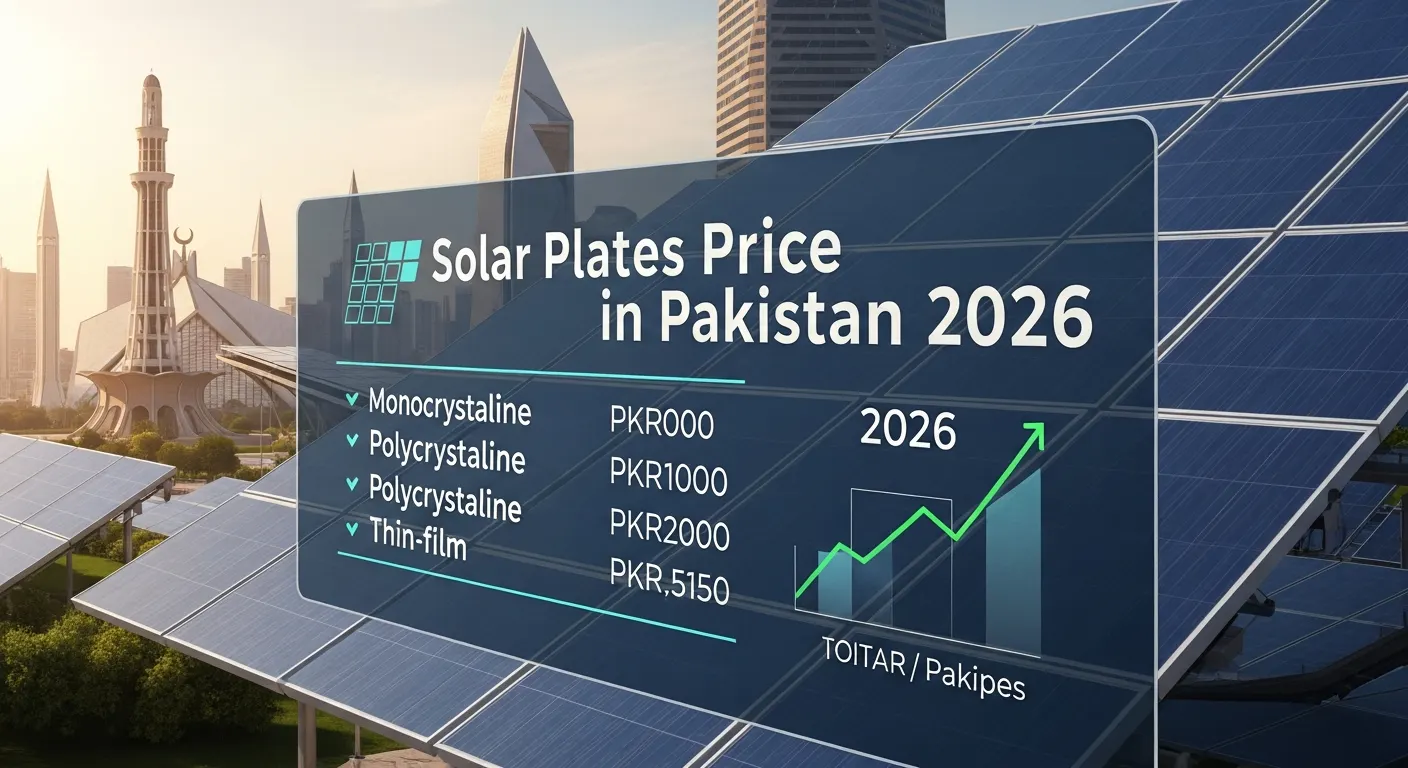
As of February 2026, Solar Plates Price in Pakistan 2026 have become more competitive due to increased local assembly and improved global supply chains. Here’s what you need to know about current pricing:
Price Per Watt Breakdown
The solar plates price in Pakistan is typically calculated per watt. Currently, A-Grade Tier-1 panels range from PKR 27 to PKR 45 per watt, depending on the brand, technology, and specifications. Here’s the detailed breakdown:
- Budget Range (PKR 27-30 per watt): Entry-level A-Grade panels from brands like JA Solar and some Trina models
- Mid Range (PKR 31-35 per watt): Premium brands like Jinko N-Type and standard Longi panels
- Premium Range (PKR 36-45 per watt): Advanced technology panels including Canadian TOPCon, bifacial modules, and high-efficiency Longi HiMO7 series
Complete Solar Panel Price Table by Wattage
| Panel Wattage | Price Range (PKR) | Best For | Average Electricity Generation |
|---|---|---|---|
| 150W | 4,000 – 6,000 | Small appliances, lights | 0.6-0.9 kWh/day |
| 300W | 8,000 – 13,000 | Fans, TV, small homes | 1.2-1.8 kWh/day |
| 545W | 15,000 – 19,000 | Medium homes | 2.2-3.3 kWh/day |
| 550W | 16,000 – 19,500 | Residential systems | 2.3-3.4 kWh/day |
| 560W | 16,500 – 20,000 | Commercial setups | 2.3-3.5 kWh/day |
| 575W | 17,000 – 20,500 | Large homes | 2.4-3.6 kWh/day |
| 605W | 18,500 – 21,500 | Industrial use | 2.5-3.8 kWh/day |
Note: Electricity generation varies based on sunlight hours, panel orientation, and weather conditions
Top Solar Panel Brands in Pakistan: Detailed Comparison
Choosing the right brand is crucial for long-term performance. Here’s an in-depth look at the best solar panel brands available in Pakistan:
1. Longi Solar Panels
Longi Green Energy Technology is currently one of the world’s largest solar panel manufacturers and highly popular in Pakistan.
Current Longi Solar Plates Price in Pakistan: PKR 32-40 per watt
Why Choose Longi:
- Industry-leading efficiency ratings (20-22.5%)
- HiMO7 series with advanced TOPCon technology
- Excellent performance in Pakistan’s hot climate
- 25-year power output warranty
- Bifacial modules available for 10-15% additional power generation
Popular Models:
- Longi HiMO7 605W: PKR 19,000-21,000
- Longi Hi-MO 5 550W: PKR 17,550-19,000
- Longi 545W Monocrystalline: PKR 17,000-18,500
2. Jinko Solar Panels
Jinko Solar is renowned for reliability and has one of the best price-to-performance ratios in Pakistan.
Current Jinko Solar Plates Price in Pakistan: PKR 27-35 per watt
Why Choose Jinko:
- Tiger Neo N-Type technology for superior efficiency
- Excellent durability in harsh weather (coastal areas, extreme heat, humidity)
- Competitive pricing
- Strong warranty coverage
- High module efficiency (up to 22.3%)
Popular Models:
- Jinko Tiger Neo 580W N-Type: PKR 19,500-20,500
- Jinko Tiger Pro 550W: PKR 16,965-18,000
- Jinko 545W: PKR 16,500-17,500
3. Canadian Solar Panels
Canadian Solar offers premium quality with slightly higher pricing but excellent long-term value.
Current Canadian Solar Plates Price in Pakistan: PKR 30-37 per watt
Why Choose Canadian:
- TOPCon technology for maximum efficiency
- Superior build quality and durability
- Excellent performance in low-light conditions
- Comprehensive warranty
- Better resale value
Popular Models:
- Canadian Solar TOPCon 570W: PKR 19,500-21,000
- Canadian Solar 550W: PKR 18,000-19,500
- Canadian Solar BiHiKu7 560W: PKR 18,500-20,000
4. Trina Solar Panels
Trina Solar combines innovation with competitive pricing, making it a favorite among Pakistani consumers.
Current Trina Solar Plates Price in Pakistan: PKR 28-33 per watt
Why Choose Trina:
- Vertex N-Type technology
- Good balance between cost and performance
- Reliable brand with strong market presence
- Multi-busbar design for better efficiency
- Strong performance in high temperatures
Popular Models:
- Trina Vertex N 575W: PKR 18,000-19,500
- Trina 550W N-Type: PKR 17,000-18,500
- Trina 545W: PKR 16,500-18,000
5. JA Solar Panels
JA Solar provides affordable entry-level options without compromising quality.
Current JA Solar Plates Price in Pakistan: PKR 27-28 per watt
Why Choose JA Solar:
- Most budget-friendly Tier-1 option
- Decent efficiency (19-21%)
- Good for cost-conscious buyers
- Reliable performance
- Suitable for large-scale installations
Popular Models:
- JA Solar 550W: PKR 16,800-17,500
- JA Solar DeepBlue 4.0 Pro 540W: PKR 16,200-17,000
Complete Solar System Price in Pakistan by Capacity
Understanding complete system costs helps you budget better. Here’s what different capacity systems cost in Pakistan:
3kW Solar System Price
Total Cost: PKR 330,000 – 450,000 (without batteries)
What’s Included:
- 5-6 solar panels (545-550W each)
- 3kW hybrid inverter
- Mounting structure
- AC & DC wiring
- Breakers and safety equipment
- Installation charges
- 2-year after-sales service
Best For: Small homes with 2-3 rooms, running basic appliances (lights, fans, TV, refrigerator)
Monthly Bill Reduction: 50-70% (approximately PKR 8,000-15,000 savings)
5kW Solar System Price
Total Cost: PKR 500,000 – 700,000 (without batteries)
What You Can Run:
- All lights and fans
- 1-2 refrigerators
- LED TVs
- Washing machine
- Water pump
- Some air conditioning during peak hours
Monthly Bill Reduction: 60-80% (approximately PKR 15,000-25,000 savings)
10kW Solar System Price
Total Cost: PKR 950,000 – 1,500,000 (without batteries)
Best For: Large homes, small businesses, or offices with heavy load
What You Can Run:
- Multiple air conditioners
- Heavy machinery
- All household appliances simultaneously
- Commercial equipment
Monthly Bill Reduction: 70-90% (approximately PKR 30,000-50,000 savings)
Payback Period: 1.5-2 years (fastest ROI among all sizes)
Complete Solar System Price Comparison Table
| System Size | Price Range (PKR) | No. of Panels | Best Application | Annual Savings |
|---|---|---|---|---|
| 3kW | 330,000 – 450,000 | 5-6 panels | Small homes | 96,000 – 180,000 |
| 5kW | 500,000 – 700,000 | 9-10 panels | Medium homes | 180,000 – 300,000 |
| 6kW | 528,000 – 800,000 | 11-12 panels | Large homes | 216,000 – 360,000 |
| 10kW | 950,000 – 1,500,000 | 18-19 panels | Large homes/Small business | 360,000 – 600,000 |
| 12kW | 1,200,000 – 1,600,000 | 22-24 panels | Commercial | 432,000 – 720,000 |
| 15kW | 1,500,000 – 1,900,000 | 27-30 panels | Commercial/Industrial | 540,000 – 900,000 |
Prices exclude batteries. Add PKR 250,000-600,000 for battery backup depending on capacity
A-Grade vs B-Grade Solar Panels: What You Must Know
One of the biggest decisions affecting solar plates price in Pakistan is choosing between A-Grade and B-Grade panels. This choice can save or cost you thousands in the long run.
A-Grade Solar Panels (Recommended)
What They Are: A-Grade panels are brand new, factory-tested panels that meet all manufacturer specifications and come with full documentation and warranties.
Characteristics:
- Perfect visual appearance (no scratches, cracks, or discoloration)
- 100% performance guarantee
- Full 10-25 year warranty
- Complete documentation and certificates
- Maximum efficiency ratings
- Tier-1 manufacturer certification
Price Range: PKR 27-45 per watt
Best For: Anyone seeking long-term reliability and maximum ROI
B-Grade Solar Panels (Not Recommended)
What They Are: B-Grade panels have cosmetic defects or minor performance variations. They’re often factory seconds or panels that didn’t pass quality control.
Characteristics:
- Visible scratches, color variations, or minor cracks
- 5-10% lower power output potential
- Limited or no warranty
- Cheaper upfront cost
- Unknown long-term reliability
Price Range: PKR 18-25 per watt
Why Avoid Them: While B-Grade panels appear cheaper initially, they’re a false economy. The lack of warranty, potential performance degradation, and unknown longevity make them unsuitable for serious solar investments. You might save PKR 50,000-100,000 initially but lose PKR 200,000-500,000 over the system’s lifetime.
(Internal link suggestion: link to your article on “Solar Panel Quality Standards in Pakistan”)
Understanding Solar Panel Technologies: N-Type vs P-Type
The technology used in solar panels significantly impacts both performance and solar plates price in Pakistan.
N-Type Solar Panels (Advanced Technology)
Current Price Premium: PKR 2-5 more per watt than P-Type
Advantages:
- 0.5-1.5% higher efficiency
- Better performance in high temperatures (crucial for Pakistan)
- Less degradation over time (0.25% per year vs 0.5% for P-Type)
- Superior low-light performance
- Longer effective lifespan
Available in: Jinko Tiger Neo, Longi HiMO7, Canadian TOPCon, Trina Vertex N
Verdict: Worth the extra cost for long-term installations
P-Type Solar Panels (Standard Technology)
Current Price: PKR 33+ per watt
Characteristics:
- Proven reliability
- Slightly lower efficiency (18-20%)
- Higher temperature coefficient
- More affordable upfront
Best For: Budget-conscious buyers or temporary installations
Bifacial vs Monofacial Panels
Bifacial Panels:
- Capture sunlight from both front and back
- 10-15% additional power generation
- PKR 3-6 more expensive per watt
- Ideal for elevated installations or reflective surfaces
Monofacial Panels:
- Traditional single-sided solar absorption
- More cost-effective
- Suitable for standard rooftop installations
Factors Affecting Solar Plates Price in Pakistan
Understanding what drives prices helps you make smarter purchasing decisions:
1. Panel Efficiency Rating
Higher efficiency panels cost more but generate more electricity per square foot. In Pakistan’s limited rooftop space scenarios, 22% efficient panels might be worth the 20-30% price premium over 18% efficient ones.
2. Brand Reputation and Country of Origin
- Chinese Tier-1 Brands (Longi, Jinko, Trina, JA): Best value-for-money, PKR 27-35 per watt
- European/North American Brands: Higher quality control but 50-100% more expensive, PKR 50-80 per watt
- Local Assembly: Emerging option with competitive pricing, PKR 25-30 per watt
3. Import Duties and Currency Exchange
Solar panels are imported items. When the Pakistani Rupee weakens against the US Dollar or Chinese Yuan, prices rise. The 18% sales tax on imports (though currently exempted for renewable energy equipment) can also impact final costs.
4. Installation Complexity
Installation costs typically range from PKR 20,000 to PKR 50,000 depending on:
- Roof type (concrete vs tin sheet vs tiles)
- Height and accessibility
- Structural reinforcement requirements
- Distance from main electrical panel
- Custom mounting requirements
5. Wholesale vs Retail Purchase
Buying directly from authorized distributors or wholesale markets can save 10-20%:
- Karachi: Saddar electronics market
- Lahore: Hall Road
- Rawalpindi: College Road
- Islamabad: I-9 and Blue Area
6. Market Demand and Supply
Solar plates price in Pakistan fluctuates seasonally:
- Peak Season (April-August): 5-10% higher due to summer demand
- Off-Season (November-February): Better negotiation opportunities
- Government Announcement Impact: Policy changes cause temporary price spikes
7. Package Deals vs Individual Components
Complete system packages often offer better value than buying components separately. Expect 8-15% savings on bundled deals.
(Internal link suggestion: link to your article on “Best Time to Buy Solar Panels in Pakistan”)
Installation Costs Breakdown in Pakistan
Beyond the solar plates price in Pakistan, installation expenses add significantly to your total investment:
Standard Installation Package Includes:
1. Labor Charges: PKR 15,000-35,000
- Technician team (2-4 people)
- 1-3 days work depending on system size
- Safety equipment
2. Mounting Structure: PKR 15,000-50,000
- Aluminum or galvanized iron framework
- Roof penetration points with waterproofing
- Anti-rust coating for coastal areas
3. Electrical Components: PKR 10,000-25,000
- AC and DC wiring (copper)
- MC4 connectors
- Circuit breakers
- Earthing system
- Junction boxes
4. Permits and Documentation: PKR 5,000-15,000
- Net metering application
- DISCO approval
- Electrical inspection certificates
Total Installation Cost: Approximately 10-15% of total system cost
DIY Installation: Is It Worth It?
While technically possible, DIY installation is strongly discouraged because:
- Risk of electrical shock or fire hazards
- Warranty void if not professionally installed
- NEPRA net metering requires certified installer documentation
- Roof damage liability
- Suboptimal panel positioning reduces output by 15-25%
The PKR 20,000-50,000 you save could cost you PKR 100,000-300,000 in lost efficiency and warranty claims.
Government Incentives and Net Metering in Pakistan (2026 Update)
Understanding current government policies is crucial for maximizing your solar investment:
Current Net Metering Status
As of February 2026, Pakistan’s net metering policy is undergoing significant reforms. Here’s what you need to know:
What Net Metering Offers:
- Sell excess solar electricity back to your DISCO (Distribution Company)
- Receive credits on your electricity bill
- Reduce or eliminate monthly electricity bills
- 7-year generation license (under current regulations)
Current Buyback Rate: Approximately PKR 21-27 per unit (under review)
Proposed Changes (Under Consultation): The National Electric Power Regulatory Authority (NEPRA) is considering:
- Reducing buyback rate from PKR 27 to PKR 10-13 per kWh
- Shifting from net metering to “net billing”
- Limiting system size to actual sanctioned load (no more 1.5x allowance)
- Reducing license validity from 7 to 5 years
What This Means For You: If you’re planning to go solar, installing before these new regulations take effect could save you significant money. Systems installed under current regulations may be “grandfathered” (protected from new rules).
How to Apply for Net Metering
Step 1: Size Your System Calculate your average monthly electricity consumption from bills
Step 2: Select Equipment Choose solar panels, inverter, and other components
Step 3: Get Installation Done Hire certified solar installers
Step 4: Submit Application Apply to your local DISCO (LESCO, K-Electric, MEPCO, IESCO, GEPCO, FESCO, PESCO, QESCO, HESCO, SEPCO)
Required Documents:
- Copy of electricity bill
- Site plan/location map
- Single line diagram
- Technical specifications of equipment
- Installation completion certificate
Step 5: Inspection and Approval DISCO conducts site inspection (7-30 days)
Step 6: Net Meter Installation Bi-directional meter installed (replaced your existing meter)
Total Process Time: 1-3 months depending on your DISCO
Tax Benefits and Exemptions
Currently Available:
- Import duty exemption on solar equipment
- Sales tax exemption on renewable energy components
- No income tax on solar installation
Note: Contrary to rumors, there is NO solar tax in Pakistan as of February 2026. The government has explicitly denied implementing any fixed tax on solar users.
(Internal link suggestion: link to your article on “Complete Net Metering Application Guide for Pakistan”)
Return on Investment (ROI) Analysis
Let’s analyze the financial benefits with real numbers:
5kW System ROI Example
Initial Investment: PKR 600,000 Monthly Electricity Bill Before Solar: PKR 25,000 Monthly Bill After Solar (with net metering): PKR 3,000-5,000 Monthly Savings: PKR 20,000-22,000 Annual Savings: PKR 240,000-264,000
Payback Period: 2.3-2.5 years
Lifetime Savings (25 years):
- Total savings: PKR 6,000,000-6,600,000
- Net profit after recovering investment: PKR 5,400,000-6,000,000
- ROI: 900-1,000%
Common Mistakes to Avoid When Buying Solar Panels
Learn from others’ expensive errors:
Mistake 1: Choosing the Cheapest Option
The Trap: Going for the lowest solar plates price in Pakistan without considering quality
The Reality: Cheap panels often means:
- B-Grade or C-Grade panels
- No warranty
- Chinese Tier-2 or Tier-3 brands
- 20-30% lower actual output
- Failure within 3-5 years
Solution: Focus on cost-per-kWh over 25 years, not just upfront cost
Mistake 2: Oversizing Your System
The Trap: Installing a 10kW system when you only need 5kW “for future expansion”
The Reality:
- 50-100% higher upfront cost
- No immediate benefit
- New regulations may not allow oversized systems
- Slower ROI
- Equipment degradation before you use full capacity
Solution: Size your system for current needs +10-15% buffer. Add more panels later if needed.
Mistake 3: Ignoring Inverter Quality
The Trap: Spending on premium panels but choosing budget inverters
The Reality:
- Inverter failure is the most common solar system problem
- Cheap inverters fail in 2-3 years (vs 5-10 for quality ones)
- Replacement costs PKR 50,000-150,000
- System downtime means zero power generation
Solution: Allocate 20-25% of your budget to a quality inverter (Goodwe, Growatt, Huawei, Sungrow, Fronius)
Mistake 4: Not Getting Multiple Quotes
The Trap: Accepting the first quote you receive
The Reality:
- Solar companies mark up prices by 20-40% for uninformed customers
- Different companies have different brands and package deals
- Installation quality varies dramatically
Solution: Get minimum 3-5 quotes. Compare component brands, warranties, and installation terms, not just total price.
Mistake 5: Believing “Lifetime Warranty” Claims
The Trap: Falling for marketing gimmicks
The Reality:
- No solar panel has a “lifetime” warranty
- Standard warranties: 10 years product, 25 years performance (80% output)
- Company must exist in Pakistan to honor warranty
- Grey market imports have no local warranty support
Solution: Only buy from authorized distributors with established local presence. Get warranty terms in writing.
Mistake 6: Poor Installation Company Selection
The Trap: Choosing installers based only on price
The Reality:
- Poor installation causes 40% of solar system problems
- Roof leaks from improper mounting
- Fire hazards from substandard wiring
- Voided warranties due to non-certified installation
Solution: Check installer credentials, previous work photos, and customer reviews. Pay for quality installation.
Mistake 7: Neglecting Maintenance Planning
The Trap: Thinking solar is “install and forget”
The Reality:
- Dust accumulation in Pakistan reduces output by 20-30%
- Bird droppings create hot spots and panel damage
- Wiring checks needed annually
- Inverter monitoring essential
Sample Calculation:
| Appliance | Quantity | Wattage | Hours/Day | Daily kWh |
|---|---|---|---|---|
| LED Bulbs | 10 | 15W | 6 | 0.9 |
| Ceiling Fans | 5 | 75W | 10 | 3.75 |
| Refrigerator | 1 | 150W | 24 | 3.6 |
| LED TV | 2 | 80W | 6 | 0.96 |
| Air Conditioner | 1 | 1800W | 8 | 14.4 |
| Washing Machine | 1 | 500W | 1 | 0.5 |
| Water Pump | 1 | 750W | 2 | 1.5 |
| Total Daily Consumption | 25.61 kWh |
On-Grid vs Off-Grid vs Hybrid Solar Systems
Understanding system types helps you choose the right configuration:
On-Grid (Grid-Tied) Solar System
How It Works: Connected to the national electricity grid. During daytime, solar powers your home and excess goes to the grid. At night, you draw from the grid.
Pros:
- Lowest upfront cost (no batteries needed)
- Net metering benefits
- Unlimited power supply
- Simplest installation
Cons:
- No power during grid failures (load-shedding)
- Dependent on grid stability
- Subject to changing net metering policies
Best For: Areas with stable electricity supply, cost-conscious buyers
Price Range: PKR 300,000-1,200,000 (3-10kW)
Off-Grid Solar System
How It Works: Completely independent from the national grid. Uses batteries to store excess power for nighttime and cloudy days.
Pros:
- Complete energy independence
- No monthly electricity bills
- Unaffected by load-shedding
- Perfect for remote areas
Cons:
- Highest upfront cost (batteries expensive)
- Limited capacity (dependent on battery storage)
- Battery replacement every 5-10 years (PKR 200,000-500,000)
- More complex maintenance
Best For: Remote locations without grid access, severe load-shedding areas
Price Range: PKR 600,000-2,500,000 (3-10kW including batteries)
Hybrid Solar System
How It Works: Best of both worlds. Connected to grid but also has battery backup. Prioritizes solar → battery → grid.
Pros:
- Grid-connected with backup security
- Net metering eligible
- Power during load-shedding
- Flexible and expandable
Cons:
- Higher cost than on-grid (batteries required)
- More complex system management
- Higher maintenance requirements
Best For: Most Pakistani households (addresses both load-shedding and high bills)
Price Range: PKR 450,000-2,000,000 (3-10kW with moderate battery backup)
Comparison Table
| Feature | On-Grid | Off-Grid | Hybrid |
|---|---|---|---|
| Initial Cost | Lowest | Highest | Medium-High |
| Power During Load-Shedding | No | Yes | Yes |
| Monthly Bills | Reduced 70-90% | Zero | Reduced 70-90% |
| Net Metering | Yes | No | Yes |
| Batteries Required | No | Yes | Yes |
| Complexity | Simple | Complex | Medium |
| Best ROI | Yes | No | Medium |
| Maintenance | Low | High | Medium |