Are you tired of skyrocketing electricity bills and frequent load shedding? You are not alone. As we step into 2026, the energy landscape in Pakistan has shifted dramatically, making a Solar Power System for Home in Pakistan 2026 not just a luxury, but a financial necessity. With grid electricity tariffs reaching all-time highs, investing in solar energy is the single best decision you can make to secure your home’s energy future.
In this comprehensive guide, we will walk you through everything you need to know about installing a solar panels system in Pakistan this year. We’ll cover the latest 2026 solar panel prices, the critical shift from Net Metering to Net Billing, and help you decide between On-Grid, Off-Grid, and Hybrid systems. By the end of this article, you will have a clear roadmap to energy independence.
(Link to your article on [Understanding Electricity Bills in Pakistan])
Why 2026 is the Critical Year to Go Solar in Pakistan
The year 2026 marks a turning point for renewable energy in Pakistan. While solar panel prices have hit historic lows due to global oversupply, the government’s policy framework has evolved. Here is why acting now is crucial:
- Record Low Panel Prices: As of early 2026, Tier-1 solar panels (Jinko, Longi, Canadian) are trading at approx. PKR 26.50 – PKR 37 per watt. This is significantly lower than in previous years.
- Rising Grid Tariffs: The cost of unit (kWh) from the grid continues to rise, pushing bills into the unaffordable range for middle-class households.
- Policy Shift: The transition to Net Billing means the strategy for solar has changed. It is no longer just about exporting power; it is about self-consumption.
Types of Solar Power Systems Explained
Before discussing prices, you must understand which Solar Power System for Home in Pakistan 2026 fits your needs. The choice depends heavily on your load shedding situation and budget.
1. On-Grid Solar System (Grid-Tied)
An on-grid system connects directly to the national grid (WAPDA/KE). It works without batteries.
- Best for: Areas with ZERO load shedding.
- Pros: Cheapest upfront cost; allows Net Metering/Billing.
- Cons: System shuts down during load shedding. You have no backup power.
2. Hybrid Solar System (The 2026 Favorite)
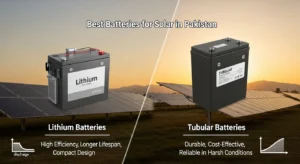
This system combines grid connection with battery backup (Lithium-ion or Tubular).
- Best for: Areas with frequent power outages (load shedding).
- Pros: Provides backup during outages; maximizes self-consumption (crucial for 2026 Net Billing policy).
- Cons: Higher cost due to batteries.
(Link to your article on [Best Solar Batteries in Pakistan 2026])
3. Off-Grid Solar System
Completely disconnected from the grid. You rely 100% on solar and batteries.
- Best for: Remote locations (villages, farmhouses, agricultural tubewells) with no grid access.
- Pros: Total independence from electricity bills; immune to grid failures.
- Cons: Very expensive; requires large battery bank which needs replacement every 3-5 years.
Deep Dive: Solar Panel Technologies (Mono-PERC vs. N-Type vs. TopCon)
In 2026, the market is flooded with various panel technologies. Choosing the wrong one can cost you 10-15% of your generation capacity annually. Let’s break down the jargon:
1. P-Type Mono PERC (The Old Standard)
Until 2024, these were the industry standard.
- Efficiency: ~21%
- Degradation: High (approx. 2% in year 1, 0.55% annually).
- Verdict: Avoid in 2026 unless you are on a very tight budget. They suffer from LID (Light Induced Degradation).
2. N-Type TOPCon (Tunnel Oxide Passivated Contact)
This is the current “King” of solar panels in Pakistan for 2026.
- Efficiency: ~22.5% – 23%
- Key Advantage: Very low degradation (0.4% annually) and better performance in hot climates like Multan or Sibbi.
- Verdict: Highly Recommended. They generate more power per square foot than P-Type.
3. HJT (Heterojunction)
The premium, futuristic option.
- Efficiency: >24%
- Key Advantage: Best temperature coefficient (doesn’t lose much power when it gets hot).
- Verdict: Excellent but expensive. Stick to TopCon for the best price-to-performance ratio.
Bifacial vs. Monofacial
- Bifacial: Glass on both sides. Captures reflected light from the roof (albedo). Can generate 5-15% extra power if installed on a white or light-colored roof/floor.
- Monofacial: Standard backsheet. Cheaper but less efficient.
- Recommendation: Always go for Bifacial N-Type panels for residential rooftops in Pakistan.
Latest Solar Power System Prices in Pakistan (2026)
One of the most common questions is: How much does a solar system cost in Pakistan in 2026?
While panel prices have dropped, the cost of inverters, copper wiring, and labor has adjusted with inflation. Below is a detailed estimated price list for Hybrid Systems (including standard quality installation and structure) as of February 2026.
Price Breakdown by System Size
| System Size | Suitable For | Estimated Cost (PKR) | Avg. Monthly Production |
|---|---|---|---|
| 3kW Hybrid | Small Home (Fans, Lights, 1 Inverter AC) | PKR 350,000 – 450,000 | 300 – 350 Units |
| 5kW Hybrid | Medium Home (1.5 Ton AC, Fridge, Pump) | PKR 600,000 – 800,000 | 550 – 600 Units |
| 8kW Hybrid | Large Home (2 ACs, Iron, Pump) | PKR 900,000 – 1,100,000 | 900 – 1,000 Units |
| 10kW Hybrid | Large Villa (3 ACs, Multiple Appliances) | PKR 1,000,000 – 1,200,000 | 1,100 – 1,200 Units |
| 15kW Hybrid | Joint Family / Small Office | PKR 1,500,000 – 1,800,000 | 1,600 – 1,800 Units |
Note: These prices are estimates. Adding high-end Lithium/LiFePO4 batteries can add PKR 150,000 to PKR 400,000 to the total cost.
Current Solar Panel Rates (Per Watt)
- Jinko N-Type: PKR 31.50/watt
- Longi Hi-MO 7: PKR 27 – 31/watt
- Canadian TopCon: PKR 30.50/watt
- Trina Solar: PKR 28 – 32/watt
(Link to your article on [Top 5 Solar Panel Brands in Pakistan])
IMPORTANT: The Net Metering vs. Net Billing Shift
In 2026, the biggest change for solar owners in Pakistan is the implementation of Prosumer Regulations 2026.
What Changed?
Previously, under Net Metering, you could trade electricity 1-for-1. One unit exported canceling out one unit imported. Now, under Net Billing, the mechanism is financial:
- Export Rate: You sell excess power to the grid at the “National Average Energy Purchase Price” (approx. PKR 8 – 11 per unit).
- Import Rate: You buy from the grid at the standard tariff (approx. PKR 40 – 65 per unit depending on slab).
- Contract: Validity reduced from 7 years to 5 years.
The Strategy for 2026
Because the “sell” price is so low, your goal should be to export LESS and consume MORE.
- Use Hybrid Inverters: Store excess day-time energy in batteries to use at night instead of selling it cheap to the grid.
- Run Heavy Loads During Day: Schedule washing machines, water pumps, and ACs between 10 AM and 3 PM.
Step-by-Step Guide: How to Install a Solar Power System for Home
Installing a solar power system for home 2026 involves several technical steps. Do not attempt this as a DIY project; always hire AEDB-certified installers.
Step 1: Site Survey & Load Calculation
A professional will visit your home to check roof space (south-facing is best) and analyze your electricity bills to determine the kW size needed.
Step 2: System Design & Quotation
You will receive a quote detailing the brands of panels, inverter, and structure (L2 or L3). Ensure the structure is Hot Dipped Galvanized to prevent rust.
Step 3: Installation (1-3 Days)
- Structure: This is the backbone of your system. Ensure your installer uses 14-Gauge Hot Dipped Galvanized (GI) Structure. Avoid “Black Paint” iron structures as they will rust within 2 years in Pakistan’s humidity.
- L2 vs L3: L2 structures (2 feet high) are standard. L3 (elevated) are used if you want to use the roof space underneath for sitting or storage.
- Panel Placement: Panels must be tilted at the optimal angle (typically equal to your city’s latitude, e.g., 30-33 degrees in Punjab) and face TRUE SOUTH.
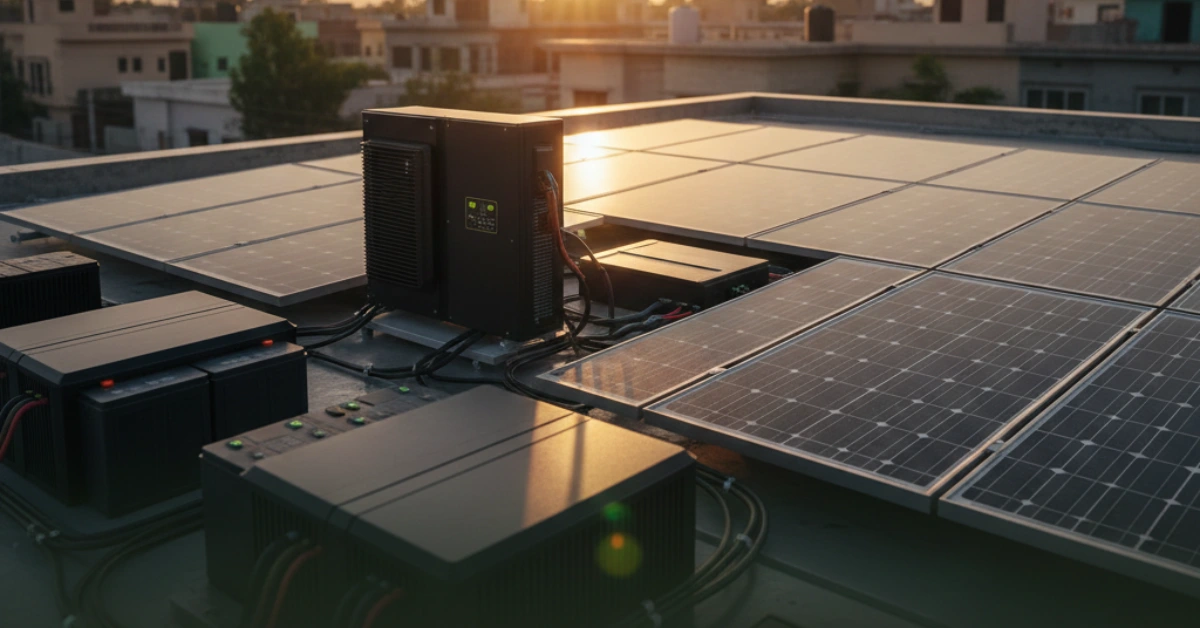
- Inverter Installation: Placed in a shaded, ventilated area. Avoid direct sunlight on the Inverter.
- Wiring & Protection:
- DC Wire: Use 6mm tin-coated copper wire (e.g., specialized solar cable).
- Earthing: Separate earthing pits for Lightning Arrester and AC/DC grounds are mandatory for safety.
- Breakers: Use genuine DC breakers (Tomzn, Schneider) to prevent fire hazards.
Step 4: Net Metering “Green Meter” Application
Your installer will file an application with NEPRA/DISCO (LESCO, K-Electric, IESCO, etc.). This process takes 30 to 60 days. Once approved, your standard meter is replaced with a bi-directional Green Meter.
Monthly Maintenance & Cleaning Guide for Maximum Efficiency
Solar panels are not “install and forget.” Dust and smog, especially in Lahore and Karachi, can reduce output by 30% or more.
1. Cleaning Schedule
- Summer: Clean panels every 7-10 days (or earlier if dusty).
- Winter: Clean every 15 days (morning dew can make dust stick).
- Smog Season (Oct-Dec): Clean every 3-4 days.
2. How to Clean
- Time: Early morning (before 8 AM) or late evening. NEVER wash hot panels effectively at noon; the thermal shock can crack the glass.
- Water: Use normal tap water. If your water is hard (khara pani), use a wiper immediately to prevent calcium deposits.
- Tools: Use a soft sponge mop or specialized solar cleaning brush. Avoid abrasive materials.
3. Inverter Care
- Clean the inverter’s fan filters/mesh every 3 months to prevent overheating.
- Check the display for any error codes regularly.
5 Common Myths About Solar Energy in Pakistan (Debunked)
Myth 1: “Solar panels don’t work on cloudy days.” Fact: They do work, but at reduced efficiency (10-25%). Hybrid systems with batteries cover this gap seamlessly.
Myth 2: “Batteries are too expensive and expire quickly.” Fact: Old lead-acid batteries lasted 1 year. The new Lithium Iron Phosphate (LiFePO4) batteries (like Pylontech, Narada) come with 5-10 year warranties and last 6000+ cycles (10+ years).
Myth 3: “Ac cannot run on Solar.” Fact: Inverter ACs are designed to run smoothly on solar. A cheap 3kW system helps, but a 5kW system can run an AC all day long.
Myth 4: “Cleaning panels is not necessary if it rains.” Fact: Rain is often muddy in Pakistan. It leaves streaks that block sunlight. Manual cleaning is better.
Myth 5: “Net Metering is useless in 2026.” Fact: While rates dropped, it still utilizes your excess power. Selling at Rs 11 is better than wasting it for Rs 0.
Top Solar Brands in Pakistan 2026
To ensure your system lasts 25+ years, stick to these Tier-1 brands available in the local market:
Best Solar Panels
- Jinko Solar: (Tiger Neo N-Type) – Best strictly for efficiency.
- Longi Solar: (Hi-MO 6 & 7) – Market leader, great warranty.
- Canadian Solar: (TopBiHiKu6) – Durable and reliable.
- JA Solar: Excellent low-light performance.
Best Solar Inverters (Hybrid)
- Huawei: Premium, highly reliable, transformerless.
- GoodWe: Excellent value and robust build.
- Solis: Industry standard for residential use.
- Growatt: Budget-friendly but reliable.
- Inverex / Nitrox: Very popular in Pakistan with good local support.
Return on Investment (ROI) Calculation
Is solar still worth it with the new 2026 Net Billing policy? YES.
Let’s look at the math for a 10kW System:
- Total Cost: PKR 1,200,000
- Annual Savings (Bill Reduction): Approx. PKR 450,000 – 500,000
- Payback Period: 2.5 to 3 Years
Even with lower export rates, the savings come from not paying the expensive grid tariff during the day. After the payback period, you enjoy effectively free electricity for the remaining 20+ years of the system’s life.
Frequently Asked Questions (FAQs)
What is the price of a 5kW solar system in Pakistan in 2026?
A complete 5kW hybrid solar system with battery backup typically costs between PKR 600,000 and PKR 800,000, depending on the quality of panels and batteries used.
Can I run an AC on a 3kW solar system?
Yes, a 3kW system can easily run one 1.5-ton Inverter AC, provided the sun is shining and you are managing other loads (like iron or motors) smartly.
Is Net Metering ending in 2026?
Net Metering is transitioning to Net Billing. While you can still export power, the rate you get paid is significantly lower (approx. Rs 11/unit) compared to previous years.
Which solar panel is best for home use?
N-type Bifaical panels (from Jinko or Longi) are currently the best technology for homes in 2026. They generate power from both sides and degrade slower than older P-type panels.
How much roof space do I need for a 10kW system?
A 10kW system requires approximately 600 to 800 square feet of shadow-free roof space.
Conclusion
Installing a solar power system for home 2026 is the smartest financial defense against inflation and rising energy costs in Pakistan. While the policy landscape has shifted towards Net Billing, the massive drop in solar panel prices makes the upfront investment more affordable than ever.
By choosing a Hybrid system and focusing on self-consumption, you can slash your bills to near zero and secure your peace of mind.