Are you a farmer in Pakistan struggling with the rising costs of electricity and diesel for irrigation? If you are looking for a sustainable, one-time investment to power your tube wells, you have come to the right place. The Solar System for Tube Well in Pakistan 2026 is revolutionizing the agricultural sector by providing a reliable and cost-effective alternative to traditional energy sources. This comprehensive guide covers everything you need to know: from current prices and government subsidies to a detailed installation guide and ROI analysis. Our goal is to answer your main intent—finding the most efficient way to irrigate your crops while saving millions in the long run.
Why Choose a Solar Tube Well System?
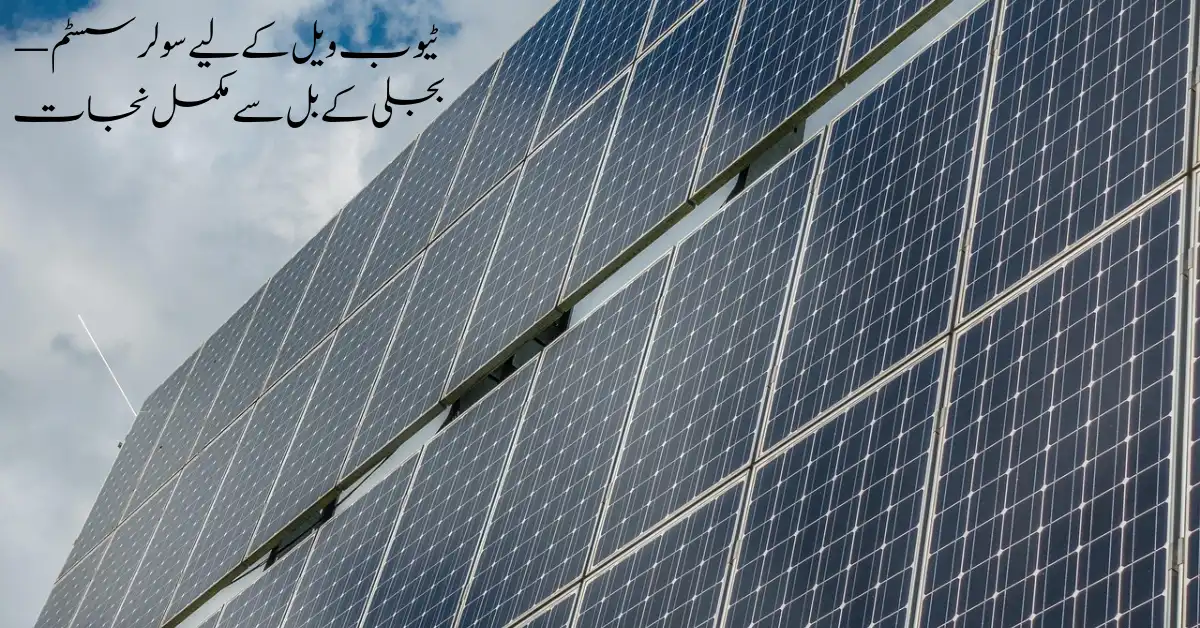
Pakistan is an agrarian economy, and water is its lifeline. However, the energy crisis and fluctuating fuel prices have made traditional tube wells a financial burden. Solar System for Tube Well in Pakistan 2026 harnesses the abundant sunlight in Pakistan to power water pumps, offering a green and free energy source.
By switching to solar, farmers can eliminate their dependency on the national grid and expensive diesel generators. Whether you own a small holding of 5 acres or a large estate of 50 acres, solar technology is scalable to meet your specific water requirements. The initial setup cost is quickly recovered through savings, making it the smartest investment for modern agriculture.
Latest Solar Tube Well Prices in Pakistan (2026)
Understanding the cost is crucial for planning. The price of a Solar System for Tube Well in Pakistan 2026 varies based on the motor’s horsepower (HP), the depth of the bore (water table), and the quality of components (panels and inverters).
Below is a detailed estimated price list for 2026. Note that these are market averages and can fluctuate with the exchange rate.
| Motor Capacity (HP) | Estimated Cost (PKR) | Number of Panels (Approx) | VFD Capacity (kW) | Suitable Land Area (Acres) |
|---|---|---|---|---|
| 3 HP | 320,000 – 350,000 | 6-8 Panels (540W+) | 4-5.5 kW | 3 – 5 |
| 5 HP | 540,000 – 750,000 | 10-12 Panels | 5.5 – 7.5 kW | 7 – 10 |
| 7.5 HP | 750,000 – 900,000 | 14-16 Panels | 11 kW | 10 – 15 |
| 10 HP | 900,000 – 1,100,000 | 18-20 Panels | 15 kW | 15 – 20 |
| 15 HP | 1,150,000 – 1,350,000 | 28-30 Panels | 18.5 kW | 20 – 30 |
| 20 HP | 1,800,000 – 2,000,000 | 36-40 Panels | 22 kW | 35 – 50 |
| 25 HP | 2,100,000 – 2,500,000 | 42-50 Panels | 30 kW | 50+ |
3 HP to 5 HP Systems: For Small Farmers
These systems are ideal for small landholdings. A 3 HP Solar System is perfect for shallow water tables (up to 80-100 ft) and can effectively irrigate smaller plots of vegetables or orchards. A 5 HP system offers slightly more power, suitable for wheat and rice crops on medium-sized farms.
10 HP to 15 HP Systems: The Commercial Standard
For commercial farming, 10 HP and 15 HP systems are the most common. They are designed for deep well applications (over 300 ft) and require high-efficiency panels to ensure consistent water flow, even during afternoon heat or slight cloud cover. These systems often employ submersible pumps rather than surface monoblocks.
20 HP and Above: Industrial Scale
Large landlords with extensive acreage (50+ acres) opt for 20 HP or 25 HP systems. These are powerful setups capable of filling large water storage reservoirs quickly. They require substantial space for panel installation and robust mounting structures.
Deep Dive: Components of a Solar Tube Well
A solar tube well system is more than just panels. It is an integrated system where every component plays a vital role.
1. Solar Panels (PV Modules)
The efficiency of your system depends on the panels.
- Monocrystalline PERC: The industry standard. Offers good efficiency (around 21%).
- Bifacial Panels: These capture sunlight from both sides (front and reflection from the ground), offering 10-30% more power. Highly recommended for tube wells where space is available.
- Brands: Look for Tier-1 brands like Longi, Jinko, Canadian Solar, and JA Solar. Avoid non-branded or “B-grade” panels as they degrade quickly.
2. Solar Inverter / Variable Frequency Drive (VFD)
The VFD is the brain of the operation. Unlike a standard inverter, a VFD adjusts the frequency and voltage supplied to the motor based on the available sunlight. This “soft start” capability protects the motor from sudden jerks and allows it to run at variable speeds, ensuring water delivery even when the sun isn’t at peak intensity. Reliable brands include INVT, Veichi, and Growatt.
3. Mounting Structure serves as the Backbone
The structure holds your investment against the elements.
- Galvanized Iron (GI): Always insist on hot-dipped galvanized iron to prevent rust.
- Manual Tracking: Allows you to manually tilt the panels East in the morning and West in the afternoon. This simple adjustment can increase daily water output by 25%.
- Auto Tracking: Uses sensors to follow the sun automatically. More expensive but maximizes efficiency.
4. Pumps and Motors
- Submersible Pump: Placed underwater in the bore. Best for deep water levels.
- Surface Monoblock Pump: Placed on the ground. Suitable for water levels less than 20-30 feet deep (e.g., near canals).
- Material: Stainless steel impellers are preferred over cast iron for longevity, especially in saline water.
Government Subsidies and Schemes (2026)
Recognizing the importance of agriculture, both Federal and Provincial governments have launched support programs.
Punjab Solar Tubewell Scheme
The Punjab Agriculture Department has been active in promoting solarization.
- Subsidy: The government offers up to 80% subsidy for solar systems aimed at high-efficiency irrigation (drip/sprinkler).
- Target: To convert thousands of diesel/electric tube wells to solar.
- Process: Applications are typically invited through newspapers and the official website. Winners are often selected via balloting.
Sindh Solar Subsidy Program
The Sindh Government supports farmers with subsidized solar tube wells.
- Share: Farmers pay a subsidized cost (e.g., PKR 6 – 8 Lakhs) while the government covers the remaining millions.
- Criteria: Usually requires landholding proof (Form VII) and a valid CNIC.
- Focus: This is critical for arid zones where groundwater is deep and grid electricity is non-existent.
Actionable Advice: stay updated with the Ministry of National Food Security & Research and local agriculture extension offices. These schemes are time-sensitive.
Detailed Installation Guide
Installing a Solar System for Tube Well in Pakistan 2026 is a technical task. Here is what the process looks like:
- Site Assessment: The team visits your farm to check the water level, motor HP, and shadow-free area for panels.
- Civil Works: Concrete foundations are poured for the mounting poles. This needs to cure for a few days to ensure stability against high winds.
- Structure Assembly: The GI structure is assembled and aligned to True South to maximize sun exposure.
- Panel Mounting: Panels are securely bolted to the structure. Care is taken not to overtighten and cause micro-cracks.
- Wiring: High-quality DC cables (4mm or 6mm depending on distance) connect the panels to the VFD.
- VFD Programming: The engineer programs the extensive parameters of the VFD (motor voltage, rated current, frequency limits, dry run protection).
- Testing: The system is turned on. Water flow is measured, and motor amps are monitored to ensure it runs within safe limits.
Maintenance and Safety Tips
Solar systems are generally low maintenance, but “low” doesn’t mean “no”.
- Cleaning: The most important task. Dust and bird droppings can reduce output by 30%. Wash panels weekly with plain water and a soft cloth/wiper. Do not use detergents as they can damage the anti-reflective coating.
- Tightening: Check the nuts and bolts of the structure every 6 months, especially after storms.
- VFD Care: Keep the VFD box sealed from dust and moisture. Ensure its cooling fan is working.
- Cable Inspection: Check wires for any damage by rodents or sun exposure.
- Safety: DC voltage can be lethal (up to 800V). Never touch bare wires or open the VFD while the system is live. Always turn off the DC breaker first.
Return on Investment (ROI) Analysis
Let’s calculate the savings for a typical 12.5 HP system.
- Scenario: A farmer runs a diesel tube well for 8 hours a day, 25 days a month.
- Diesel Consumption: Approx 2.5 liters/hour * 8 hours = 20 liters/day.
- Daily Cost: 20 * PKR 280 (Diesel Price) = PKR 5,600.
- Monthly Cost: 5,600 * 25 = PKR 140,000.
- Annual Cost (8 months season): 140,000 * 8 = PKR 1,120,000.
- Solar Investment: Approx PKR 1,200,000.
- Payback Period: 1 Year and 1 Month.
Yes, in just over a year, the system pays for itself. For the remaining 23+ years of the panel’s life, your irrigation cost is effectively zero. This is creating wealth for the farmer.
Environmental Impact
Adopting a Solar System for Tube Well in Pakistan 2026 is a direct contribution to fighting climate change.
- Carbon Footprint: Eliminating diesel reduces CO2 emissions.
- Noise Pollution: Solar pumps are silent compared to the loud thrum of diesel engines.
- Sustainability: It prevents soil contamination from oil spills associated with diesel engines.
Frequently Asked Questions (FAQs)
1. Is a License required for a solar tube well?
generally, for private agricultural land, no special license is needed for the solar system itself. However, creating a new bore/tube well might specific permissions from local water authorities depending on groundwater regulations in your district.
2. Can the system work at night?
No, standard solar tube wells work only when the sun is shining. To run at night, you would need a massive battery bank, which is currently too expensive to be economically viable for agriculture. Most farmers build a water storage pond to use during the night if needed.
3. What happens if the water level drops?
If the water table drops significantly, the pump discharge will reduce. The VFD helps here; it can speed up the motor to compensate, but ultimately you might need to lower the pump or upgrade the motor HP.
4. Can I get a loan for a solar tube well?
Yes, many banks in Pakistan (like ZTBL, NBP, Meezan Bank) offer agricultural loans specifically for solar tube wells under the State Bank of Pakistan’s green financing schemes. These loans often have lower markup rates.
5. What is the difference between On-Grid and Off-Grid for tube wells?
Tube wells are almost always Off-Grid (independent of the grid). On-Grid (Net Metering) is less common for tube wells because they are usually located far from 3-phase grid connections. However, if you have a connection, you can install a hybrid system to export excess power when the pump is off.
Conclusion
The verdict is clear: A Solar System for Tube Well in Pakistan 2026 is the most powerful tool a farmer can own in 2026. It liberates you from the shackles of monthly bills and fuel shortages. The initial capital might seem daunting, but with a payback period of barely 1-1.5 years, it is a financial no-brainer.
Whether you are in Punjab, Sindh, KPK, or Balochistan, the sun is shining. It’s time to harvest that energy. Start by consulting with a certified solar installer to design a system tailored to your land and water needs. Investing in solar today ensures a prosperous and green harvest for generations to come.
Keywords: Solar System for Tube Well in Pakistan, Solar Tube Well Price in Pakistan 2026, Solar Tube Well Subsidy Punjab, Agricultural Solar System, 3HP Solar System Price, 5HP Solar System Price, Tube Well Solar Panel Price, Solar VFD Inverter Price in Pakistan.