Are soaring electricity bills consuming your agricultural profits? With grid electricity tariffs reaching an all-time high in 2026, farmers across Pakistan are facing a critical challenge: how to irrigate crops without going broke. The solution that is revolutionizing the agricultural landscape is the Solar Water Pump Price in Pakistan 2026 technology.
This isn’t just about saving a few thousand rupees; it’s about complete energy independence. In 2026, the shift towards solar tubewells has accelerated, driven by massive government subsidies and the undeniable ROI of solar energy. Whether you are a small farmer in Punjab looking for the “Maryam Nawaz Solar Scheme” or a landowner in Sindh seeking efficient irrigation, this guide will cover everything you need to know.
We will break down the latest solar water pump prices in Pakistan, analyze the best systems for deep wells, and give you a step-by-step application guide for the latest government schemes. Let’s dive in.
What is a Solar Water Pump?
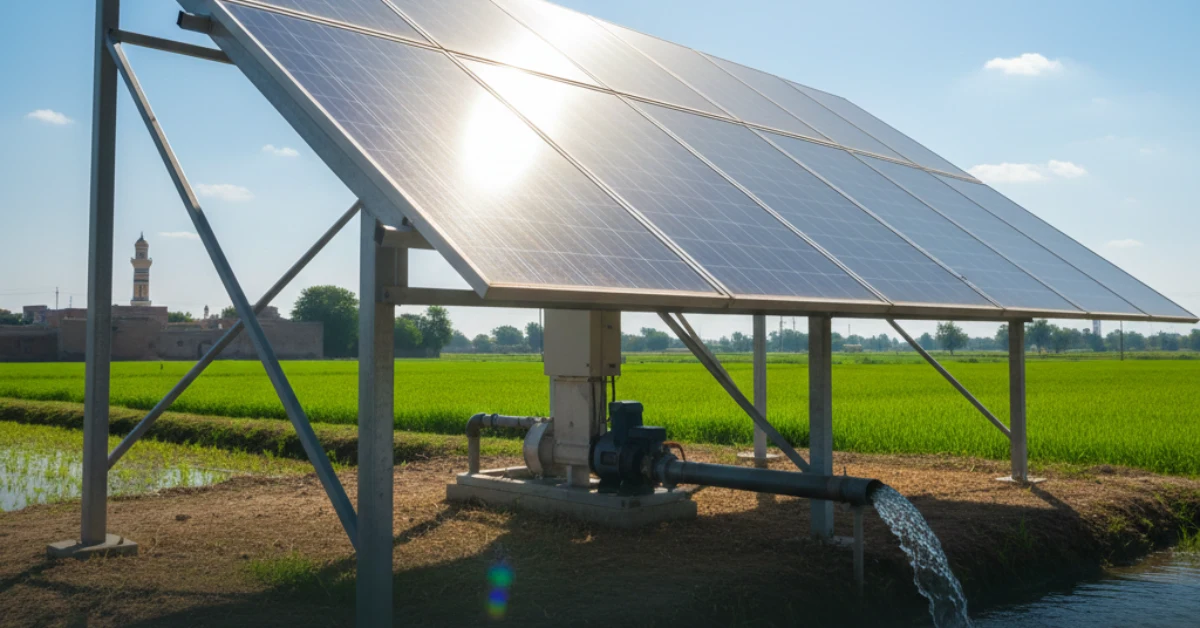
A solar water pump is an automated pumping system that runs on electricity generated by solar photovoltaic (PV) panels. Unlike traditional diesel or grid-connected pumps, it does not rely on expensive fuel or the unreliable national grid (WAPDA).
How It Works
The system consists of three main components:
- Solar Panels: Capture sunlight and convert it into DC electricity.
- Solar Inverter (VFD): Converts DC power into AC power to run the motor. It also regulates the frequency to ensure the pump runs smoothly even during low sunlight.
- Pump Unit: A submersible or surface pump that draws water from the ground and supplies it to your fields.
For Pakistani farmers, this means zero monthly bills. Once installed, the sunlight is free, and the maintenance is minimal.
Solar Water Pump Price in Pakistan 2026 (Updated Rates)
One of the most common questions is, “What is the price of a 5HP solar system?” In 2026, prices have stabilized due to improved import policies, though they fluctuate slightly with the dollar rate.
Below is a detailed breakdown of the estimated costs for complete solar tubewell systems in Pakistan for 2026.
Complete Solar Tubewell System Prices (Estimated)
| System Size (HP) | Suitable Depth (Feet) | Discharge (Inches) | Estimated Price (PKR) |
|---|---|---|---|
| 1 HP System | 50 – 150 ft | 1 – 1.5″ | ₨ 600,000 – 800,000 |
| 3 HP System | 150 – 250 ft | 2″ | ₨ 900,000 – 1,100,000 |
| 5 HP System | 250 – 350 ft | 3″ | ₨ 1,200,000 – 1,500,000 |
| 10 HP System | 350 – 500 ft | 4″ | ₨ 2,000,000 – 2,500,000 |
| 15 HP System | 500 – 600 ft | 5″ | ₨ 2,800,000 – 3,200,000 |
| 20 HP System | 600+ ft | 6″ | ₨ 3,500,000+ |
Note: These prices include solar panels, VFD inverter, pump motor, mounting structure, and installation. Prices may vary based on the brand of panels (Jinko, Longi, JA Solar) and the pump origin (Italian vs. Chinese).
Component-Wise Price Breakdown
If you are assembling the system yourself or upgrading an existing tubewell, here are the individual component costs:
- Solar Panels (Tier 1 A-Grade): ₨ 35 – 45 per watt.
- Submersible Pump (Motor + Pump End):
- 1 HP (Chinese): ₨ 40,000 – 60,000
- 5 HP (Italian/USA): ₨ 150,000 – 200,000
- Solar VFD Inverter:
- 5.5 kW (for 5HP): ₨ 65,000 – 85,000
- 11 kW (for 10HP): ₨ 110,000 – 130,000
- Structure (GI Galvanized): ₨ 8,000 – 10,000 per panel stand.
Pro Tip: Always opt for A-Grade Bifacial Solar Panels in 2026. They generate power from both sides and offer 10-15% higher efficiency, crucial for early morning and late afternoon pumping.
Government Solar Tubewell Schemes 2026
To support the agriculture sector, both federal and provincial governments have launched massive subsidy schemes in 2026. This is the “secret weapon” for smart farmers to get a system at a fraction of the cost.
1. Punjab Solar Tubewell Scheme 2026 (Maryam Nawaz Initiative)
The Punjab government has allocated massive funds for the solarization of agricultural tubewells.
- Subsidy: Up to 80% of the total cost is covered by the government. The farmer only pays 20%.
- Target: 8,000 tubewells in the first phase.
- Eligibility:
- Must be a resident of Punjab.
- Must own land (minimum 1 acre).
- Valid CNIC and no bank defaulter status.
- Deadline: The initial deadline was January 31, 2026, but new phases are expected to open mid-year. Keep checking the agripunjab website.
2. Balochistan Solarization Project
The federal government has initiated a project to solarize 28,000 tubewells in Balochistan.
- Funding: A joint venture between the federal and provincial governments (Rs 55 Billion project).
- Benefit: This region suffers from severe grid unavailability. Solarizing these pumps is a lifeline for orchards and crop farming in the province.
- Status: Funds (Rs 14 Billion) have been released as of March 2025/2026 to accelerate installation.
3. Sindh Solar Lift Pump Scheme
The Sindh government offers subsidies specifically for solar hire and lift pumps.
- Details: Subsidized rates for submersible pumps up to 250 ft depth.
- Cost Share: Farmers pay a reduced amount (e.g., Rs 600,000 for a lift pump vs. the market rate of Rs 1.2M).
(Read our detailed guide on [How to Apply for Punjab Green Tractor Scheme 2026] for more subsidy news.)
Types of Solar Water Pumps
Choosing the right type of pump is critical for performance.
1. Submersible Solar Pumps
These are installed deep underground in a borehole (tubewell). They are the most common type used in Pakistan for agriculture.
- Best for: Water tables deeper than 25-30 feet.
- Pros: High efficiency, no priming required, long lifespan.
2. Surface (Monoblock) Solar Pumps
These are installed on the ground level, usually near a river, canal, or pond.
- Best for: Lifting water from surface sources or shallow wells (less than 20 feet).
- Pros: Cheaper, easier to maintain.
- Cons: Limited suction depth.
3. DC vs. AC Pumps
- DC Pumps: Run directly on DC current. Highly efficient for small setups (1-2 HP) but expensive.
- AC Pumps: Standard grid pumps adapted to run on solar using a VFD inverter. These are the standard for agriculture in Pakistan (5HP to 20HP) because they are powerful, repairable, and affordable.
Benefits of Switching to Solar Tubewells
Why are thousands of Pakistani farmers dismantling their Peter engines and disconnecting WAPDA connections in 2026?
- Zero Fuel Costs: Diesel prices fluctuate around Rs 280-300 per liter. A solar pump requires Rs 0 for fuel.
- Inflation Proof: Once installed, you are immune to rising electricity unit rates (which have crossed Rs 60/unit for some slabs).
- Low Maintenance: No oil changes, no filter replacements, and no engine overhauls. Solar systems are “fit and forget.”
- Increased Crop Yield: Reliable water supply means you can irrigate exactly when the crop needs it, not when the grid decides to give power.
- Environmentally Friendly: Reduces carbon footprint and noise pollution on the farm.
Best Solar Water Pump Brands in Pakistan
When investing millions, you must choose reliable brands. Here are the top performers in the Pakistani market for 2026:
Pump Brands
- Grundfos (Denmark): The “Ferrari” of pumps. Expensive but extremely durable and efficient.
- Lorentz (Germany): Specialized in DC solar pumping systems. High tech.
- Dongyin (China): The best budget-friendly option. widely available spares and decent performance.
- Mastra: Known for good pressure and reliability in deep wells.
Solar Panel Brands
- LONGi: Himo 6 and Himo 7 series (580W – 600W).
- Jinko Solar: Tiger Neo N-Type panels.
- JA Solar: Deep Blue 4.0 Pro.
(Check out our review of [Longi Solar Panel Prices in Pakistan 2026] to choose the right panels.)
Installation Guide: Step-by-Step
Installing a solar water pump is a technical job, but knowing the process helps you supervise the contractor.
- Site Survey: Determine the best location for panels (south-facing, no shade) and verify the borehole depth and static water level.
- Structure Installation: Dig concrete foundations for the mounting structure. Use Hot Dip Galvanized (GI) iron sheets (14-16 gauge) to prevent rust.
- Pump Lowering: Connect the submersible pump to the delivery pipe (UPVC or HDPE) and lower it into the bore. Secure it with a safety steel rope.
- Wiring: Connect the pump cable to the VFD inverter. Connect the solar panels in series/parallel strings to match the inverter’s voltage requirement (e.g., 600V-800V DC).
- VFD Parameter Setting: The technician will program the VFD for your specific motor (RPM, voltage, frequency, dry run protection).
- Testing: Run the system at noon to check maximum flow. Adjust the solar angle if necessary.
ROI Analysis: Is It Worth It?
Let’s do a quick calculation for a standard 10 HP Tubewell.
- Initial Investment: Rs 2,200,000 (approx).
- Monthly Savings:
- If replacing Diesel: Rs 150,000 (assuming 500 liters/month @ Rs 300).
- If replacing Grid: Rs 100,000 (assuming high unit rates and fixed charges).
- Payback Period:
- Vs Diesel: 1.2 Years (15 months).
- Vs Grid: 1.8 Years (22 months).
After the payback period, the system provides free electricity for the next 20+ years. It is arguably the best investment in agriculture today.
FAQ Section
Q1: What is the price of a 5HP solar water pump in Pakistan? A: A complete 5HP solar tubewell system costs between Rs 1,200,000 to Rs 1,500,000 in 2026, depending on the quality of panels and the motor brand.
Q2: How can I apply for the Punjab Solar Tubewell Scheme 2026? A: You can apply online via the dedicated portal of the Agriculture Department Punjab. You will need your land fard (ownership document) and valid CNIC. Watch for announcements on the “Green Tractor” or “Solarization” initiatives.
Q3: Can a solar tubewell run at night? A: No, standard solar pumps only run during the day. To run them at night, you need a Hybrid VFD that can switch to grid power or a generator, or you need an expensive battery bank (not recommended for large motors).
Q4: Which solar panel is best for tubewells? A: Bifacial N-Type panels (e.g., Jinko Tiger Neo or Longi Himo 7) are best. They capture sunlight reflected from the ground, boosting efficiency by up to 10-15%.
Q5: What is the lifespan of a solar water pump system? A: Solar panels last 25+ years. The pump and inverter typically last 8-12 years with proper maintenance (cleaning panels, checking wire connections).
Conclusion
The transition to a solar water pump pakistan 2026 is no longer a luxury; it is a necessity for survival in the agricultural sector. With skyrocketing energy costs, the only way to ensure profitable farming is to generate your own power.
Whether you take advantage of the generous 80% government subsidy or invest privately, the return on investment is guaranteed. Start 2026 by securing your water supply and cutting your costs to zero.
Ready to switch? Consult with a certified solar installer today and request a quote for an A-Grade system that fits your bore depth.