
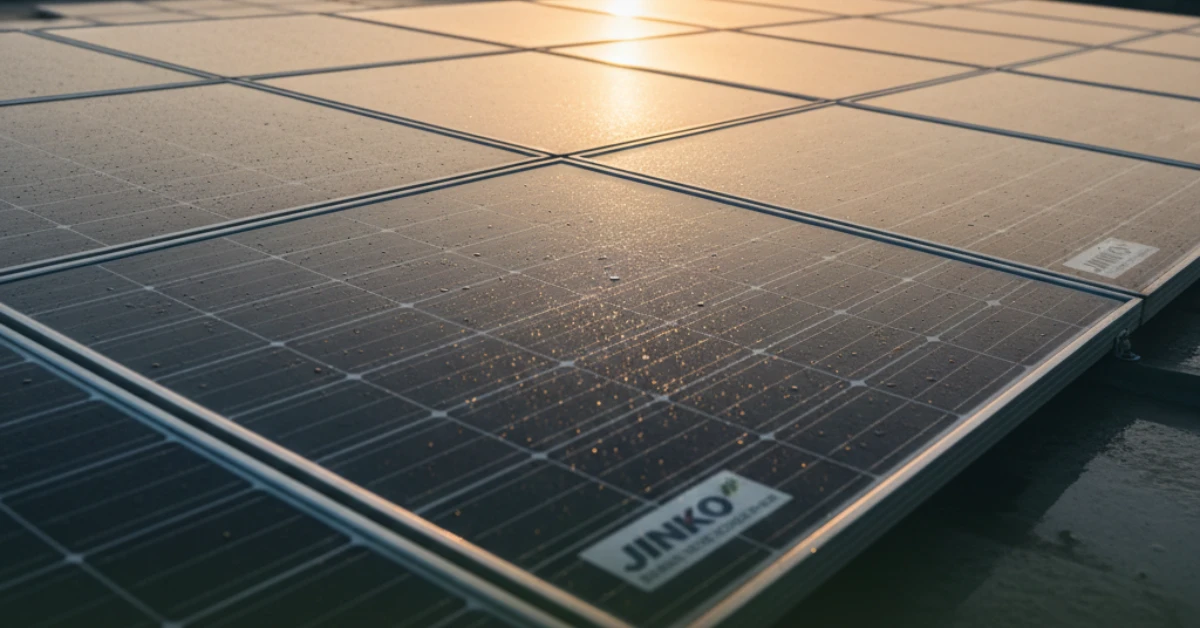
In the rapidly evolving world of renewable energy, efficiency is the single most critical metric for solar panel performance. For homeowners, businesses, and industrial giants in Pakistan facing ever-rising electricity tariffs, the question isn’t just about going solar—it’s about maximizing every square inch of roof space. As we navigate through 2026, one name dominates the conversation regarding high-efficiency photovoltaics: What is Jinko Panel Efficiency Rating 2026?.
Specifically, the search for the Jinko panel efficiency rating 2026 reveals a landscape where technological limits are being pushed further than ever before. With the widespread adoption of N-Type TOPCon technology, Jinko Solar has solidified its position as a global leader, offering commercial modules that are rewriting the rules of energy generation.
If you are planning to install a solar system this year, you might be asking: How much power can I actually get from a Jinko panel in 2026? Is the hype around N-Type real?
The short answer is: Jinko’s latest Tiger Neo N-Type panels in 2026 boast module efficiencies exceeding 22.8% to 24.8%, with cell laboratory efficiencies currently breaking past 26.4%. This makes them one of the most efficient, high-yield options available in the Pakistani market today.
In this comprehensive 2000-word guide, we will provide an in-depth analysis of Jinko’s 2026 efficiency ratings, dissect the Tiger Neo technology, compare it with top competitors like Longi and Canadian Solar, and explain exactly why this matters for your electricity bill in Lahore, Karachi, or Islamabad.
1. Jinko Panel Efficiency Rating 2026: The Numbers You Need
When we evaluate the What is Jinko Panel Efficiency Rating 2026?, we are primarily looking at their flagship Tiger Neo series (specifically the Tiger Neo 3.0). Jinko Solar has aggressively shifted 100% of its premium production towards N-Type TOPCon (Tunnel Oxide Passivated Contact) technology, effectively rendering the older P-Type PERC technology obsolete for new high-end installations.
Official 2026 Efficiency Benchmarks
To understand the capability of these panels, we must distinguish between cell efficiency and module efficiency.
- Module Efficiency (The Real-World Number): For the commercially available Tiger Neo series in Pakistan (typically the 575W, 585W, 615W, and 635W variants), the efficiency rating on the datasheet typically ranges from 22.5% to 23.9%.
- Cell Efficiency (The Tech Potential): The underlying N-Type mono-crystalline cells used in these panels have achieved mass production efficiencies of 26.4% to 27% in 2026.
- Laboratory Records: Jinko’s R&D department continues to break world records. As of early 2026, their N-Type TOPCon-based perovskite tandem solar cells have reached conversion efficiencies exceeding 34% in controlled lab environments.
Why N-Type TOPCon is the New Standard
The jump to N-Type TOPCon technology is the main driver behind these high ratings. Unlike older P-Type panels that suffered from “Light Induced Degradation” (LID) due to the boron-oxygen reaction, N-Type cells use phosphorus, which makes them immune to this specific type of degradation. This means your panels start efficient and stay efficient for decades.
2. Deep Dive: The Technology Behind Jinko’s Efficiency
To truly appreciate the Jinko panel efficiency rating 2026, you need to understand the engineering marvel inside the glass. It’s not just about “more watts”; it’s about better watts.
The “Tiger Neo” Advantage
The Tiger Neo series isn’t just a marketing name; it represents a specific architectural change in the solar cell.
- HOT 2.0 Technology: Jinko uses a specialized passivation technology known as HOT 2.0. This reduces the recombination of electrons and holes at the cell surface, which is a fancy way of saying “fewer electrons get lost as heat, and more are captured as electricity.”
- SMBB (Super Multi Busbar): If you look closely at a 2026 Jinko panel, the silver lines (busbars) are thinner and more numerous than on older panels. This shortens the distance electrons have to travel, reducing internal resistance and shading, which directly boosts efficiency by 0.4% – 0.6%.
Superior Bifaciality
One of the hidden efficiency boosters of Jinko panels in 2026 is their improved bifacial rating.
- Standard Bifacial Panels: 70% bifaciality.
- Jinko Tiger Neo (2026): 85% bifaciality factor.
This means robustness. If you install these panels on a raised structure (common in Pakistani rooftops for cleaning access) or over a white/reflective surface, the back of the panel can generate electricity at 85% of the efficiency of the front. This can boost your total system generation by 5% to 30% without buying a single extra panel.
3. Real-World Performance: Heat & Degradation
Pakistan is a hot country. In June and July, roof temperatures can easily exceed 60°C. This is where the efficiency rating on the paper often fails to match reality—unless you have Jinko N-Type.
Temperature Coefficient: Beating the Heat
Solar panels hate heat. As they get hotter, their voltage drops, and efficiency plummets.
- Standard P-Type Panels: Typically lose 0.35% to 0.40% of power for every degree Celsius rise above 25°C.
- Jinko Tiger Neo (2026): Features an industry-leading low temperature coefficient of -0.29%/°C.
The Calculus of Heat: On a 45°C day in Multan, a standard panel might operate at 20°C above ambient (65°C total). That’s 40 degrees above the standard test temperature.
- Standard Panel Loss: 40 * 0.40% = 16% efficiency loss.
- Jinko Tiger Neo Loss: 40 * 0.29% = 11.6% efficiency loss.
Result: The Jinko panel retains roughly 4.4% more power purely because it handles heat better. This “hot climate efficiency” is critical for Pakistani users.
4. Jinko Solar Panel Efficiency Comparison 2026 (Table)
To quantify the value of the Jinko panel efficiency rating 2026, let’s compare it head-to-head with other Tier-1 giants available in the local market.
Premier Tier-1 Panel Comparison (2026 Models)
| Feature | Jinko Tiger Neo 3.0 (N-Type) | Longi Hi-MO 7 (HPBC/N-Type) | Canadian Solar TOPBiHiKu6 | Standard P-Type PERC |
|---|---|---|---|---|
| Max Module Efficiency | 23.9% – 24.8% | 23.8% – 24.4% | 23.0% – 23.8% | 21.3% |
| Power Class (bins) | 575W – 635W | 580W – 610W | 570W – 600W | 540W – 550W |
| Bifacial Factor | 85% | Varies (often single side) | 80% | 70% |
| Temp. Coefficient | -0.29% / °C | -0.29% / °C | -0.29% / °C | -0.34% / °C |
| LID Degradation (Year 1) | < 1.0% | < 1.5% | < 1.0% | < 2.0% |
| Annual Degradation | 0.40% | 0.40% | 0.40% | 0.55% |
| Warranty (Linear Power) | 30 Years @ 87.4% | 25 Years @ 88.9% | 30 Years @ 87.4% | 25 Years @ 84.8% |
Analysis: While Longi offers fierce competition with its Hi-MO 6 and 7 series (often focused on aesthetics with black-on-black designs), Jinko often holds the edge in pure industrial/efficiency metrics, particularly with the 85% bifacial factor which is superior to many competitors. Canadian Solar is a strong runner-up but often trails slightly in the top-bin wattage availability in the local market.
5. Why Higher Efficiency Matters for Pakistani Homeowners
You might wonder, * “Is a 1.5% efficiency gain worth the extra cost?”* In the context of a 25-year investment under Pakistan’s net metering rules, the answer is a resounding “Yes”.
1. Maximizing Limited Roof Real Estate
In densely populated urban centers like Lahore, Rawalpindi, and Karachi, mostly 5-marla or 10-marla houses have limited roof space.
- Scenario: You have 300 square feet of usable roof manufacturing space.
- Old Tech (21%): You might fit a 6kW system.
- Jinko 2026 (23%+): You can fit a 7kW to 7.5kW system in the exact same space. This extra capacity means more units exported to WAPDA/KE, resulting in a significantly lower (or negative) bill.
2. Lower Degradation = More Lifetime Units
The Jinko panel efficiency rating 2026 ensures your system is still a powerhouse in the year 2040.
- Jinko N-Type panels are guaranteed to retain 87.4% of their initial power output after 30 years.
- Standard P-Type panels drop to 80% or lower by year 25.
- That 7.4% difference equates to thousands of free units of electricity over the system’s life—units you don’t have to buy from the grid at Rs. 60+ per unit.
3. Early Wake-Up, Late Sleep
High-efficiency N-Type cells have superior shunt resistance and low-light response. They “wake up” to generate voltage 15-20 minutes earlier in the morning and produce power 15-20 minutes later in the evening compared to standard panels. Over a year, this adds up to substantial extra generation hours.
6. Identification: How to Spot Fake Jinko Panels in 2026
With Jinko’s popularity comes the curse of counterfeits. The market in Pakistan is flooded with “B-grade” or rebranded panels sold as A-grade Tiger Neo. Here is how to ensure you are getting the true Jinko panel efficiency rating 2026:
- The Flash Test Report: Every legitimate pallet of Jinko panels comes with a serial number list and a “Flash Test” report. This document shows the exact tested wattage and efficiency of those specific serial numbers. If your installer cannot provide this, do not buy.
- Bloomberg Tier 1 Verified: Ensure your installer acts as a legitimate distributor. Jinko is a Tier 1 brand; buying from unauthorized roadside dealers risks getting panels with micro-cracks that ruin efficiency.
- Visual Cue: N-Type cells have a distinct, uniform appearance. Unlike the bluish, multi-shaded look of older poly panels, 2026 Tiger Neo N-Type panels are a deep, uniform black/dark blue with very thin round busbars.
- Barcode Scanning: Use the Jinko Solar official app to scan the barcode on the side of the panel. It should confirm the model, manufacturing date (should be late 2025 or 2026), and factory origin.
7. Future Outlook: Beyond 2026
Is this the peak of solar efficiency? Not quite. Jinko Solar is already piloting Tandem Perovskite Cells.
- Concept: Layering a perovskite cell on top of a silicon N-Type cell.
- Potential: This stack captures different parts of the light spectrum, pushing theoretical efficiency towards 30% – 35%.
- Timeline: While laboratory samples exist in 2026, commercial mass production of these 30%+ efficiency panels is likely expected around 2027-2028. For now, the N-Type TOPCon at ~24% is the “sweet spot” of price-to-performance.
8. Frequently Asked Questions (FAQ)
Q1: What is the exact efficiency of the Jinko 585W N-Type panel?
The Jinko 585W Tiger Neo N-Type panel specifically features a module efficiency rating of approximately 22.65% to 22.8%. The higher bin 620W-635W versions push this efficiency higher, towards 23.5%.
Q2: Is Jinko Tiger Neo better than Longi Hi-MO 6 for Pakistan?
Both are top-tier. However, Jinko Tiger Neo generally offers a better bifacial factor (85%) compared to Longi Hi-MO 6 (which acts more as a monofacial board in many residential configs). If you have a rooftop with good reflectivity (white paint/marble), Jinko will likely yield higher total generation.
Q3: How much power does a Jinko panel lose per year?
In the first year, Jinko N-Type panels lose less than 1.0% (due to LID/LeTID). From year 2 to year 30, the annual degradation is only 0.4%. This is significantly better than the industry standard of 0.55% – 0.70%.
Q4: What is the price of high efficiency Jinko panels in Pakistan (2026)?
As of early 2026, high-efficiency N-Type panel prices in Pakistan are hovering between Rs. 32 to Rs. 45 per watt. A 585W panel would therefore cost roughly Rs. 18,500 to Rs. 26,000, depending on import duties, exchange rates, and stock availability. Note: Prices fluctuate weekly.
Q5: Can I mix Jinko 2026 panels with my old 2022 panels?
It is not recommended. Jinko 2026 panels are likely N-Type with different voltage and current (Imp/Vmp) characteristics compared to 2022 P-Type panels. Mixing them in the same string will cause “mismatch loss,” dragging the efficiency of the new panels down to the level of the old ones. Always use a separate inverter MPPT or a new inverter for expansion.
Conclusion
The Jinko panel efficiency rating 2026 represents a maturity in solar technology that benefits the end consumer immensely. This isn’t just about incremental gains; it’s about a fundamental shift to N-Type TOPCon as the reliable, high-yield standard.
With module efficiencies nearing 24%, ultra-low degradation rates that guarantee performance for 30 years, and a temperature coefficient engineered for the Pakistani heat, Jinko’s Tiger Neo N-Type series is effectively the “Toyota Corolla” of solar—reliable, efficient, and holding its value.
By choosing these high-efficiency panels in 2026, you aren’t just buying hardware; you are securing an asset that will deliver maximum units of electricity for decades to come. Whether you are battling load shedding or aiming for a zero-bill net metering status, investing in 2026-gen industry-leading efficiency is a decision that pays for itself.

Pingback: Is Jinko Better Than Canadian Solar in 2026? Expert Review
Pingback: Canadian Solar vs LONGi Comparison 2026 – Full Panel Review